Hardware Software Integration Projects
Hardware Software Interaction
How Software Talks to Hardware
At its core, a computer is a partnership. Software provides the instructions, and hardware carries them out. Think of it like your brain telling your hand to pick up a cup. The intention (software) is translated into physical action (hardware). But this translation isn't magic; it requires a clear line of communication and a shared language.
This communication doesn't happen directly. An application you're using, like a web browser, doesn't know the specific, intricate details of the network card that connects you to the internet. Instead, it relies on intermediaries, specialized pieces of software that act as translators.
device driver
noun
A program that controls a particular type of device that is attached to a computer.
A device driver is the primary translator. It's a highly specific program that understands the language of one particular piece of hardware. The operating system uses the driver for your network card to send and receive data, the driver for your graphics card to draw images on the screen, and the driver for your keyboard to register keystrokes. Each driver is custom-built for the hardware it controls.
The Universal Translator
Writing a unique driver for every single piece of hardware for every operating system would be a nightmare. Imagine if every time a new graphics card was released, Microsoft, Apple, and the Linux community all had to write entirely new, custom code from scratch. It would be incredibly inefficient.
To solve this, operating systems use a Hardware Abstraction Layer, or HAL. The HAL is a layer of software that creates a consistent interface for developers. It hides the specific, complex details of the hardware and provides a simpler, more general set of commands. The operating system talks to the HAL, and the HAL talks to the specific device drivers, which in turn talk to the hardware. This layered approach makes software more portable and easier to maintain.
With this structure in place, hardware manufacturers can focus on writing a single driver for their device, knowing the HAL will help it communicate with the rest of the system.
Mechanisms of Communication
So how does the actual conversation happen at the lowest level? There are three primary methods that software uses to communicate with hardware components.
Memory-Mapped I/O (MMIO): This is the most common method. The system reserves a region of memory addresses and assigns them to a hardware device. The CPU can then communicate with the device by simply reading from or writing to these specific memory addresses, just as it would with regular RAM. To tell a graphics card to change a pixel's color, the CPU might write a color value to a specific address that the graphics card is listening to.
With Memory-Mapped I/O, the CPU reads from and writes to device registers as if they were regular RAM.
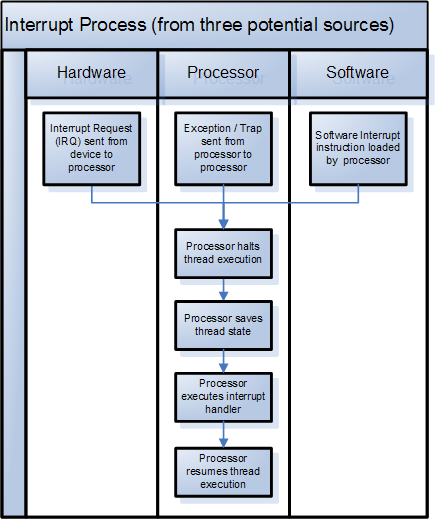
Interrupt Handling: What happens when a device needs to get the CPU’s attention right now? For example, when you press a key on your keyboard. The device can't just wait for the CPU to check its memory-mapped mailbox. Instead, it sends an interrupt signal to the CPU.
An interrupt is like a doorbell. When the signal arrives, the CPU immediately pauses its current task, saves its place, and runs a special piece of code called an Interrupt Service Routine (ISR) to handle the device's request. Once the request is handled (the keystroke is registered), the CPU returns to its original task, right where it left off.
Direct Memory Access (DMA): For moving large amounts of data, like reading a file from a hard drive into RAM, involving the CPU for every single byte is extremely inefficient. The CPU has more important things to do. This is where Direct Memory Access comes in.
With DMA, the CPU delegates the data transfer task to a special piece of hardware called a DMA controller. The CPU tells the controller: "Move this block of data from the hard drive to this location in RAM." The DMA controller then manages the entire transfer on its own, without bothering the CPU. Once the transfer is complete, the DMA controller sends an interrupt to the CPU to let it know the data is ready. This frees up the CPU to perform other computations while the transfer happens in the background.
DMA allows hardware to access system memory directly, freeing the CPU from managing bulk data transfers.
What is the primary role of a device driver?
Which hardware communication method involves the CPU treating a device's control registers as if they were standard memory locations?
Understanding these layers of abstraction and communication methods is key to building systems where complex hardware and software components work together seamlessly.