Guptas and Vakatakas: Imperial Synthesis
Geopolitical Consolidation
A Tale of Two Empires
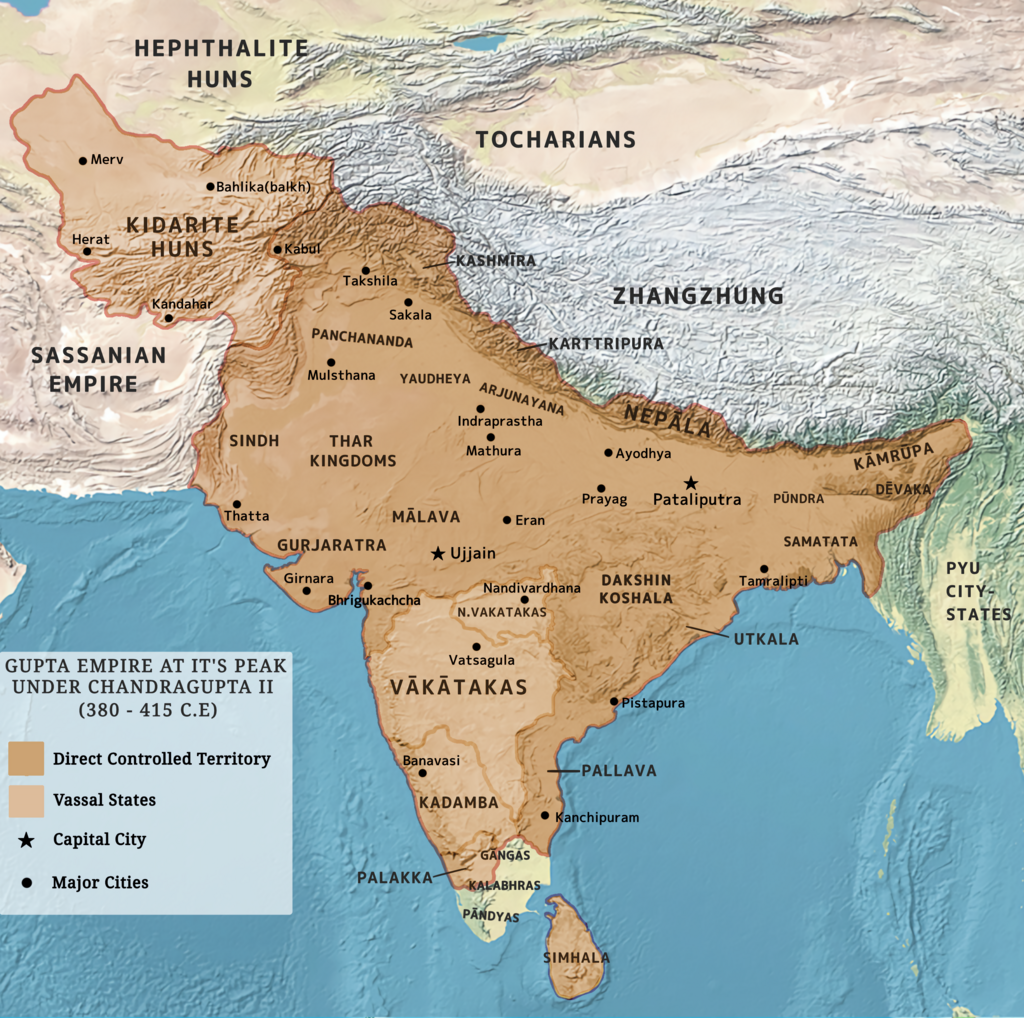
After the decline of the Mauryan and Kushan empires, the Indian subcontinent was a mosaic of smaller kingdoms. Into this fragmented landscape, two major powers emerged in the 4th century CE: the Guptas in the fertile Gangetic plains of Magadha, and the Vakatakas in the strategic Deccan plateau. Their rise wasn't just a matter of military might; it was a masterclass in ancient geopolitics, guided by a sophisticated doctrine of statecraft.
Both dynasties understood the principles of the , an ancient Indian framework for foreign policy. This theory views the political world as a series of concentric circles, with the ambitious king (the vijigishu, or conqueror) at the center. His immediate neighbours are his natural enemies (ari), while the states beyond his neighbours are his natural friends (mitra), as they share a common enemy. The goal wasn't always outright conquest but creating a stable system of alliances and subordinate states, ensuring the security and prosperity of one's own kingdom. The Guptas, and later their Vakataka allies, played this game of geopolitical chess with remarkable skill.
Samudragupta's Grand Strategy
The architect of Gupta expansion was Samudragupta. Our primary source for his reign is a glowing panegyric inscribed on an Ashokan pillar in modern-day Prayagraj. This inscription, known as the , was composed by his court poet Harishena. It's more than just praise; it's a detailed record of a carefully executed geopolitical strategy that treated different regions with different policies.
In the northern heartland of Aryavarta, the region between the Himalayas and the Vindhyas, Samudragupta followed a policy of Digvijaya—complete and total conquest. He violently uprooted nine kings and absorbed their territories directly into the Gupta empire. This created a large, secure, and centrally administered core.
His approach to the south, or Dakshinapatha, was entirely different. Here, he practiced a policy of Grahan-Moksha-Anugraha. This translates to 'capturing, liberating, and favouring'.
Samudragupta defeated the twelve kings of the south, but instead of annexing their kingdoms, he reinstated them as tributary rulers. They acknowledged his supremacy, paid tribute, and were allowed to govern their own lands. This was a pragmatic move, recognizing the difficulty of directly administering a vast and distant territory.
| Policy | Region | Method | Outcome |
|---|---|---|---|
| Digvijaya | Aryavarta (North) | Conquest and Annexation | Direct Gupta Rule |
| Grahan-Moksha-Anugraha | Dakshinapatha (South) | Subjugation and Reinstatement | Vassal States & Tribute |
The Vakataka Alliance
Samudragupta's southern campaign established Gupta influence but not direct control. The , a formidable dynasty ruling the Deccan, were left untouched. They were too powerful to be easily subjugated and too important to ignore. Their territory formed a strategic buffer between the Gupta heartland and the southern kingdoms. For Samudragupta's successor, Chandragupta II, a peaceful alliance was a smarter move than a costly war.
The solution was a masterstroke of matrimonial diplomacy. Chandragupta II arranged for his daughter, Prabhavatigupta, to marry the Vakataka king, Rudrasena II. This wasn't just a marriage; it was a merger of interests. When Rudrasena II died young, Prabhavatigupta served as regent for her minor sons for about two decades. During this period, the Vakataka kingdom effectively became an extension of Gupta power, guided by its queen from the Gupta dynasty.
This alliance had a clear strategic goal: the final removal of the Western Kshatrapas (also known as the Shakas). This foreign dynasty had ruled the wealthy western regions of Malwa and Gujarat for centuries, controlling lucrative ports and trade routes. With the Vakatakas securing his southern flank and providing a staging ground, Chandragupta II launched a campaign that decisively defeated the Shakas. The annexation of their territory brought the rich western coastline under Gupta control, flooding the empire with new wealth and trade opportunities. It was the crowning achievement of a long-term geopolitical strategy, executed perfectly across two generations.
According to the Mandala theory of statecraft, what is the typical relationship between an ambitious king (the vijigishu) and his immediate neighbours?
What was the primary source of information for Samudragupta's reign and military campaigns?