Guitar Scales Unlocked
Major Scales
The Major Scale
The major scale is the foundation of most of the music you hear every day. From pop songs to classical concertos, its bright, happy sound is everywhere. Think of it as the musical equivalent of the primary colors. By understanding this one scale, you unlock the ability to build chords, write melodies, and navigate the fretboard with confidence.
A scale is just a series of notes played in a specific order, ascending or descending in pitch.
What gives the major scale its distinct sound is the specific pattern of distances between its notes. These distances are called intervals, and the two smallest are the half step and the whole step.
Half Step
noun
The smallest interval in Western music. On a guitar, it's the distance from one fret to the very next one on the same string.
Whole Step
noun
An interval equal to two half steps. On a guitar, it's the distance of two frets on the same string.
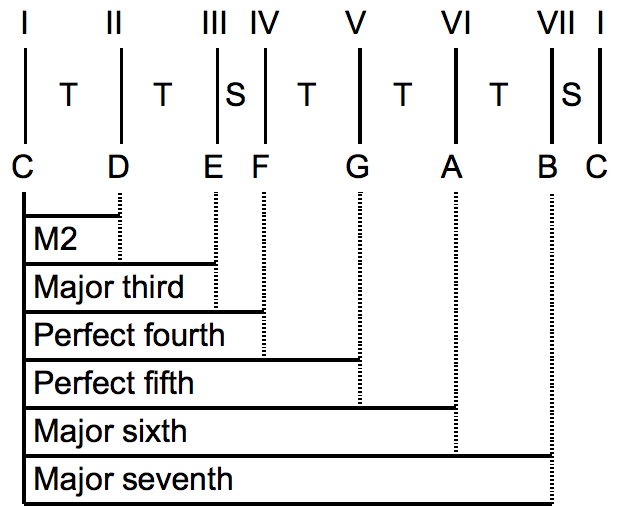
The major scale is built from a simple, memorable pattern of these steps. Starting from any note, called the root, you follow this sequence to create a major scale:
Whole - Whole - Half - Whole - Whole - Whole - Half
Let's build the C major scale, the simplest one because it uses only the white keys on a piano and has no sharp or flat notes. The notes are C, D, E, F, G, A, B, and back to C.
| From | To | Step |
|---|---|---|
| C | D | Whole |
| D | E | Whole |
| E | F | Half |
| F | G | Whole |
| G | A | Whole |
| A | B | Whole |
| B | C | Half |
Playing on the Fretboard
On the guitar, you can play this pattern anywhere. A scale can be played in an "open position," which means it uses one or more open strings. This is often how beginners first learn scales. For example, here's a common way to play the C major scale in open position.
While open positions are useful, they aren't movable. If you want to play a G major scale, you need a whole new fingering. This is where closed positions come in. A "closed position" scale pattern uses no open strings, which means you can slide the entire shape up or down the neck to play in any key you want.
Navigating with CAGED
The CAGED system is a powerful method for mapping out the entire fretboard. It's based on five fundamental open chord shapes: C, A, G, E, and D. Each of these chord shapes has a corresponding scale pattern that connects to it. By learning these five patterns, you can play the major scale across the entire neck, in any key.
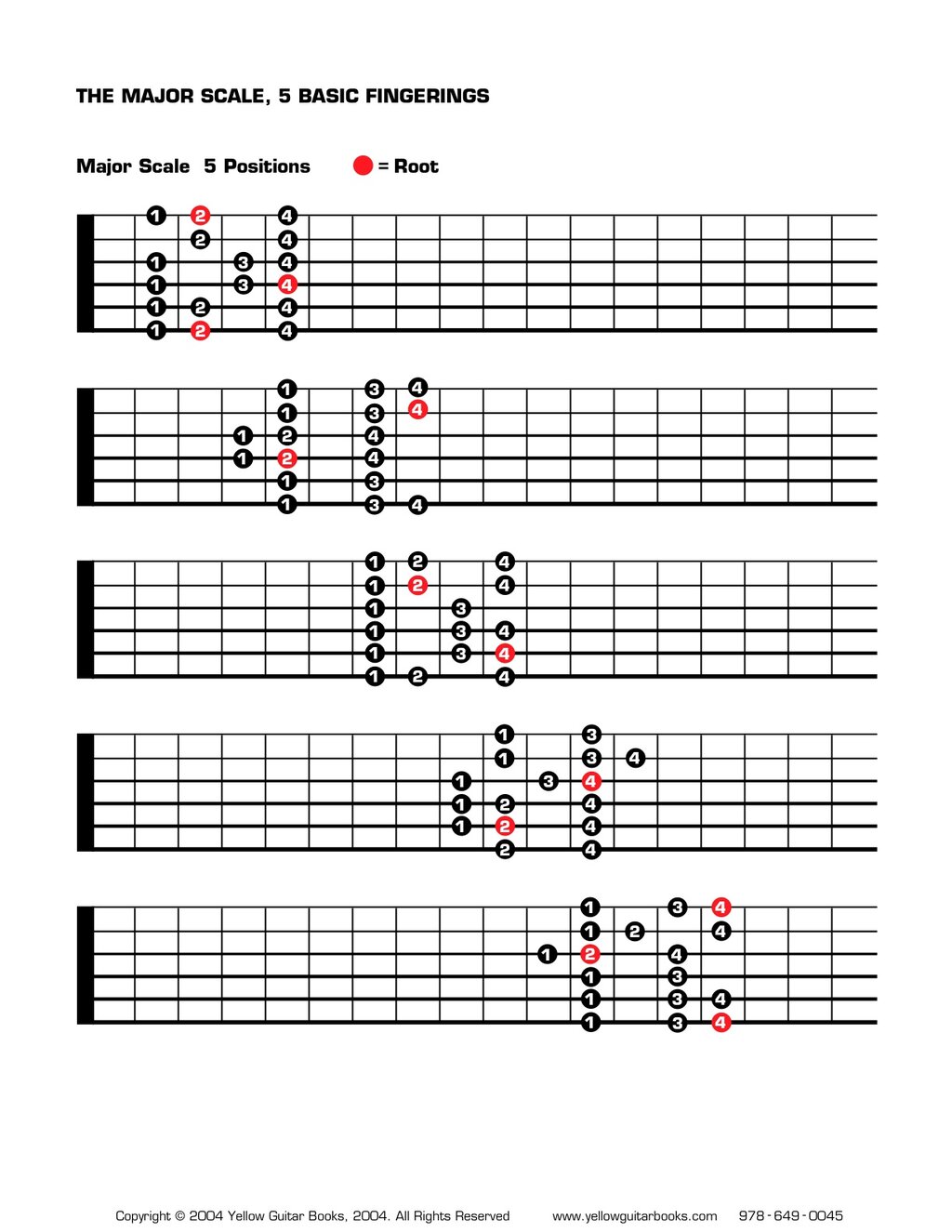
Let's look at one example. We can use the 'G shape' to play a C major scale. The pattern is based on the shape of a G major open chord, but we'll move it up the neck so the root notes are C. This shape becomes a movable pattern for the C major scale starting on the 8th fret of the low E string.
By mastering this shape and the other four (C, A, E, and D), you'll find they all connect, allowing you to move seamlessly across the neck. It's a system that takes time to learn, but it completely demystifies the fretboard.
By practicing these mappings, you’ll develop a deeper understanding of how scales fit over chords, enhancing your ability to craft compelling solos and progressions.
Time to check your understanding of these core concepts.
What is the correct pattern of whole (W) and half (H) steps for a major scale?
Which of the following notes is NOT in the C major scale?
Learning the major scale is a fundamental step. It provides the building blocks for countless melodies and harmonies, making it an essential tool for any musician.