Guitar Pentatonic Scale Soloing
Pentatonic Scale Basics
The Five-Note Scale
Scales are the building blocks of melodies and harmonies. While many common scales, like the major and minor scales, have seven notes, one of the most widespread and versatile scales has only five. This is the pentatonic scale.
The name comes from the Greek words pente (meaning five) and tonic (meaning tone). At its core, a pentatonic scale is simply any scale with five notes per octave.
The most common version is derived from the major scale by removing two specific notes. Let's take the C major scale: C, D, E, F, G, A, B. To create the C major pentatonic scale, we remove the fourth and seventh degrees, which are F and B. What's left are the notes C, D, E, G, and A. These five notes form the C major pentatonic scale. The removal of the notes F and B is significant because they form a tritone, a dissonant interval. By taking them out, the scale becomes incredibly smooth and consonant.
Major and Minor
Just like their seven-note counterparts, pentatonic scales come in major and minor varieties. Each has a distinct emotional feel.
The major pentatonic scale sounds bright, open, and happy. It's built from the 1st, 2nd, 3rd, 5th, and 6th degrees of a major scale. You hear it everywhere, from folk songs like "Oh! Susanna" to the opening guitar riff of "My Girl" by The Temptations.
The minor pentatonic scale sounds bluesy, soulful, or somber. It's built from the 1st, 3rd (flat), 4th, 5th, and 7th (flat) degrees of the natural minor scale. This scale is the foundation of countless blues and rock solos.
An interesting fact: the C major pentatonic scale (C, D, E, G, A) contains the exact same notes as the A minor pentatonic scale (A, C, D, E, G), just starting from a different note. This is because A minor is the relative minor of C major.
| Scale Type | Notes (Starting on C) | Scale Degrees | Sound |
|---|---|---|---|
| Major Pentatonic | C, D, E, G, A | 1, 2, 3, 5, 6 | Bright, cheerful |
| Minor Pentatonic | C, E♭, F, G, B♭ | 1, ♭3, 4, 5, ♭7 | Bluesy, melancholic |
A Global Sound
The pentatonic scale isn't a recent invention. It's one of the oldest and most widely used scales in the world. Evidence of its use dates back thousands of years and appears independently in countless cultures.
You can hear its influence in the traditional music of China, Japan, and Southeast Asia. It’s also fundamental to African folk traditions, Celtic tunes, and Native American chants. In modern Western music, its simplicity and versatility made it a cornerstone of genres like blues, jazz, rock, and pop music.
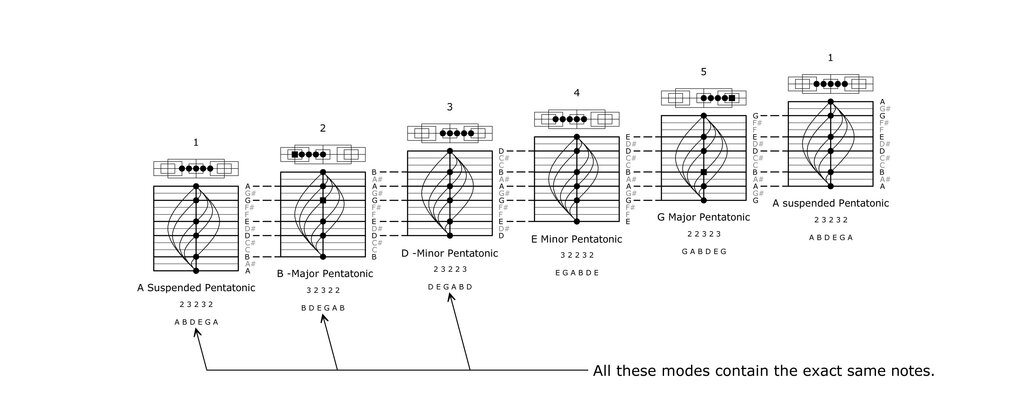
Why is it so universal? Its structure, lacking the dissonant half-steps found in many other scales, makes it inherently pleasing to the ear. This lack of tension means that you can play almost any of the five notes over a related chord and it will sound good. This makes it a fantastic starting point for anyone learning to improvise. For educators, the pentatonic scale is a powerful tool to introduce students to melody and harmony without overwhelming them with complex theory.
Ready to test your knowledge? Let's see what you've learned about the five-note scale.
A pentatonic scale is defined as any scale containing ___ notes per octave.
To create a major pentatonic scale from a standard major scale, which two scale degrees do you remove?
With its simple structure and global reach, the pentatonic scale is a fundamental concept in music. It's a key that unlocks countless melodies across genres and cultures.