Guitar Music Theory Scales and Modes
Guitar Basics
Meet Your Guitar
Before you can play a guitar, it helps to know your way around it. Whether you have an acoustic or an electric, the main parts are largely the same. Let's take a look.
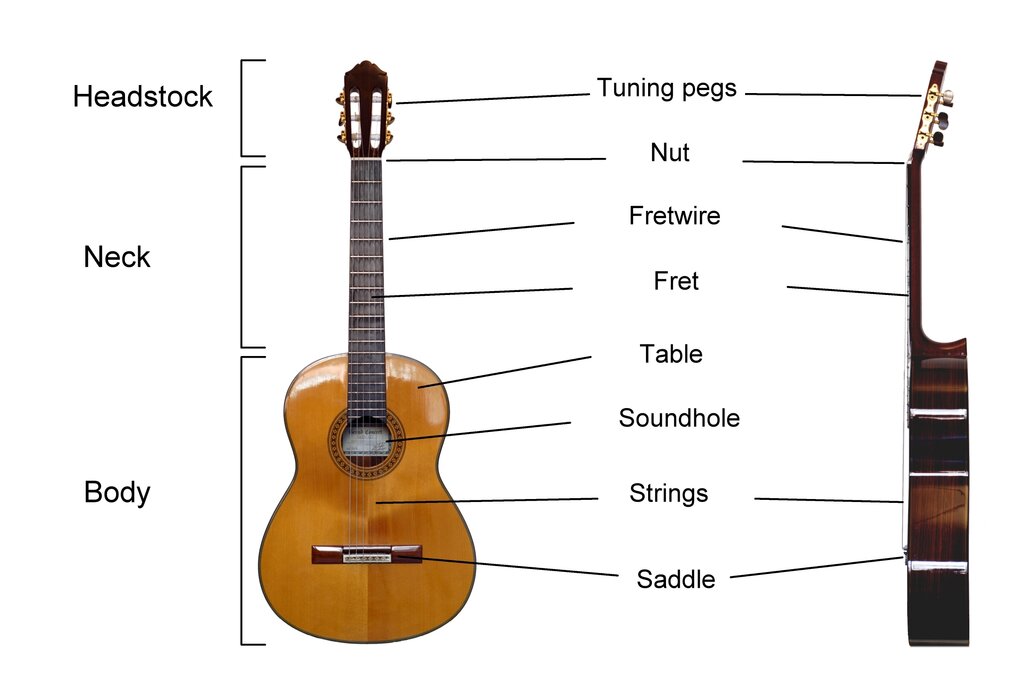
At the top, you have the headstock, which holds the tuning pegs. You turn these pegs to tighten or loosen the strings, which changes their pitch. The strings run from the headstock down to the bridge on the guitar's body.
Just below the headstock is the nut, a small strip with grooves that guide the strings onto the neck. The front of the neck is the fretboard, where you'll press the strings down. The metal strips running across the fretboard are called frets. Pressing a string against a fret shortens its vibrating length, producing a higher note.
The main part of the guitar is the body. On an acoustic guitar, the soundhole helps project the sound. On an electric guitar, you'll find pickups in this area, which convert the string vibrations into an electrical signal.
Getting in Tune
Guitars need to be tuned regularly. The standard tuning is the most common setup and the one we'll use. It arranges the strings from the thickest (lowest pitch) to the thinnest (highest pitch).
The six strings are tuned to E, A, D, G, B, and E.
A popular mnemonic to remember this is "Eddie Ate Dynamite, Good Bye Eddie."
The lowest-pitched string is called the low E string or the 6th string. The highest-pitched one is the high E string or the 1st string. It's helpful to get this straight, as instructions will often refer to strings by their number or note name.
How to Play a Note
Making music on a guitar involves two basic actions: pressing down on a string with one hand (your fretting hand) and striking that string with your other hand (your strumming or picking hand). For most right-handed players, the left hand is the fretting hand.
To fret a note, use the tip of your finger to press a string down firmly just behind a fret, not on top of it. Your finger should be curved, like you're holding a ball. This ensures the note rings out clearly without buzzing.

Once a note is fretted, you can strike the string to produce a sound. You can use your thumb, other fingers, or a small piece of plastic called a pick. Using a pick generally produces a brighter, louder sound. For now, just focus on striking one string at a time.
Let's try playing your very first note. The diagram below shows you where to place your finger. The vertical lines represent the strings (6th on the left, 1st on the right), and the horizontal lines are the frets. The black circle shows you where to press.
Place your index finger on the first fret of the thinnest string (the high E string). Press down firmly and then strike that string with your other hand. Congratulations, you just played an F note!
Practice pressing down on different frets and strings to get a feel for the instrument. Try to make each note sound clean and clear. Don't worry about speed, just focus on good technique.
Now that you know the parts of the guitar and how to make a sound, you can begin to explore chords and scales. But first, let's review what you've learned.