Guitar Music Theory Fundamentals
Musical Alphabet
The Musical Alphabet
Music has its own alphabet, but it's much simpler than the one you're used to. It only has seven letters: A, B, C, D, E, F, and G. After G, the cycle just starts over again at A. That's it. Every melody, chord, and scale you'll ever play is built from these seven notes.
The musical alphabet is a simple loop: A-B-C-D-E-F-G-A-B-C...
Think of it like the days of the week. After Sunday, you're always back to Monday. In music, after G, you're always back to A. This repeating pattern is the foundation for understanding the entire guitar fretboard.
Between the Notes
So, what about the spaces between those letters? That's where sharps and flats come in. A sharp, shown with the symbol #, means a note is slightly higher. A flat, shown with a b, means a note is slightly lower. These notes live in the gaps between the main letters of the musical alphabet.
For example, the note between A and B can be called A# (A sharp) or Bb (B flat). They are the exact same pitch, just with different names. This is called an "enharmonic equivalent." Which name you use depends on the musical context, but for now, just know that they represent the same sound.
This gives us a total of 12 unique notes. There are seven 'natural' notes (A-G) and five 'accidental' notes (the sharps and flats).
There are two important exceptions to this pattern. There is no sharp or flat between B and C, and there is no sharp or flat between E and F. These notes are direct neighbors. Memorizing this is key to navigating the fretboard.
Higher and Lower
After you go through all 12 notes (A, A#, B, C, C#, D, D#, E, F, F#, G, G#), you arrive back at A. While it's the same letter, it has a higher pitch. This distance between one note and its next higher or lower version is called an octave.
Your guitar is a great example of this. The thickest string and the thinnest string are both tuned to the note E. Pluck them one after the other. You'll hear they sound like the same note, but one is much lower and one is much higher. They are two octaves apart.
Every note on the fretboard repeats in this way. As you move up the neck, the pitches get higher. Finding these repeating notes, or octaves, is a fundamental skill for playing guitar.
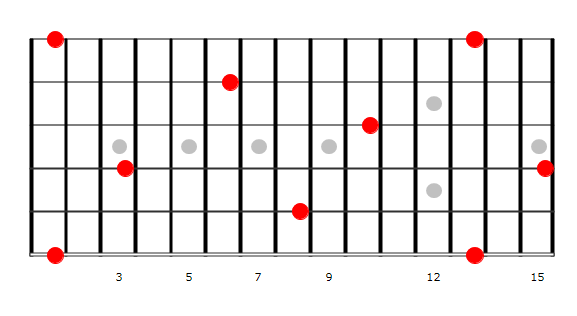
Understanding this simple alphabet and how it repeats is the first major step to mastering the guitar. It turns a confusing grid of frets and strings into a logical map of notes.
How many letters are in the musical alphabet?
In the repeating cycle of the musical alphabet, which note immediately follows G?
With these basics down, you have the building blocks for every musical idea you'll learn from here on out.