Guitar Mastery Intermediate
Barre Chords
The Fretboard Shortcut
So far, you've likely been playing chords near the headstock of the guitar. These open chords are the foundation, but what if you could play any chord, anywhere on the neck? That's where barre chords come in.
A barre chord uses your index finger as a movable capo, pressing down across all six strings. This single technique unlocks the entire fretboard, allowing you to play familiar chord shapes in new positions to create new chords.
Think of it this way: with just two new shapes, you'll be able to play every major and minor chord that exists.
The E Shape Barre Chord
The first essential barre chord shape comes from the open E major chord. To turn it into a movable shape, you just need to change your fingering. Instead of using your first, second, and third fingers, try forming the E major shape with your second, third, and fourth (pinky) fingers.
Now, slide that entire shape up one fret. Your second finger should be on the 2nd fret of the A string. Then, flatten your index finger across all six strings at the 1st fret. You're now playing an F major chord. Your index finger acts as the nut of the guitar.
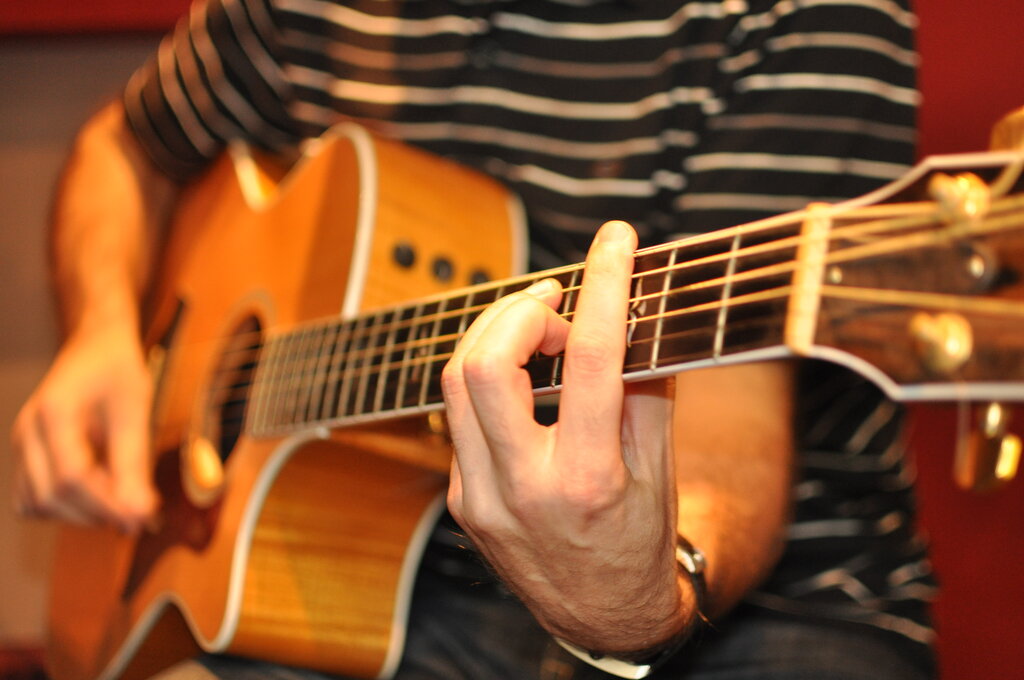
The name of the chord comes from the root note your index finger is playing on the low E (6th) string. If you barre the 3rd fret, you're playing a G major. Barre the 5th fret, and it's an A major. This pattern works all the way up the neck.
To play the minor version, simply lift your second finger. That's it. An F major becomes an F minor. A G major becomes a G minor. This one small change turns any major E shape barre chord into its minor counterpart.
The A Shape Barre Chord
The second key shape is based on the open A major chord. Like before, we need to free up the index finger. The most common way is to use your third (ring) finger to press down the D, G, and B strings at the same fret. It can feel awkward, but it's efficient.
Slide that shape up. To play a C major chord, for example, you'll place your ring finger across the D, G, and B strings at the 5th fret. Then, lay your index finger down for a barre at the 3rd fret. With this shape, you only barre the top five strings. The low E string should be muted.
For the A shape, the root note is on the A (5th) string. Barring the 2nd fret gives you B major, the 3rd fret C major, and so on. To make an A shape barre chord minor, you again change just one note. This time, you use a more standard fingering with your second and third fingers to create the minor shape, as shown above.
Getting a Clean Sound
Barre chords are tough on the hands at first. A buzzing or muted sound is normal. The key is consistent pressure and proper finger placement.
Roll your index finger: Don't try to press down with the fleshy part of your finger. Roll it back slightly toward the headstock, so you're using the harder, bonier side. This gives you more leverage.
Stay close to the fret: Just like with any other note, place your barring finger as close to the fret wire (the metal bar) as possible. This requires less pressure for a clean sound.
Use your thumb: Your thumb should be on the back of the neck, opposite your index finger, creating a clamp-like pressure. Don't let it creep up over the top of the neck.
Mute unused strings: For the A shape, your barring finger should lightly touch the low E string to mute it. For both shapes, ensure only the intended strings ring out. This control is a critical part of playing cleanly.
Start by practicing for just a few minutes at a time. Building calluses and hand strength takes patience. Don't overdo it and strain your muscles.
Now, let's put these shapes into practice.
Time to see what you've learned about these powerful chord shapes.
What is the primary function of the index finger when playing a barre chord?
If you are playing a barre chord based on the open E major shape, and your index finger is barred across the 3rd fret, what chord are you playing?
Mastering barre chords is a milestone for any guitarist. It opens up the ability to play thousands of songs in any key. Keep practicing these shapes, focusing on clean transitions and consistent pressure. Your hands will adapt, and soon it will feel effortless.