Guitar Mastery in One Year
Guitar Basics
Getting to Know Your Guitar
Before you can play, it helps to know your way around the instrument. A guitar has three main sections: the body, the neck, and the headstock. Think of them as the torso, arm, and head.
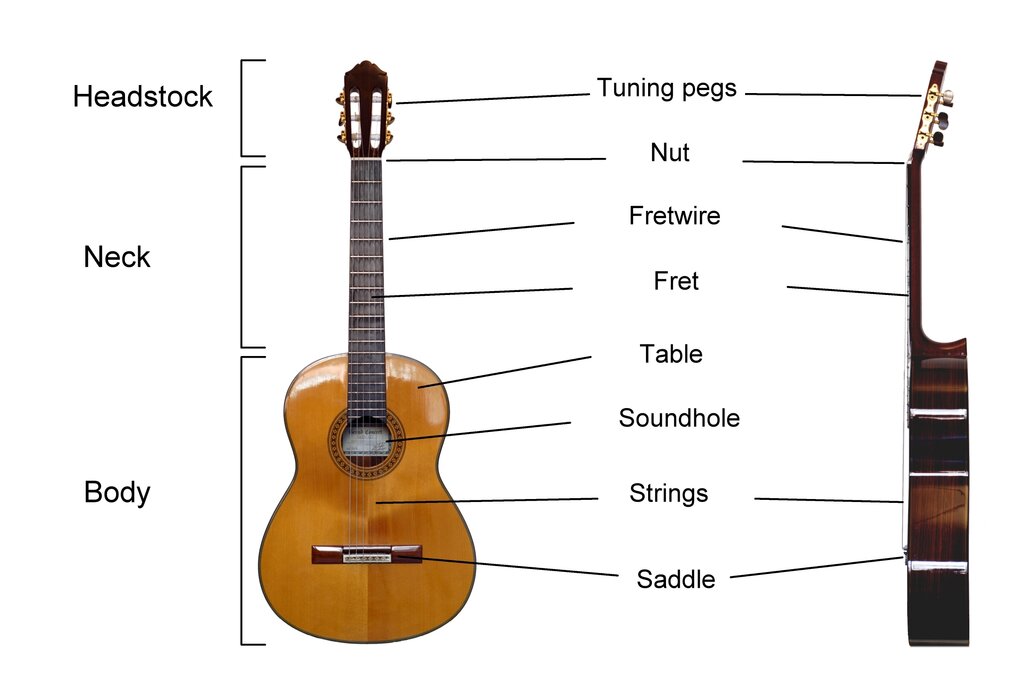
The body is the largest part and is where the sound resonates on an acoustic guitar. The neck is the long part you hold, and it's lined with metal strips called frets. Pressing a string against a fret changes its pitch.
The headstock is at the very top and holds the tuning pegs, which you turn to tighten or loosen the strings, changing their pitch. The strings run from the bridge on the body all the way up to the headstock. Each part works together to create sound.
Holding It Right
How you hold your guitar affects everything from comfort to sound. Start by sitting on a chair without arms. Sit up straight, but don't be stiff. You want to be relaxed.
Rest the guitar's waist on your right thigh (if you're right-handed). The guitar should be angled slightly upward, making it easy for both of your hands to reach their positions without straining. Your right arm should rest comfortably over the body of the guitar, allowing your hand to fall naturally over the strings.

Your fretting hand (usually your left) should support the neck. Place your thumb on the back of the neck, roughly opposite your middle finger. Your fingers should curve over the fretboard, ready to press down on the strings. Keep your wrist straight and your fingers arched like you're holding a ball. This position gives you strength and flexibility.
Relaxation is key. A tense grip will slow you down and can cause strain. If you feel any pain, take a break.
Getting in Tune
An out-of-tune guitar never sounds good, no matter how well you play it. Tuning should be the first thing you do every time you pick it up. Standard tuning is the most common and is what we'll use. The strings are tuned from the thickest (6th string, closest to the ceiling) to the thinnest (1st string, closest to the floor).
| String Number | Note | Mnemonic Device |
|---|---|---|
| 6 (Thickest) | E | Eddie |
| 5 | A | Ate |
| 4 | D | Dynamite |
| 3 | G | Good |
| 2 | B | Bye |
| 1 (Thinnest) | E | Eddie |
The easiest way to tune is with an electronic tuner. You can use a clip-on tuner that attaches to the headstock or a smartphone app. Pluck a single string, and the tuner will tell you if it's sharp (too high) or flat (too low). Turn the corresponding tuning peg to adjust it. A small turn can make a big difference, so go slowly.
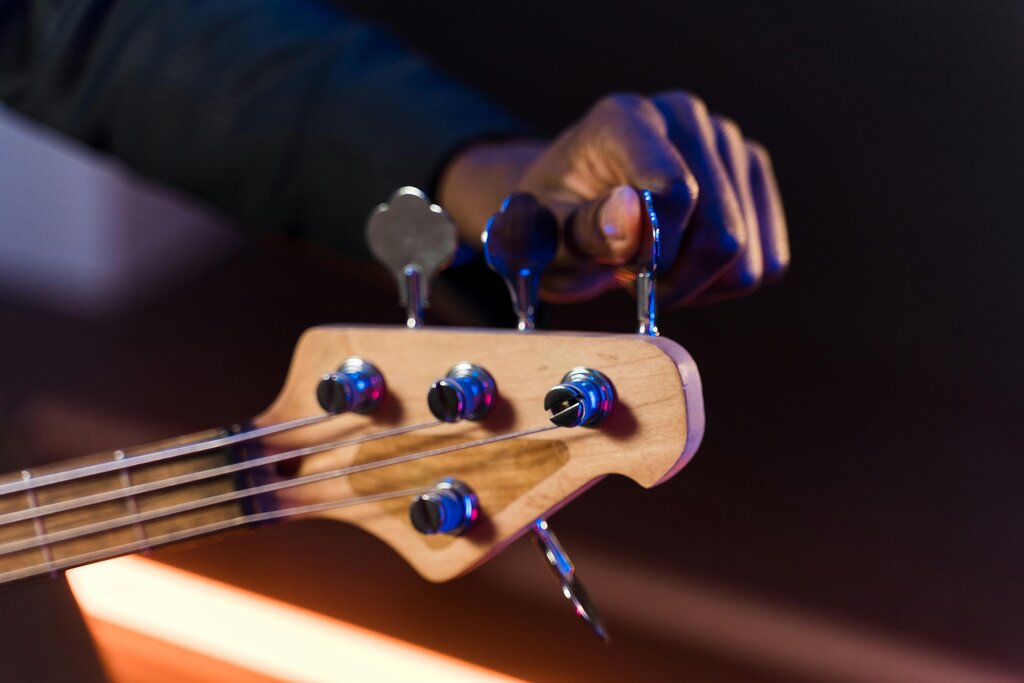
Turn the peg away from you to make the pitch higher and towards you to make it lower. Keep plucking the string and adjusting until the tuner shows the correct note is perfectly in tune. Repeat for all six strings.
First Finger Exercises
Before playing chords and songs, you need to build some basic strength and coordination in your fretting hand. These simple exercises will help your fingers get used to moving around the fretboard.
Remember to press down just behind the fret, not on top of it. Use only the tips of your fingers, and press just hard enough to get a clear sound. Start slowly. The goal is clarity, not speed.
Let's try a simple exercise called the "Spider Walk."
- Start with the thickest string (low E). Place your first (index) finger on the first fret.
- Pluck the string once to make sure the note is clear.
- Keeping your first finger down, place your second (middle) finger on the second fret of the same string and pluck it.
- Keep the first two fingers down, place your third (ring) finger on the third fret and pluck.
- Finally, place your fourth (pinky) finger on the fourth fret and pluck. Your hand should be stretched across the four frets.
Once you've played all four notes, move down to the next string (the A string) and repeat the pattern. Continue this all the way to the thinnest string. Then, try doing it backward, from the 4th fret to the 1st.
Try to keep your fingers down as you move up the frets. This builds strength and helps with finger independence.
Do these exercises for a few minutes each day. It might feel awkward at first, but with a little practice, you'll build the muscle memory needed to play chords and melodies smoothly.
What is the primary function of the guitar's body?
When tuning a guitar with an electronic tuner, you find a string is 'flat'. What does this mean and what should you do?