Guitar Fundamentals For Beginners
Guitar Anatomy and Setup
Meet Your Guitar
Before you can play a single note, it helps to know your way around the instrument. Think of it like learning the names of car parts before you learn to drive. Let's break down the main components you'll be working with.
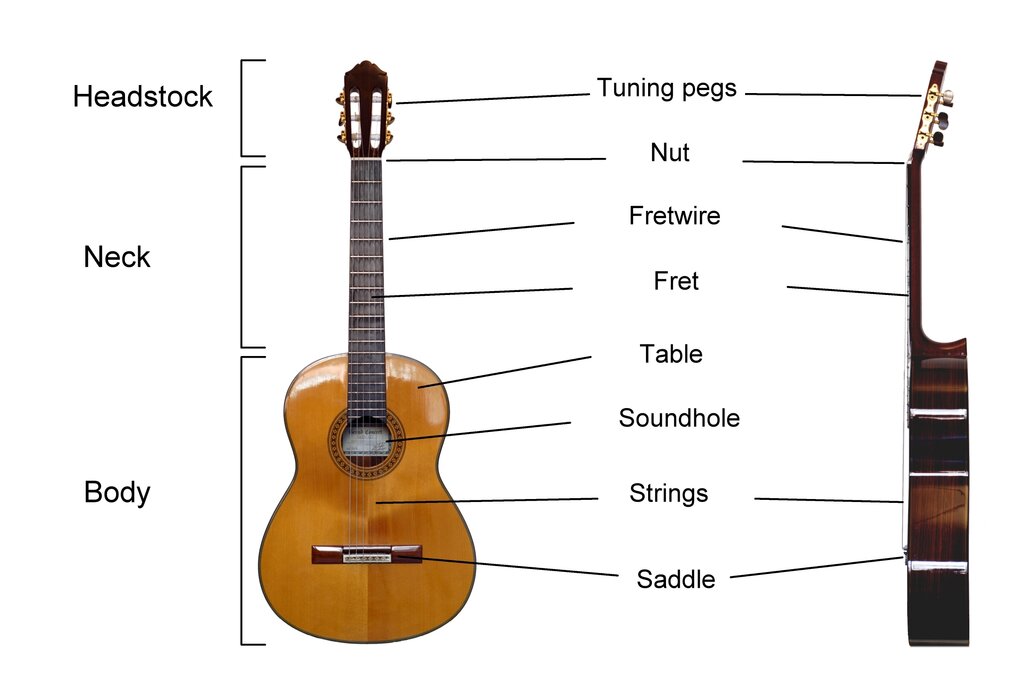
The large, hollow wooden part is the body. It's where the sound resonates and gets its volume and tone. The long piece you hold with your fretting hand is the neck. At the very top of the neck is the headstock, where the tuning happens.
Running up the neck is the fretboard, a flat piece of wood where you'll press down on the strings. The metal strips embedded in the fretboard are called frets. They act as note separators. The space between two frets is where you'll place your fingers.
Fret
noun
A raised element on the neck of a stringed instrument. Frets divide the neck into fixed segments at intervals related to a musical framework.
Of course, you can't make music without strings. Most guitars have six of them, varying in thickness. They are anchored at the bridge on the body and run all the way up to the tuning pegs (or machine heads) on the headstock. These pegs are what you'll turn to adjust the pitch of each string.
Getting in Tune
An out-of-tune guitar never sounds right, no matter how well you play it. Tuning is the first skill every guitarist learns. The easiest way is with a digital tuner, which can be a physical clip-on device or an app on your phone.

Turn on your tuner and pluck one open string. The tuner will tell you what note you're playing and whether it's sharp (too high) or flat (too low). If the note is flat, tighten the string by turning the corresponding tuning peg. If it's sharp, loosen it. Make small adjustments until the tuner gives you the green light.
Standard tuning for a six-string guitar, from the thickest string (closest to you) to the thinnest, is E-A-D-G-B-E.
A good way to remember the standard tuning order is with a mnemonic like Eddie Ate Dynamite, Good Bye Eddie.
Once you're comfortable with a tuner, you can try tuning by ear. This involves tuning one string (usually the low E) to a reference pitch, like a piano key, and then tuning the other strings relative to each other. For example, the 5th fret of the low E string should sound the same as the open A string next to it. This method takes practice but sharpens your ear.
String Care
Your strings do a lot of work, and they need a little care to sound their best. The oils and dirt from your fingers can build up on them, making them sound dull over time. A simple way to extend their life is to wipe them down with a clean, dry cloth after each time you play.
Eventually, all strings need to be replaced. How often depends on how much you play. If you play daily, you might change them every month. If you play less often, every few months might be fine. You'll know it's time when they look discolored, feel grimy, or have trouble staying in tune.
Changing strings seems tricky at first but gets easier with practice. You'll remove the old string, thread the new one through the bridge and up to the tuning post, and then slowly tighten it to the correct pitch.
Restringing your guitar is a fundamental skill that pays huge dividends in sound and playability.
Now that you know the basic anatomy and care, let's test your knowledge.
The large, hollow wooden part of the guitar where sound resonates is called the ______.
What is the primary function of the frets on a guitar's fretboard?
Understanding your instrument is the first major step. With these basics down, you're ready to start making music.