Guitar Fundamentals for Beginners
Guitar Basics
Meet Your Guitar
Before you can play a song, it helps to know your way around the instrument. A guitar might seem complex, but it's made of just a few key parts that work together to create sound. Let's break them down.
The body is the largest part of the guitar and creates the sound. The vibration of the strings resonates through the body and is amplified out of the soundhole.
The strings run from the bridge, where they are held in place by pins, over a small strip called the saddle. They stretch up the neck along the fretboard. The metal strips on the fretboard are called frets. Pressing a string against a fret changes its length, which changes the note you hear.
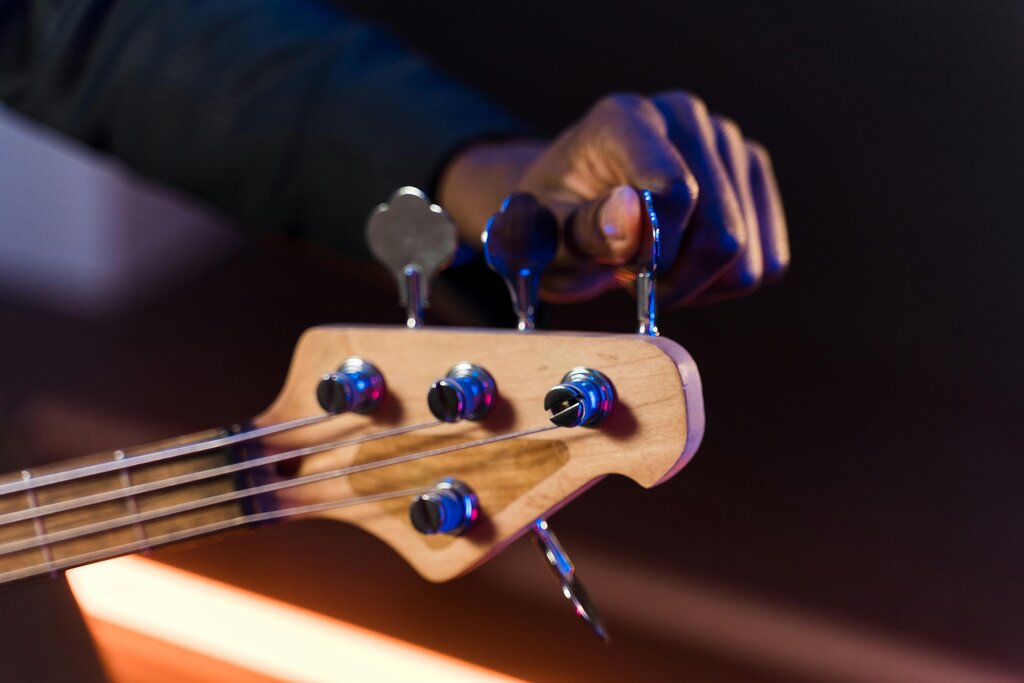
At the top of the neck is the nut, which guides the strings to the tuning pegs on the headstock. You turn these pegs to tighten or loosen the strings, changing their pitch.
Strings and Tuning
A standard guitar has six strings. They are numbered from thinnest to thickest. The thinnest string is the 1st string, and it plays the highest note. The thickest is the 6th string, which plays the lowest note.
Each string is tuned to a specific musical note. From thickest to thinnest (6th to 1st), the notes are E, A, D, G, B, and E. It can be tricky to remember, so many players use a mnemonic device.
| String | Note | Mnemonic Device |
|---|---|---|
| 6 (thickest) | E | Eddie |
| 5 | A | Ate |
| 4 | D | Dynamite |
| 3 | G | Good |
| 2 | B | Bye |
| 1 (thinnest) | E | Eddie |
Your guitar needs to be in tune to sound right. Most beginners use an electronic tuner. You can get a clip-on tuner that attaches to the headstock, or simply download a tuner app on your phone. Some acoustic guitars even have them built-in.
To tune, pluck a single string and let it ring. The tuner will tell you if the note is sharp (too high) or flat (too low). Turn the corresponding tuning peg to adjust the string's tension. A small turn can make a big difference, so go slowly until the tuner shows the note is correct. Repeat for all six strings.
How to Hold the Guitar
Good posture helps you play comfortably and avoid bad habits. Sit on a chair without arms, and keep your back straight. The guitar should rest on your lap.
Most right-handed players rest the curve of the guitar's body on their right thigh. Your right arm comes over the top of the guitar to strum the strings, and your left hand moves along the neck to press the strings. If you're left-handed, you'll likely do the opposite.
Your fretting hand—the one on the neck—should be relaxed. Place your thumb on the back of the neck for support, roughly behind your index or middle finger. Use the very tips of your other fingers to press the strings down. Aim to press just behind the fret, not on top of it. This gives you the clearest sound with the least effort.
Your other hand is your strumming or picking hand. It should rest comfortably over the soundhole. Whether you use your fingers or a pick, this hand is responsible for creating the rhythm.
Getting comfortable will take time. Your fingers might feel sore at first, but that's normal. Keep your practice sessions short and frequent, and soon it will feel natural.
What is the function of the tuning pegs on a guitar's headstock?
True or False: The thinnest string on a guitar is called the 6th string and it plays the lowest note.
With these basics down, you have a solid foundation to start making music.