Guitar Fundamentals
Guitar Basics
Meet Your Guitar
Before you can play a song, it helps to know your way around the instrument. Think of it like learning the names of the players on a team. Each part has a specific job to do, and they all work together to create music.
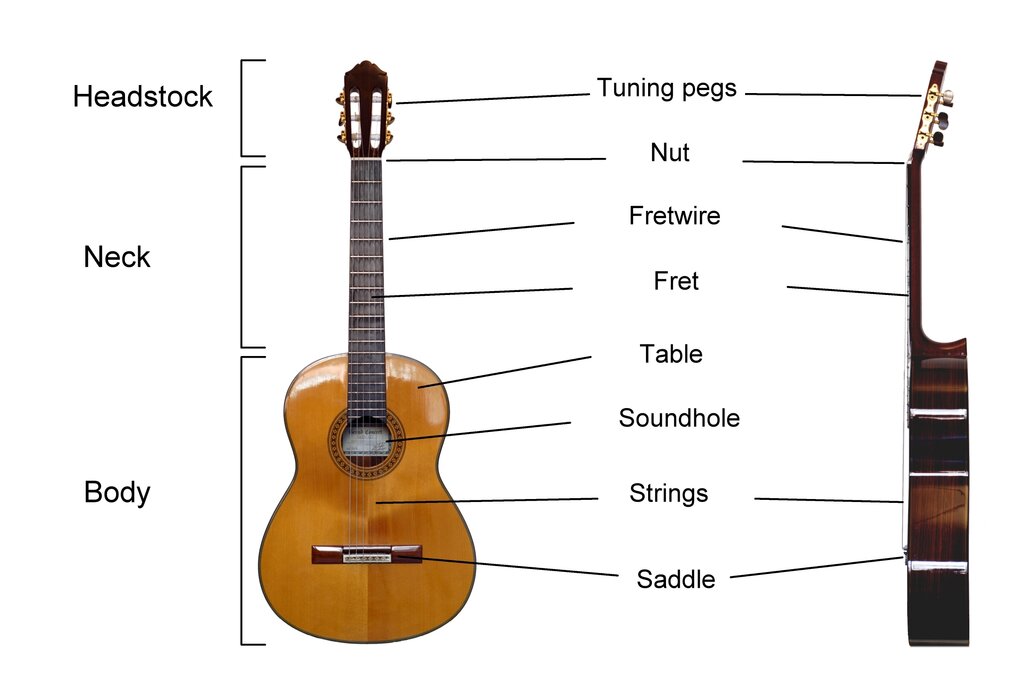
Let's break down the key areas you'll be interacting with:
- Headstock: This is at the very top. Its main job is to hold the tuning pegs.
- Tuning Pegs: These are the knobs you turn to tighten or loosen the strings, which changes their pitch. Turning them is how you tune the guitar.
- Neck: This is the long part of the guitar that you'll hold with your fretting hand. The front of the neck is the fretboard.
- Fretboard & Frets: The fretboard is the flat surface on the front of the neck where you press down the strings. The metal strips running across it are the frets. Pressing a string down just behind a fret changes the note you play.
- Body: This is the large, curved part of the guitar. On an acoustic guitar, its hollow shape amplifies the sound of the strings.
- Soundhole: The opening in the body of an acoustic guitar that helps project the sound.
- Bridge: This piece sits on the body and anchors the strings at the other end, opposite the headstock.
Getting in Tune
Playing a guitar that's out of tune is like trying to have a conversation where everyone is speaking a slightly different language. It just doesn't work. Tuning should be the first thing you do every single time you pick up your instrument.
The standard tuning for a six-string guitar is, from the thickest string (closest to you) to the thinnest string (closest to the floor): E - A - D - G - B - E.
A common mnemonic to remember the string names is: Eddie Ate Dynamite, Good Bye Eddie.
The easiest way to tune is with an electronic tuner. You can use a clip-on tuner that attaches to the headstock or a smartphone app.
Here’s how it works:
- Pluck the thickest string (the low E string).
- The tuner will show you what note it's playing.
- If the note is too low (or "flat"), slowly tighten the string by turning its tuning peg until the tuner indicates it's the correct pitch, usually with a green light.
- If the note is too high (or "sharp"), slowly loosen the string until it's in tune.
- Repeat this process for all six strings.
How to Hold the Guitar
How you hold your guitar makes a huge difference in your comfort and ability to play cleanly. Bad habits here can lead to strain and make playing feel much harder than it needs to be.
Proper posture and holding the guitar correctly are essential for beginners to play comfortably and avoid strain.
Sit on a chair without arms, and plant both feet flat on the floor. Sit up straight but stay relaxed. Rest the waist of the guitar—the indented part of the body—on your right thigh if you're right-handed. The guitar should be angled slightly upward, with the headstock pointing away from you, roughly parallel to the floor or a little higher.
The guitar should be stable enough that you can let go with both hands and it won't fall. Your arms shouldn't be holding its weight; their job is to play.

Positioning Your Hands
With the guitar resting comfortably, let's look at what each hand does.
The Fretting Hand This is your left hand if you're right-handed. Its job is to press the strings down onto the fretboard to create different notes.
Place your thumb on the back of the neck, somewhere behind the first or second fret. It should be roughly opposite your index or middle finger. Keep your palm away from the neck to give your fingers room to curve.
Your fingers should arch over the fretboard, like you're holding a ball. When you press a string, use the very tip of your finger, not the flat pad. Press down just behind the fret, not on top of it. This will give you the clearest sound with the least amount of pressure.

The Picking Hand This is your right hand if you're right-handed. It's responsible for striking the strings to produce sound, either by strumming chords or picking individual notes.
To start, let's use a pick. Hold it between the pad of your thumb and the side of your index finger. Only a small tip of the pick should be showing. Your other fingers can be curled loosely.
Rest your forearm on the upper part of the guitar's body. This provides a stable anchor point. Your hand should hover over the soundhole or slightly behind it. When you strum, the motion should come mostly from your wrist, not your whole arm. Keep it loose and relaxed.

Getting these fundamentals right from the start will build a solid foundation. It might feel a little awkward at first, but with practice, it will become second nature.
Time to check your understanding of these core concepts.
What is the primary function of the headstock on a guitar?
What is the correct standard tuning for a six-string guitar, starting from the thickest string (low E) to the thinnest (high E)?
With a solid grasp of the parts of the guitar, tuning, and proper posture, you're ready to start making music.