Guitar Fretboard Mastery and Improvisation
Fretboard Basics
Your Fretboard Map
Think of the guitar neck as a grid. The metal strips are called frets, and the six strings run from the headstock to the body. When you press a string down behind a fret, you shorten its vibrating length, which raises its pitch. No frets pressed? That's an open string.
Most guitars use standard tuning. From thickest to thinnest, the open strings are tuned to E, A, D, G, B, and E. Memorizing this is your first step: Eddie Ate Dynamite, Good Bye Eddie.
Each fret represents a half step, the smallest interval in Western music. Moving from one fret to the next on the same string raises the note by a half step. Two frets make a whole step.
Let's use the low E string as an example. The open string is E. The first fret is F. Why not E-sharp? Because some notes don't have sharps between them. We'll get to that. The second fret is F-sharp (), and the third is G. This sequence of half steps is called the chromatic scale.
Finding the Notes
Instead of memorizing every single note, start by learning the natural notes: A, B, C, D, E, F, and G. There's a crucial pattern to remember: there is only a half step between B and C, and between E and F. All the other adjacent natural notes are a whole step apart.
This means you won't find a B-sharp or an E-sharp on the fretboard in most contexts. B moves directly to C, and E moves directly to F. This simple rule is the key to navigating the entire neck.
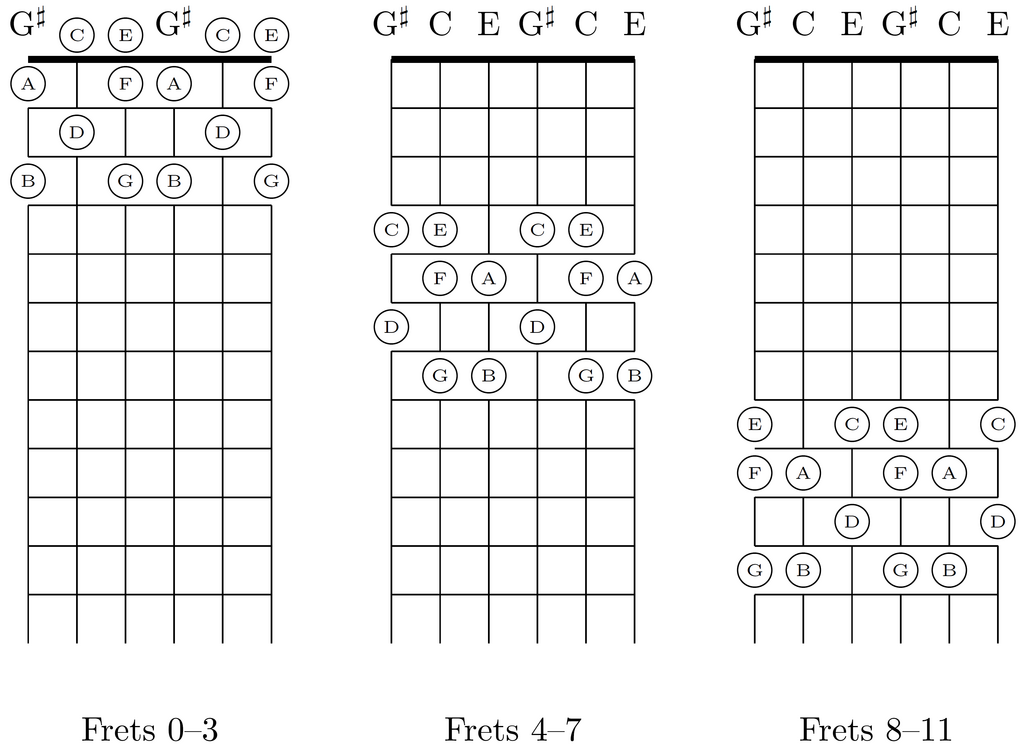
Another powerful pattern involves octaves. An octave is the same note at a higher pitch. On the guitar, the 12th fret is exactly one octave above the open string. So, the note on the 12th fret of the low E string is another E. The 13th fret is F, just like the 1st fret, but an octave higher.
The entire fretboard pattern repeats itself after the 12th fret. If you learn the notes from the open string to the 11th fret, you know the whole neck.
From Notes to Patterns
Knowing individual note locations is important, but music happens when you connect them into patterns. Scales are the fundamental patterns that form melodies and solos. The most common is the major scale.
You can think of any major scale as a specific sequence of whole steps (W) and half steps (H).
The major scale formula: Whole-Whole-Half-Whole-Whole-Whole-Half (W-W-H-W-W-W-H).
Let's build a C major scale on the A string. Our starting note, or root, is C, located at the 3rd fret. Following the pattern:
- C (3rd fret) to D (5th fret) is a whole step.
- D (5th fret) to E (7th fret) is a whole step.
- E (7th fret) to F (8th fret) is a half step.
And so on. Once you learn this pattern shape, you can move it anywhere. Start on the 10th fret of the E string (a D note), apply the same pattern, and you're playing a D major scale. This is the foundation of improvisation.
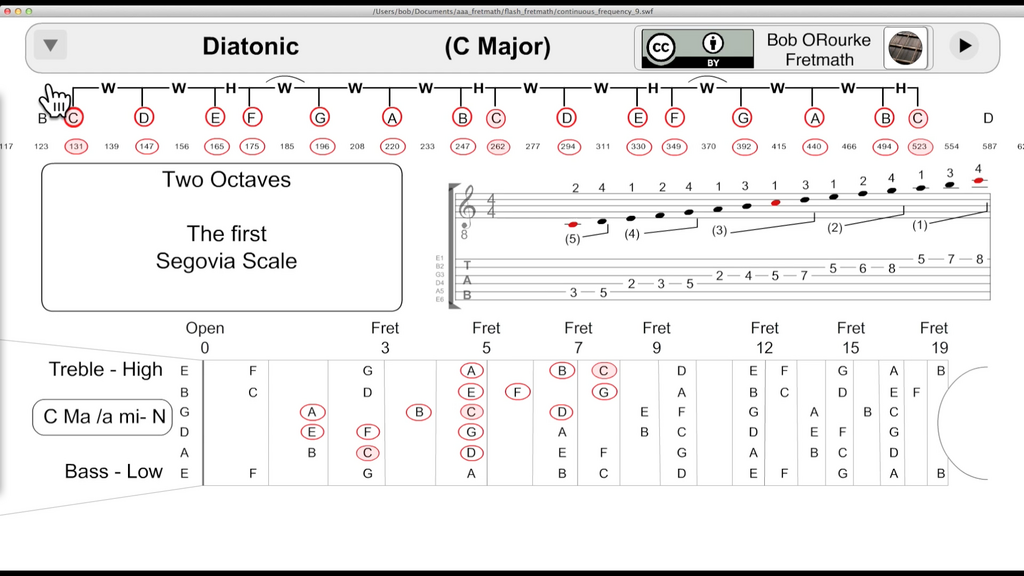
Instead of seeing a confusing jumble of frets and strings, you can start to see a landscape of interconnected patterns. Mastering this mental map is what separates good guitarists from great ones.
Fretboard mastery is the gateway to complete musical freedom.
Let's review the key terms we've covered before testing your knowledge.
Ready to see what you've learned? Give these questions a try.
What are the names of the six strings on a guitar in standard tuning, ordered from the thickest string to the thinnest?
On a guitar, moving from one fret to the very next fret on the same string changes the note's pitch by one ____.
The best way to learn the fretboard is to spend time with it. Pick a single string and try to find all the C notes. Then do it for G, then D. Slowly, the map will become clear, and your fingers will know where to go without you having to think about it.