Guitar Chord Voicings Beyond the Basics
Chord Construction Basics
The Building Blocks of Chords
Chords aren't just random groups of notes that sound good together. They're built using a specific recipe, and the core ingredients are called intervals. Think of intervals as the measurement of distance between any two notes.
The primary building blocks of chords are intervals, stacked one on top of the other.
For the most basic chords, we only need to worry about three specific intervals, all measured from a starting note called the root. The root is the foundation of the chord and gives the chord its name (like the C in a C major chord).
| Interval | Role in the Chord |
|---|---|
| Root (1) | The foundation, the chord's home base. |
| Third (3) | The mood-setter. It determines if the chord is major (happy) or minor (sad). |
| Fifth (5) | The stabilizer. It adds richness and support to the root and third. |
These three notes—the root, third, and fifth—form a powerful and stable combination that serves as the basis for almost all the music you hear.
Scales Are Your Cheat Sheet
So where do we find these thirds and fifths? We get them from scales. A scale is just an organized sequence of notes. For chord building, the two most important scales are the major scale and the minor scale.
The major scale has a bright, happy sound. Its formula of whole (W) and half (H) steps is consistent for every key: W-W-H-W-W-W-H. A whole step is two frets on the guitar, and a half step is one fret.
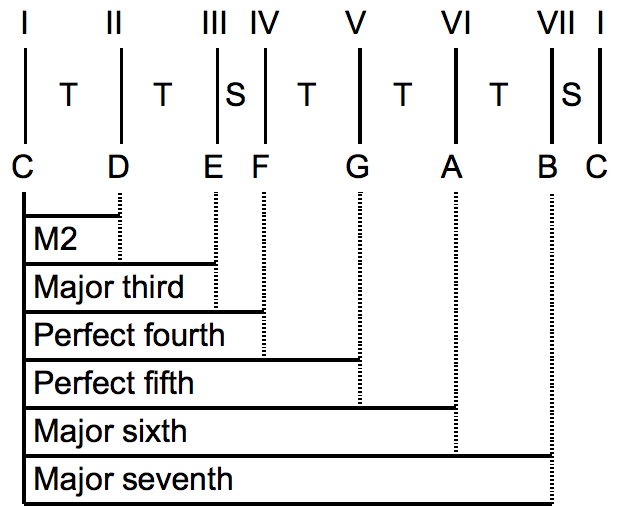
The minor scale has a more somber or melancholy sound. Its defining characteristic is a 'flatted' third, meaning the third note is one half step lower than the third in the major scale. This one small change completely alters the mood.
Major Scale = Bright and happy Minor Scale = Dark and sad
Meet the Triads
When you take the root, third, and fifth from a scale and play them together, you get a triad. A triad is the simplest form of a chord, containing just three notes.
triad
noun
A chord made of three notes, typically a root, a third, and a fifth.
If you pull the 1st, 3rd, and 5th notes from a major scale, you create a major triad. Its formula is simply 1-3-5.
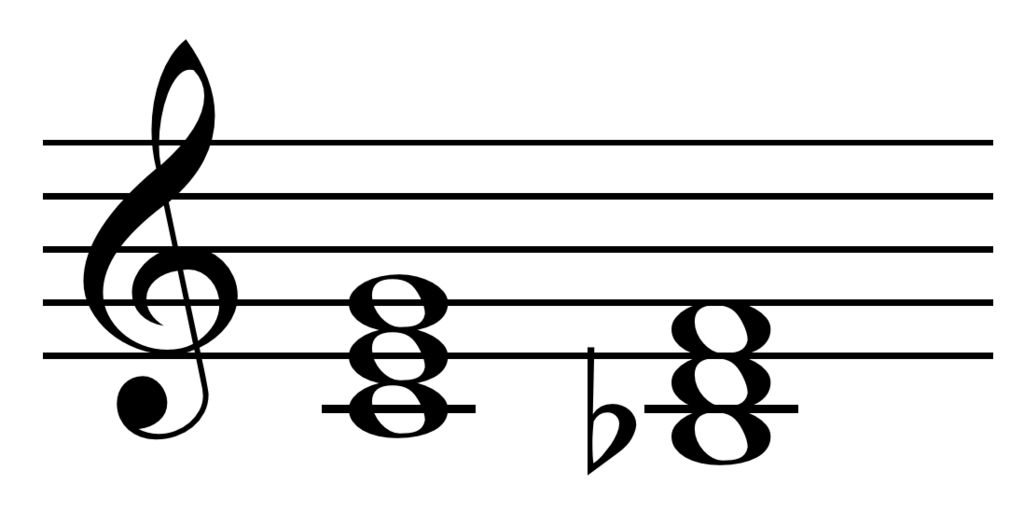
To build a minor triad, you do the same thing but use the minor scale as your source. Because the third is lower in the minor scale, the formula for a minor triad becomes 1-♭3-5 (read as "one, flat three, five"). That ♭3 is the secret ingredient for the minor sound.
| Chord Type | Source Scale | Formula | Notes (in C) | Sound |
|---|---|---|---|---|
| Major Triad | Major Scale | 1, 3, 5 | C, E, G | Happy, bright |
| Minor Triad | Minor Scale | 1, ♭3, 5 | C, E♭, G | Sad, somber |
Beyond the Basics
Music would be pretty boring if we only used triads. To add more color and complexity, we can add more notes from the scale to our basic 1-3-5 chords. These added notes are called extensions.
Think of it like adding spices to a meal. The triad is your base flavor, and extensions like the 6th, 7th, or 9th notes of the scale add new layers of texture and emotion. We can also alter notes by sharpening (raising by a half step) or flatting (lowering by a half step) them to create even more tension and interest.
Chord extensions add flavor. Chord alterations add tension.
Understanding how triads are built from scales is the first, most crucial step. Once you grasp that relationship, building bigger, more complex chords is just a matter of adding a few more ingredients from the scale.
Now, let's test what you've learned about the building blocks of chords.
What are the three fundamental notes that form a basic triad?
The primary difference between a major triad and a minor triad is that the third note is lowered by one half step in the minor triad.