Guitar Chord Mastery
Guitar Anatomy
Meet Your Guitar
Before you can play a song, it helps to know your way around the instrument. A guitar might seem complex, but it's just a collection of simple parts working together. Let's break them down.
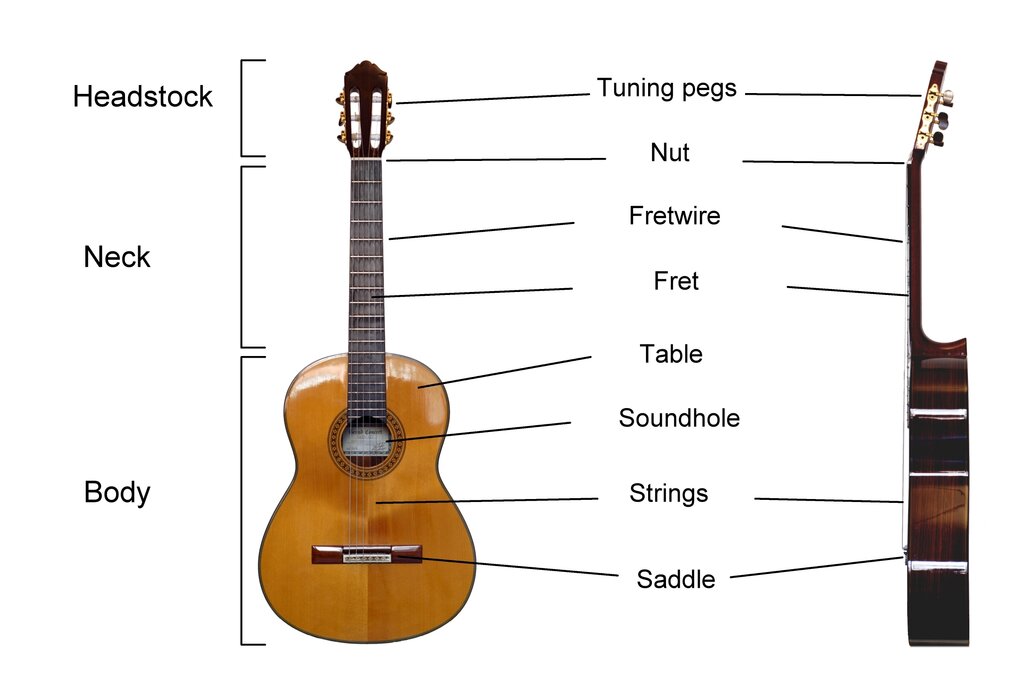
The largest part of the guitar is its body. On an acoustic guitar, the body is hollow and has a soundhole. This design naturally amplifies the sound of the vibrating strings. Electric guitars usually have solid bodies and rely on electronic pickups and an amplifier to produce sound. The shape and size of the body can affect the guitar's tone and volume.
The Neck and Fretboard
Extending from the body is the long neck. The front-facing part of the neck is a flat piece of wood called the fretboard (or fingerboard). This is where you'll press down on the strings to create different notes.

You'll see thin metal strips running across the fretboard. These are called frets. They divide the neck into specific segments, and each one represents a different musical pitch.
Fret
noun
A raised element on the neck of a stringed instrument. Frets divide the neck into fixed segments at intervals of a semitone.
Frets are numbered starting from the end of the neck closest to the headstock. The fret nearest the headstock is the 1st fret, the next is the 2nd, and so on. The space between the nut (the small grooved strip where the neck meets the headstock) and the 1st fret is where you play the 1st fret notes.
Think of it this way: pressing a string at a fret shortens the string's vibrating length, which raises the pitch. Each fret raises the pitch by one half-step.
Headstock and Tuning
At the very top of the neck is the headstock. Its main job is to hold the tuning pegs (also called tuners or machine heads). The strings wrap around posts that pass through the headstock, and you turn the pegs to tighten or loosen the strings. This changes their pitch, allowing you to tune the guitar.
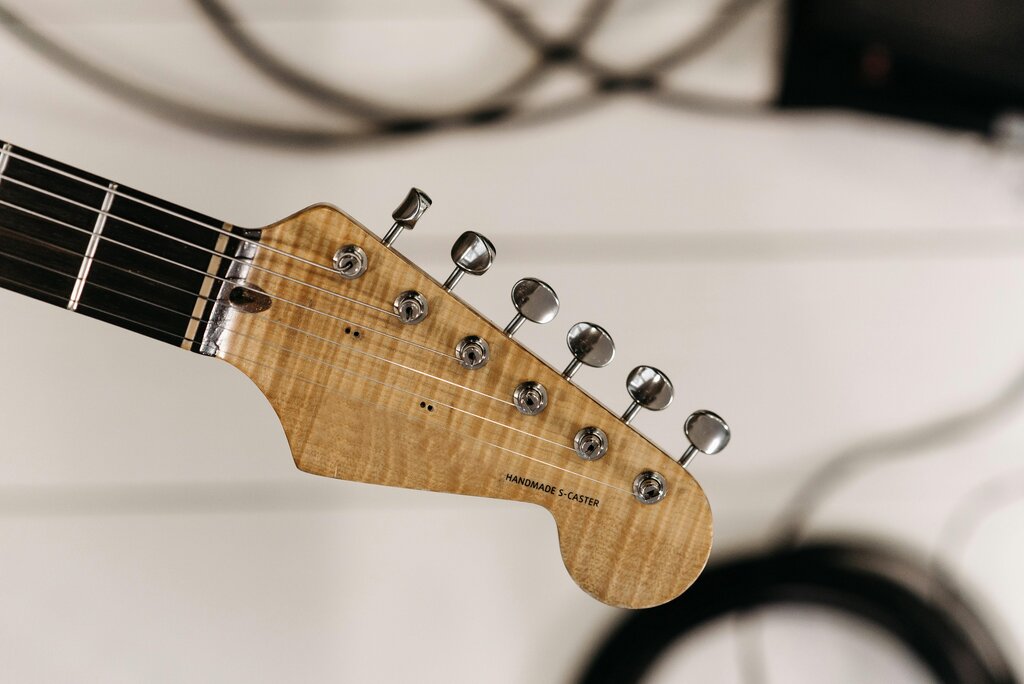
Most guitars have six strings. The thickest string produces the lowest pitch, and the thinnest string produces the highest. Standard tuning is the most common way to set the pitch of these strings. From thickest to thinnest, the notes are E, A, D, G, B, and E.
A popular mnemonic to remember the string names is: Eddie Ate Dynamite, Good Bye Eddie.
The strings are also numbered from 1 to 6, starting with the thinnest string.
| String # | Note | Description |
|---|---|---|
| 6 | E | Thickest, lowest pitch |
| 5 | A | |
| 4 | D | |
| 3 | G | |
| 2 | B | |
| 1 | E | Thinnest, highest pitch |
Now that you know the basic parts of the guitar, let's test your knowledge.
What is the primary function of the headstock?
On a standard six-string guitar, the 1st string is the thickest one, producing the lowest pitch.
Understanding these parts is the first step on your journey. It gives you the language to understand how the instrument works and how to interact with it.