Guitar 3 Notes Per String Scale System
Introduction to 3 Notes Per String Scales
A New Way to See the Fretboard
Most guitarists learn scales using patterns where the number of notes on each string changes. You might play two notes on one string, then three on the next. This works, but it can feel a bit clunky, especially when you want to play faster or move smoothly up and down the neck.
The '3 notes per string' (3NPS) system is exactly what it sounds like: a method where you play three notes on every single string. This simple rule creates a more uniform and predictable way to navigate the fretboard.
Instead of learning scattered 'box' shapes, 3NPS organizes scales into consistent, linear patterns that flow more easily across the strings.
Consistency is Key
The main advantage of 3NPS is its consistency. With every string having three notes, the picking and fretting motions become more rhythmic and repeatable. This is a huge help for developing speed and fluidity, making techniques like alternate picking and legato (hammer-ons and pull-offs) feel more natural.
Think of it like walking versus skipping. Traditional scale patterns can feel like taking two steps, then three, then two again. It works, but it’s irregular. 3NPS is like taking a steady, even stride, making it easier to build momentum and move gracefully.
| Feature | Traditional Patterns (e.g., CAGED) | 3 Notes Per String (3NPS) |
|---|---|---|
| Structure | Varying notes per string (2 or 3) | Always 3 notes per string |
| Best For | Visualizing chords within scales | Speed, fluidity, linear runs |
| Movement | More vertical, 'box' oriented | More horizontal, across the neck |
| Picking | Can be irregular | Consistent and predictable |
Mapping the Major Scale
So how does this apply to something familiar, like the major scale? The entire major scale can be mapped across the fretboard using seven distinct 3NPS patterns. Each pattern starts on a different note of the scale, giving you a different 'mode' or flavor of the scale.
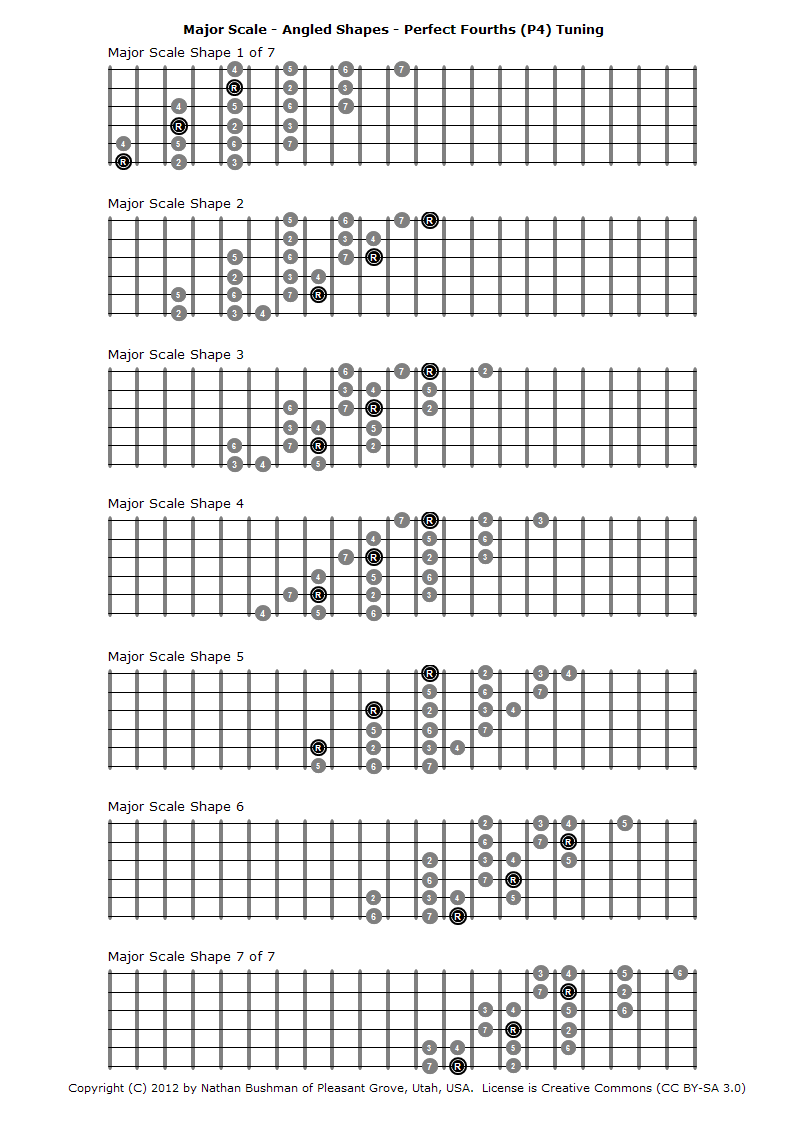
You don't need to memorize all seven patterns at once. The goal is to understand that this system provides a comprehensive map of the fretboard. It breaks you out of being stuck in one position and helps you see the neck as a single, connected landscape. This perspective is incredibly freeing for improvisation, as it allows you to follow melodic ideas wherever they lead, without being confined to a single box.
What is the fundamental rule of the '3 notes per string' (3NPS) system for guitar scales?
What is the main advantage of using the 3NPS system compared to traditional scale patterns?
This system provides a new framework for thinking about scales and navigating the guitar.