Grok vs ChatGPT AI Models
Introduction to Transformer Architectures
From Chains to Webs
For a long time, computers struggled with a basic human skill: understanding context in language. Early artificial intelligence models, like Recurrent Neural Networks (RNNs), tried to tackle this by reading text one word at a time, in order. They’d read the first word, try to remember it, then read the second word, and so on. It was like trying to understand a long story by reading it through a tiny pinhole, word by word.
This sequential process had a major flaw. By the time the model reached the end of a long paragraph, it often forgot what was said at the beginning. The connection between a pronoun at the end of a sentence and the noun it referred to at the start could get lost. The model was chained to the sequence of words, unable to easily look back and connect the dots.
Then, in 2017, a new architecture changed everything: the Transformer. Instead of processing words one by one, the Transformer looks at the entire sentence at once. It sees all the words and can draw connections between any of them, no matter how far apart they are. It broke the sequential chain and replaced it with a web of relationships.
The Power of Attention
The magic behind the Transformer is a mechanism called self-attention. Think about how you read. When you see the sentence, "The cat chased the mouse, but it got away," your brain instantly knows "it" refers to the mouse, not the cat. You’re paying more attention to "mouse" when you interpret "it."
Self-attention allows a model to do the same thing. For every word in a sentence, it weighs the importance of all the other words. It learns which words are most relevant to understanding the meaning of the current word. This allows the model to build a rich, contextual understanding of the text.
In the sentence, "The delivery truck was late because it had a flat tire," self-attention helps the model link "it" directly to "truck," and "flat tire" to the reason for being "late."
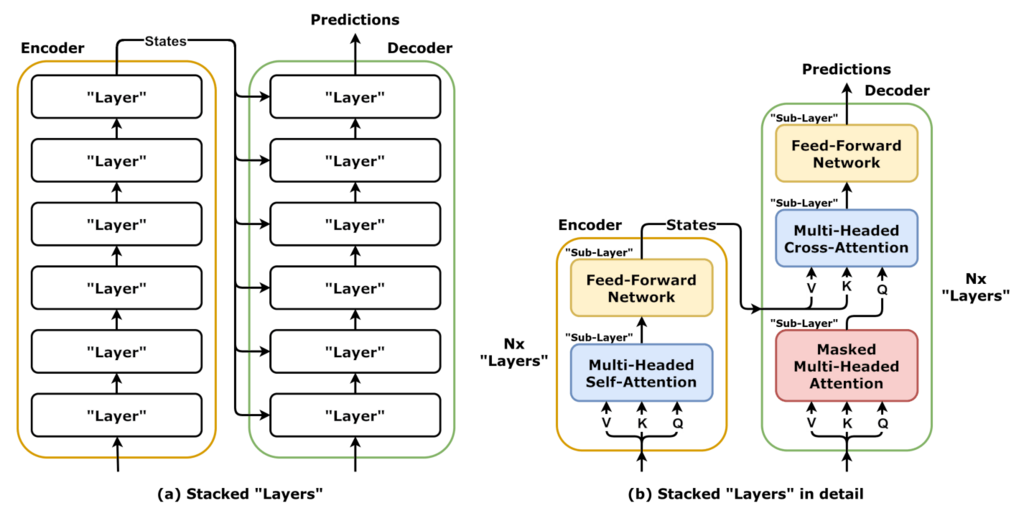
Technically, this works by creating three special vectors, or lists of numbers, for each word: a Query, a Key, and a Value.
- Query: A question about the word itself, like "What context do I need to understand this word?"
- Key: A label that describes the word, like "I am a thing that can have a flat tire."
- Value: The actual meaning or substance of the word.
The model compares the Query vector of one word with the Key vectors of all other words in the sentence. When a Query and a Key match well, the model knows those words are highly related. It then uses the Value from the related word to build a better understanding of the original word. This happens for every word, all at the same time, creating that powerful web of context.
Parallel Processing
This ability to process all words simultaneously is a huge advantage. Unlike the old RNNs that had to wait to process one word before moving to the next, Transformers can handle the entire sentence in parallel. This makes them incredibly efficient to train on massive amounts of data.
Because they aren't tied to a strict word order for processing, Transformers need a way to understand the sequence. This is done through something called positional encoding, which adds a bit of information to each word that tells the model its position in the sentence. It’s like adding a quiet footnote to each word that says, “I’m the first word,” or “I’m the fifth word.” This way, the model gets the best of both worlds: the freedom of the web and the structure of the sequence.
This combination of self-attention and parallel processing is what makes the Transformer architecture the foundation for nearly all modern large language models.
Time to check your understanding of these core concepts.
What was a major limitation of Recurrent Neural Networks (RNNs) for understanding long texts?
What is the key mechanism introduced by the Transformer architecture that allows it to weigh the importance of different words in a sentence relative to each other?