Greenhouse Gases Explained
Introduction to Greenhouse Gases
Earth's Climate Blanket
Think of greenhouse gases as a blanket for our planet. Just like a blanket traps your body heat on a cold night, these gases trap some of the Sun's heat in our atmosphere. This natural process, called the greenhouse effect, is essential for life. Without it, Earth would be a frozen, uninhabitable rock. The problem isn't the blanket itself, but that human activities are making it thicker, trapping too much heat.
Greenhouse Gas
noun
A gas in the atmosphere that absorbs and emits radiation within the thermal infrared range, causing the greenhouse effect.
These gases make up a tiny fraction of our atmosphere, which is mostly nitrogen and oxygen. But their ability to absorb heat gives them an outsized impact on the planet's temperature. The balance is delicate; natural cycles have kept this blanket at the right thickness for millennia. Now, we're changing that balance.
The Main Gases
While there are many greenhouse gases, four main players are responsible for most of the warming. They come from both natural processes and human activities.
Carbon Dioxide (CO₂) is the most famous. It's released naturally through breathing, volcanic eruptions, and decomposition. But the vast majority of excess CO₂ comes from human activities, primarily burning fossil fuels like coal, oil, and natural gas for energy and transportation. Deforestation also plays a big role, as trees absorb CO₂.
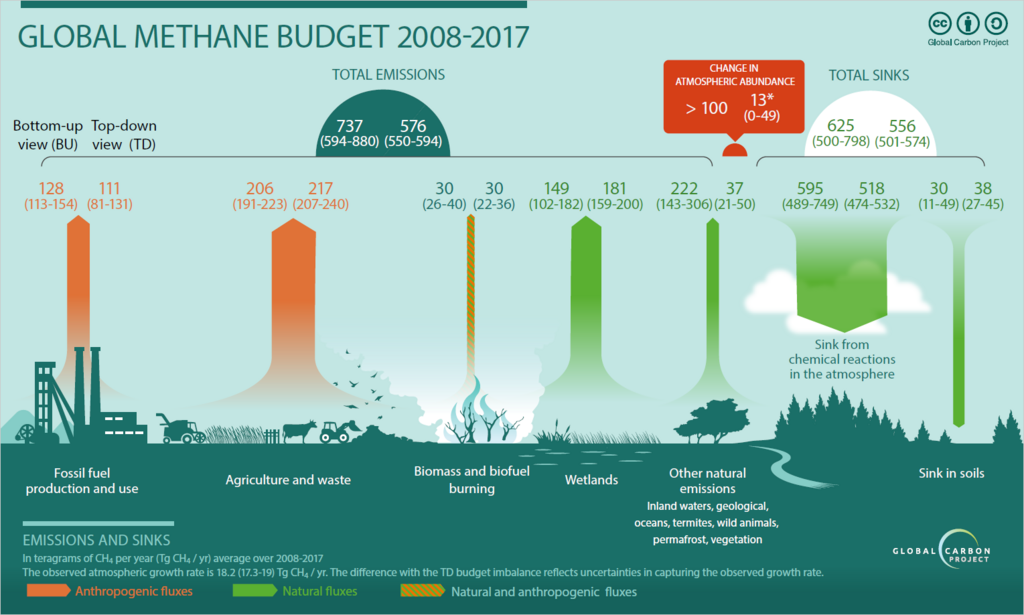
Methane (CH₄) is another major contributor. On a molecule-for-molecule basis, it's much more powerful at trapping heat than CO₂, but it stays in the atmosphere for a shorter time. Natural sources include wetlands and termites. Human-caused sources are significant, including livestock farming (from cow burps and manure), natural gas leaks, and decaying trash in landfills.
Nitrous Oxide (N₂O) is even more potent than methane. It occurs naturally in soils and the ocean. However, human activities have boosted its concentration, mainly through the use of nitrogen-based fertilizers in agriculture. It's also released from burning fossil fuels and certain industrial processes.
Fluorinated Gases are a family of synthetic chemicals that includes hydrofluorocarbons (HFCs), perfluorocarbons (PFCs), and sulfur hexafluoride (SF₆). Unlike the others, these have no natural sources. They are used as refrigerants, solvents, and in various industrial applications. Though released in smaller quantities, they are thousands of times more powerful than CO₂ at trapping heat and can linger in the atmosphere for centuries or even millennia.
How They Trap Heat
The mechanism behind the greenhouse effect is based on energy absorption. The Sun's energy reaches Earth primarily as visible light and ultraviolet (UV) radiation. The Earth's surface absorbs this energy and warms up. In turn, the warmed planet radiates heat back toward space as infrared (IR) radiation, which is a different, lower-energy wavelength.
Gases like nitrogen and oxygen are transparent to this outgoing infrared radiation, letting it pass through. Greenhouse gas molecules, however, are different. Their molecular structure allows them to absorb the energy from IR radiation. After absorbing this energy, they vibrate and then re-emit the radiation in all directions. Some of it goes out to space, but much of it is directed back down toward the Earth's surface, warming it further.
This constant absorption and re-emission of heat is what keeps our planet warmer than it would otherwise be. The more greenhouse gas molecules there are in the atmosphere, the more heat gets trapped, and the warmer the planet becomes.
Carbon dioxide is a greenhouse gas and traps heat in the atmosphere.
Human activities since the Industrial Revolution, especially the burning of fossil fuels, have dramatically increased the concentration of these gases, thickening the planet's thermal blanket and driving global warming.
The "greenhouse effect" is often compared to a blanket for the Earth. What is the primary function of this "blanket" in the analogy?
What is the primary way greenhouse gas molecules contribute to warming the planet?
Understanding these fundamental gases and how they work is the first step to understanding climate change.