Great Learning AI Foundations Highlights
Learning Paradigms Compared
Mapping vs. Discovery
At its core, supervised learning is a mapping exercise. The goal is to learn a function that maps a given input, , to a specific output, . Think of it like a student learning with an answer key. The model is given examples of emails () and told which ones are spam and which are not (). After seeing enough examples, it learns to predict the label for new, unseen emails. This process is incredibly powerful for tasks with a clear, defined outcome.
The major requirement for this approach is high-quality labeled data. Creating this is often the most expensive and time-consuming part of a machine learning project. It requires human experts to manually classify thousands or even millions of data points, whether it's identifying tumors in medical scans or flagging fraudulent transactions.
Unsupervised learning, on the other hand, is a discovery engine. It works with data that has no predefined labels. Instead of predicting a known answer, its job is to find the inherent structure or patterns within the data. It's like being given a massive box of mixed LEGO bricks and being asked to sort them into logical piles. You might group them by color, shape, or size, discovering categories that weren't obvious at first.
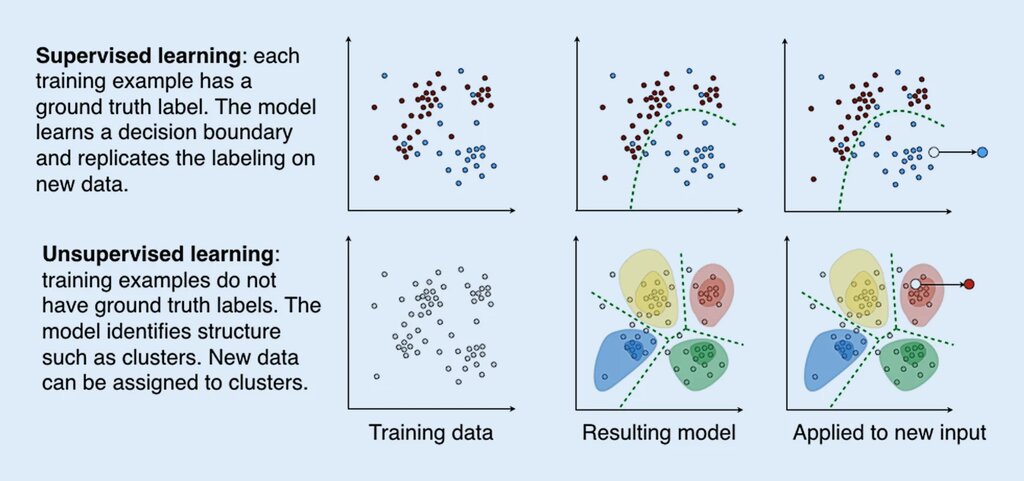
This makes unsupervised learning ideal for problems like customer segmentation, where a business wants to discover natural groupings of customers based on purchasing habits, or anomaly detection, where the goal is to find unusual data points that don't fit with the rest.
Bridging the Data Gap
The high cost of labeling data has pushed the industry toward hybrid approaches that try to get the best of both worlds. Two of the most important are semi-supervised and self-supervised learning.
Semi-supervised learning uses a small amount of labeled data to help guide the interpretation of a much larger pool of unlabeled data. The initial labeled points act as 'seeds' that help the model make educated guesses about the remaining data, dramatically reducing the need for manual annotation.
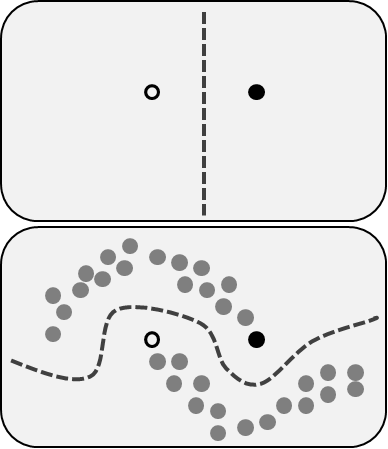
Self-supervised learning is a clever form of unsupervised learning where the data itself provides the supervision. The algorithm creates its own labels from the input data. For example, it might take a sentence, remove a word, and then train itself to predict that missing word. Or it might take an image, hide a patch of it, and learn to fill in the blank. This allows models to learn rich representations of data without any human-provided labels at all. This is the technique that powers many modern (LLMs).
Choosing the Right Tool
Selecting the right learning paradigm depends entirely on the business problem you're trying to solve. The key is to match the problem's characteristics to the strengths of the learning approach.
| Use Case | Best Paradigm | Why? |
|---|---|---|
| Fraud Detection | Supervised | The goal is a binary classification (fraud/not fraud), and historical data with known outcomes is available for training. Accuracy is critical. |
| Customer Segmentation | Unsupervised | The goal is to discover unknown groups within a customer base. There are no pre-existing labels for what these groups are. |
| Medical Image Analysis | Semi-Supervised | A small set of images can be labeled by expert radiologists, while a vast library of unlabeled images can help the model learn general features of the anatomy. |
| Content Recommendation | Self-Supervised | A model can learn user preferences by predicting which articles or videos a user will click on next, based on their history. The supervision comes from user behavior, not manual labels. |
Even with the right model, the job isn't done once the algorithm provides an answer, especially in unsupervised learning. The clusters or anomalies it identifies are just mathematical groupings. They require human interpretation to become actionable business insights. This is where the concept of a becomes critical.
A marketing analyst must examine the customer segments found by an unsupervised model to determine what they represent. A security expert needs to investigate an anomaly flagged by a system to confirm if it's a genuine threat or just a harmless outlier. The AI finds the needle in the haystack; the human confirms it's the right needle.
What is the primary requirement for a supervised learning approach?
A marketing team wants to discover natural groupings of its customers based on their purchasing habits, without any predefined categories. Which machine learning paradigm is best suited for this task?
By understanding these different paradigms not just by their definitions but by their strategic applications and trade-offs, you can better determine which approach will deliver the most value for a given challenge.