Gravity Explained
Introduction to Gravity
The Unseen Pull
Drop a pen. It falls. Toss a ball in the air. It comes back down. These simple actions demonstrate one of the most fundamental forces in the universe: gravity. It's the invisible pull that keeps your feet on the ground, holds the Moon in orbit around the Earth, and clusters stars into vast galaxies. Though we experience it every moment, our understanding of gravity has evolved dramatically over centuries.
Early Ideas About Falling
For nearly 2,000 years, the ancient Greek philosopher Aristotle had the most accepted explanation for why things fall. He believed that every object had a “natural place” in the universe. The natural place for earthy, heavy objects was the center of the universe, which he believed was the Earth itself. The natural place for airy, light things like smoke was up in the sky.
According to Aristotle, a rock falls because it's trying to get back to its natural place—the ground. A heavier rock, he reasoned, would fall faster than a lighter one because it had a stronger desire to return to its home.
Aristotle's theory: Heavy objects fall faster than light objects because they are more eager to reach their 'natural place' at the center of the Earth.
This idea made intuitive sense. A feather clearly falls slower than a cannonball. For centuries, this was the accepted wisdom. But it took a new way of thinking, and some clever experiments, to challenge it.
Galileo's Revelation
In the 16th century, the Italian astronomer and physicist Galileo Galilei began to question the old ideas. He suggested that the reason a feather falls slower than a cannonball isn't because of its nature, but because of air resistance. In a space with no air—a vacuum—he predicted they would fall at the exact same speed.
Legend says Galileo climbed the Leaning Tower of Pisa and dropped two spheres of different masses to prove his point. While this story may be a myth, his writings and experiments with rolling balls down inclined planes were real and revolutionary. They showed that all objects accelerate downward at the same rate, regardless of their weight.
Galileo's discovery: The acceleration of a falling object is constant and does not depend on its mass.
Newton's Universal Law
About 50 years after Galileo's death, Isaac Newton had a profound insight. He realized that the force pulling an apple from a tree to the ground was the same force that kept the Moon orbiting the Earth. Gravity wasn't just an earthly phenomenon; it was universal.
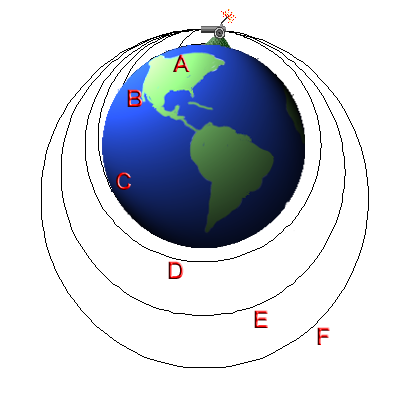
Newton formulated his Law of Universal Gravitation, which states that every particle of matter in the universe attracts every other particle. The strength of this attraction depends on two things: how massive the objects are and how far apart they are.
More mass means a stronger gravitational pull. Greater distance means a weaker pull. He captured this elegant relationship in a single equation.
| Variable | Meaning |
|---|---|
| The force of gravity | |
| The gravitational constant (a fixed number) | |
| , | The masses of the two objects |
| The distance between the centers of the objects |
This single law explained the motions of planets, moons, and comets with stunning accuracy. It confirmed that the heavens and the Earth operate under the same set of physical rules, a truly revolutionary idea.
According to the ancient Greek philosopher Aristotle, why would a heavy rock fall faster than a light one?
Galileo Galilei theorized that in a vacuum (a space with no air), a feather and a cannonball dropped from the same height would fall at the exact same speed.