Graphing Quadratic Functions
Quadratic Functions
Meet the Parabola
Beyond straight lines, one of the next simplest and most common shapes in mathematics is the parabola. You've seen this U-shape before, whether it's the path of a thrown ball or the design of a satellite dish.
The function that creates this curve is called a quadratic function. Its standard form looks like this:
In this equation, and are the variables that trace the curve. The letters , , and are coefficients—constants that define the specific shape and position of the parabola. The only rule is that cannot be zero. If it were, the term would vanish, and we'd be left with a simple linear function, .
The Role of 'a'
The coefficient is the most influential character in the story of a parabola. It controls two key features: the direction the parabola opens and how wide or narrow it is.
If is positive, the parabola opens upwards, like a smiling face. If is negative, it opens downwards, like a frowning face.
The magnitude of (its value without the sign) determines the parabola's width. A larger magnitude makes the parabola steeper and narrower. A smaller magnitude (a value between -1 and 1, but not zero) makes it wider and flatter.
Think of it like gravity. A large is like strong gravity, pulling the sides of the parabola in tightly. A small is like weak gravity, letting the sides spread out.
Positioning the Parabola
While sets the shape, and determine the parabola's position on the coordinate plane. The coefficient has the simplest job: it moves the entire parabola vertically.
The value of is the parabola's y-intercept. It's the point where the curve crosses the vertical y-axis.
If you change , the parabola slides straight up or down without changing its shape. A positive shifts it up, and a negative shifts it down.
The coefficient is a bit more complex. It works together with to shift the parabola horizontally and vertically. Changing moves the parabola along a curved path, affecting both its horizontal and vertical position. For now, just know that plays a key role in sliding the parabola left and right.
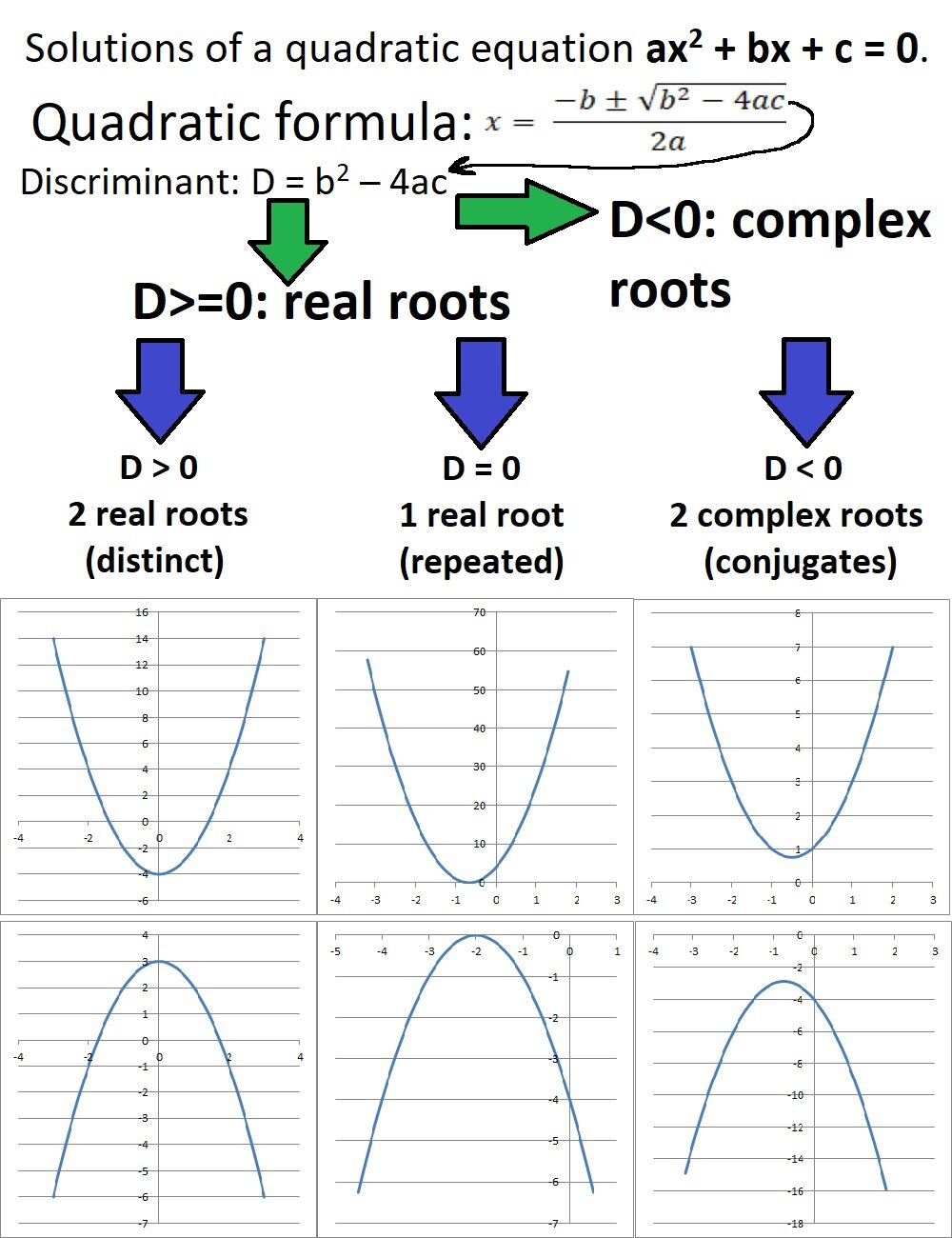
By understanding what , , and do, you can look at any quadratic function in standard form and get a good idea of what its graph will look like without plotting a single point. You can tell if it opens up or down, whether it's wide or narrow, and roughly where it sits on the plane.
Let's check your understanding of these building blocks.
In the standard form of a quadratic function, , what happens if the coefficient 'a' is zero?
Which coefficient in is responsible for shifting the parabola vertically up or down without changing its shape?
Mastering these fundamentals is the first step toward solving quadratic equations and modeling real-world phenomena.