Graphic Design Fundamentals
Design Elements
The Building Blocks of Design
Every visual composition, from a simple logo to a complex website, is built from the same fundamental components. These are the elements of design. Think of them as the basic vocabulary you'll use to create and communicate visually. Mastering these seven elements is the first step toward creating work that is both effective and compelling.
Line
noun
A mark made between two points. It is the most basic element of design and can be used to direct the eye, create emphasis, or divide space.
Lines are everywhere in design. They connect points, separate sections, and guide the viewer's gaze. The character of a line—whether it's straight, curved, thick, thin, dotted, or zigzagged—carries its own energy and meaning.
Straight lines suggest order and stability, while curved lines feel more natural and dynamic. A thin line might feel delicate, whereas a thick, bold line feels strong and assertive.
When a line encloses an area, it creates a shape.
Shape and Form
Shapes are two-dimensional areas defined by a boundary. They are flat. We typically categorize them into two groups:
- Geometric shapes: These are the precise, mathematical shapes we know well, like circles, squares, and triangles. They often feel structured and stable.
- Organic shapes: These are irregular, free-flowing shapes found in nature, like leaves, clouds, or puddles. They tend to feel more spontaneous and natural.
Shapes are crucial for creating symbols, structuring content, and forming the basis of more complex illustrations.
When a shape gains a third dimension—depth—it becomes a form. A square becomes a cube, and a circle becomes a sphere.
In two-dimensional design, like on a screen or a page, we create the illusion of form. This is done by using light, shadow, and perspective. By manipulating these, you can make a flat shape appear as a three-dimensional object, adding depth and realism to your work.
Color, Value, and Texture
Color is one of the most powerful tools in design, capable of grabbing attention and evoking emotion instantly. Every color has three main properties:
- Hue: This is the pure color itself (e.g., red, blue, green).
- Saturation: This refers to the intensity or purity of the hue. A highly saturated color is bright and vivid, while a desaturated color is more muted or gray.
- Value: This is the lightness or darkness of the color, ranging from white to black.
The element of value is critical on its own. It’s the engine behind contrast. A design with a wide range of values, from very light to very dark, will have high contrast and feel dramatic. A design with a narrow range of values will have low contrast and feel more subtle and calm.
Value does the work, but color gets all the credit.
Finally, texture refers to the surface quality of an object. In design, we mostly deal with visual texture—the illusion of a physical surface. It's what makes something look rough, smooth, glossy, or soft. Texture adds a tactile dimension to a flat design, making it more engaging and rich.
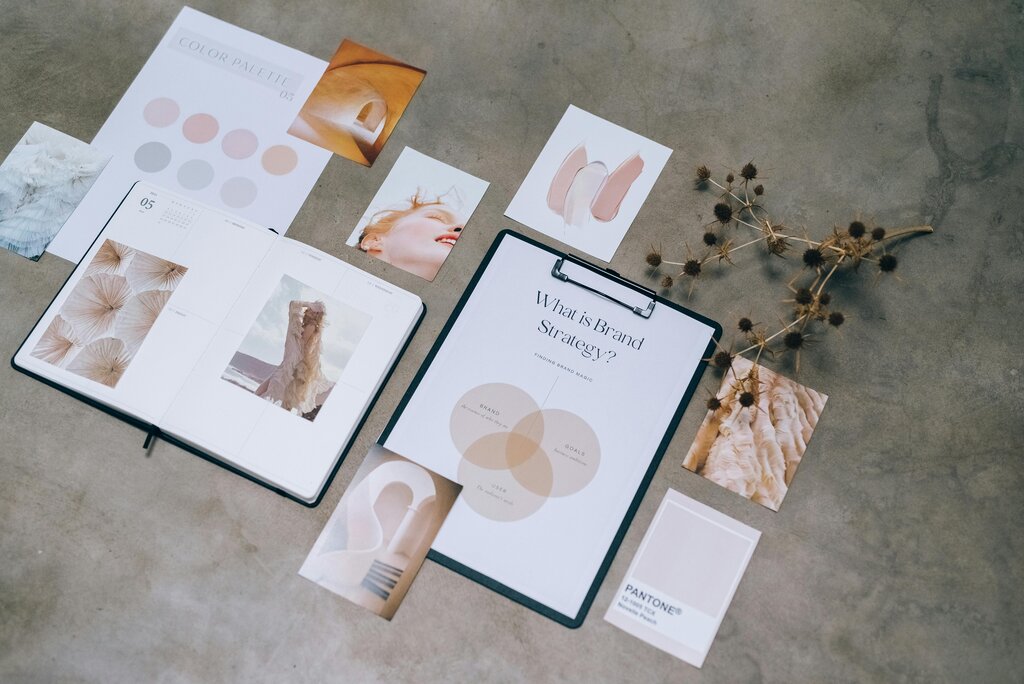
The Importance of Space
The final element is space—the area around, between, and within your design components. It's often broken down into two types:
- Positive Space: The area occupied by your main subjects, like text or images.
- Negative Space: The empty area surrounding your subjects. This is also called whitespace.
Beginner designers are often tempted to fill every inch of the canvas, but negative space is not wasted space. It is an active and essential element. It gives your design room to breathe, reduces clutter, improves readability, and helps create focus by drawing the eye to the most important elements.
When a line encloses an area, it creates a ____.
In design, how is the illusion of a three-dimensional form created on a two-dimensional surface?
These seven elements are the fundamental tools at your disposal. Learning to see them in the world around you and use them deliberately is the foundation of all design work.