Graphene Explained
Introduction to Graphene
The Thinnest Material Imaginable
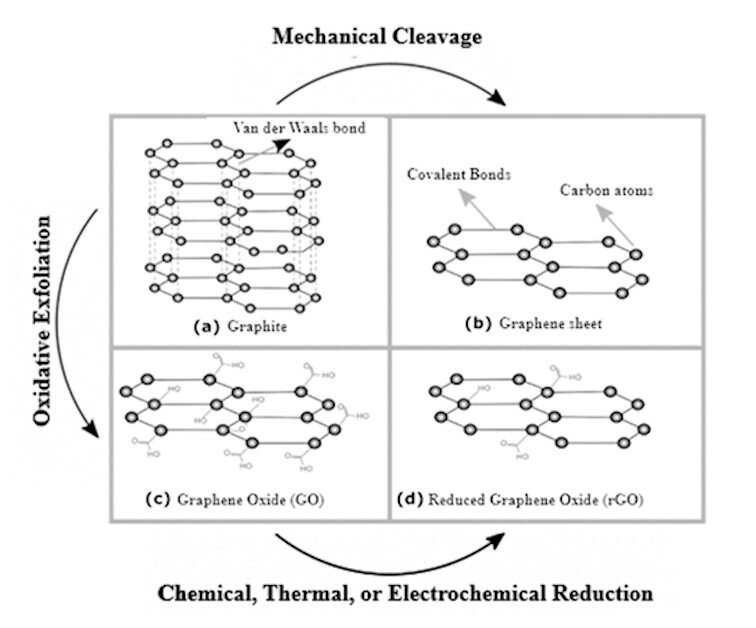
Imagine a material so thin it's considered two-dimensional. That's graphene. It's a single layer of carbon atoms, the very same atoms that make up charcoal and diamonds, arranged in a repeating hexagonal pattern. Think of it as a sheet of atomic-scale chicken wire or a honeycomb.
This simple, elegant structure is the basic building block for other carbon materials. If you stack many graphene sheets on top of each other, you get graphite—the familiar material in your pencil. If you roll a sheet of graphene into a tube, you get a carbon nanotube.
An Unexpected Discovery
For decades, scientists theorized about graphene, but many believed a two-dimensional material would be too unstable to exist. It was thought that thermal fluctuations would cause it to curl up or tear apart.
Then, in 2004, physicists Andre Geim and Konstantin Novoselov at the University of Manchester made a breakthrough using a surprisingly low-tech tool: Scotch tape. They applied a piece of tape to a chunk of graphite and peeled it off, pulling away thin flakes. By repeatedly applying the tape to the flakes themselves, they managed to peel away thinner and thinner layers until they isolated a single, one-atom-thick sheet. It was a simple yet revolutionary act that earned them the Nobel Prize in Physics in 2010.
A Material of Superlatives
The discovery of graphene opened a floodgate of research, as scientists began to uncover its extraordinary properties. It's often described as a 'wonder material' because it excels in so many areas.
Graphene is about 200 times stronger than steel by weight, a better conductor of electricity than copper, and an exceptional conductor of heat. It's also nearly transparent and so dense that not even a helium atom, the smallest gas atom, can pass through it.
Its electrical conductivity is particularly interesting. Electrons move through graphene's hexagonal lattice with virtually no resistance, behaving in ways that physicists usually only see in the realm of quantum mechanics. This high-speed, unimpeded flow makes it a subject of intense interest for the future of electronics.
Future Potential
The combination of these properties makes graphene a promising candidate for countless innovations. Its strength and light weight could be used to create revolutionary composite materials for cars, airplanes, and spacecraft. Its conductivity could lead to ultra-fast electronics, more efficient solar cells, and longer-lasting batteries.
Other potential uses include advanced water filtration systems, where graphene sheets could act as perfect molecular sieves, and biomedical sensors that can detect diseases at the earliest stages. While many of these applications are still in the research and development phase, the scientific community is buzzing with the possibilities. Graphene has given us a completely new material to build the future with, one atom at a time.
What is the fundamental structure of graphene?
How did Andre Geim and Konstantin Novoselov first isolate a single layer of graphene in 2004?