Grandeur and Governance of the Mughal Empire
Mansabdari System Mechanics
A New Kind of Loyalty
How does an emperor control a vast, diverse territory? For the Mughal emperor Akbar, the answer wasn't just conquest, but brilliant administration. He needed a way to manage his nobles, command his army, and run the civil government through a single, unified structure. His solution was the Mansabdari system.
Instead of relying on hereditary lords who might build their own power bases, Akbar created a new class of imperial officers called mansabdars. Every high-ranking official, whether a military commander or a court administrator, was a mansabdar. They were appointed by, promoted by, and directly answerable to the emperor. This system replaced the old feudal allegiances with direct loyalty to the throne, turning potential rivals into dependent state employees.
The Two-Part Rank
A mansabdar's position in the imperial hierarchy wasn't defined by a single title, but by a dual rank: zat and sawar. These two numbers told you everything you needed to know about their status and responsibilities.
Zat was the personal rank. It determined the holder's status in the court hierarchy and, crucially, their personal salary. A higher zat meant more prestige and more pay.
Sawar was the cavalry rank. This number specified how many armed horsemen and horses a mansabdar was required to maintain for the emperor's service. The state paid the mansabdar a separate allowance to cover the costs of maintaining this contingent.
For example, a mansabdar might have a rank of 5000 zat / 3000 sawar. This meant he had the personal status and salary of a 5000-rank officer, but was obligated to maintain a force of 3000 cavalrymen. Not all mansabdars had a sawar rank. A high-ranking court official or a judge might have a high zat rank but zero sawar, as their duties were purely administrative.
| Zat Rank | Sawar Rank | Role |
|---|---|---|
| 7000 | 7000 | Top-tier military commander, a prince |
| 5000 | 2000 | Senior general with administrative duties |
| 3000 | 0 | High-ranking court administrator |
| 1000 | 1000 | Mid-level field commander |
Getting Paid
A mansabdar's massive salary and the funds for their troops had to come from somewhere. The Mughal administration used two methods of payment.
Some mansabdars were paid in cash, or naqd, directly from the central treasury. This was simpler, but it put a strain on the empire's cash reserves.
The more common method was an assignment of land revenue, known as a The mansabdar, now called a jagirdar, was given the right to collect the state's share of revenue from a specific piece of land. This revenue was expected to cover both his personal salary (the zat portion) and the maintenance of his troops (the sawar portion). Importantly, the jagirdar did not own the land; he only had the right to its revenue for a period of time. The emperor could, and often did, transfer jagirs between officers to prevent them from developing local power bases.
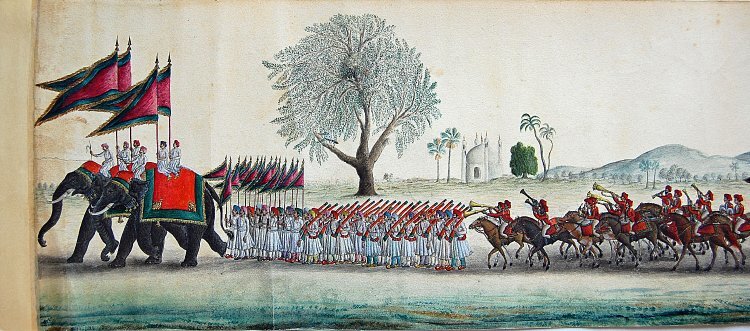
With so much money and power at stake, the temptation for corruption was immense. A mansabdar could easily cheat the system by not maintaining the required number of soldiers or by using subpar horses, pocketing the difference from the sawar allowance. Akbar, ever the systems-builder, anticipated this.
Keeping Everyone Honest
To ensure that mansabdars actually maintained the forces they were paid for, the administration enforced strict regulations, most famously the dagh and chehra practices.
(branding) was a system of marking the horses. During periodic inspections, each cavalry horse was branded with the imperial insignia and the mansabdar's personal mark. This prevented an officer from borrowing horses from another mansabdar just for the inspection, or from presenting the same horse twice.
Chehra (descriptive roll) was a detailed record of each individual soldier. It listed the man's name, his father's name, his tribe, and distinguishing physical features. This created a unique identity for each trooper, making it impossible to pass off hired-for-the-day locals as trained soldiers or to claim pay for "ghost" soldiers who didn't exist.
These measures created a powerful system of checks and balances. By centralizing military and civil power in a ranked bureaucracy and implementing rigorous anti-fraud measures, Akbar built an administrative machine that was the bedrock of Mughal strength for over a century.
What was the primary purpose of Akbar's Mansabdari system?
Under the Mansabdari system, the rank of zat determined a noble's personal salary and status, while the rank of sawar determined: