Grafana Mimir Explained
Introduction to Time-Series Databases
Data with a Timestamp
Almost everything we measure has a time component. Think about the heart rate from your smartwatch, the temperature outside, or the stock price of a company. These are all examples of time-series data: a sequence of data points recorded over time.
Time-Series Data
noun
A sequence of data points indexed in time order. Each data point typically consists of a timestamp and a corresponding value.
This type of data has a few key characteristics. First, it arrives in a time-ordered sequence and is almost always appended, not changed. You don't go back and edit yesterday's temperature reading; you just add a new one for today. Second, the data points often come in at high frequency, sometimes millions of points per second.
Finally, queries on this data usually involve time. You might ask, "What was the average CPU load over the last hour?" or "Show me all user sign-ups for the month of May."
A regular database, like one you'd use for an e-commerce store, could handle this. But it wouldn't be very good at it. It's like using a family sedan to haul construction materials. It might work for a small job, but it's not the right tool and will struggle under a heavy load.
Why a Special Database?
This is where time-series databases (TSDBs) come in. They are built specifically for the challenges of time-series data.
TSDBs are optimized for a few key operations:
- High-speed writes: They need to ingest massive amounts of data points continuously without slowing down.
- Efficient storage: They often use compression techniques to store data smartly, since the raw volume can be huge.
- Fast time-based queries: They excel at retrieving data for specific time ranges and performing aggregations like averages, sums, and counts over those ranges.
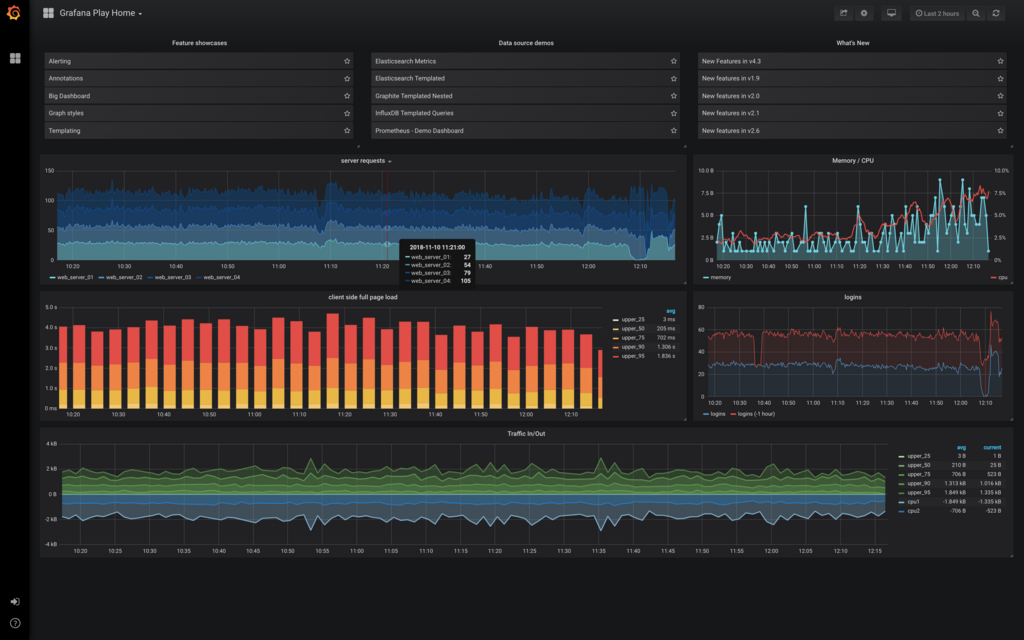
This specialized design makes them perfect for monitoring systems. When you're tracking the health of hundreds of servers, you need to know right now if a critical metric like memory usage is spiking. A TSDB can answer that query in milliseconds, where a traditional database might take seconds or even minutes.
For observability, speed is not a luxury. It's a necessity. Time-series databases provide the performance needed to monitor complex systems in real-time.
Common Players
While there are many TSDBs, a few are very common in the world of system monitoring and observability.
| Database | Key Feature |
|---|---|
| Prometheus | Pull-based model; scrapes metrics from configured targets. |
| InfluxDB | Push-based model; services send their metrics to it. |
| TimescaleDB | An extension for PostgreSQL, mixing SQL with TSDB power. |
Prometheus is a popular open-source choice, especially in cloud-native environments. It actively scrapes, or pulls, metrics from different services at regular intervals. It also has a powerful query language called PromQL and a built-in alerting system.
InfluxDB is another well-known option. It works on a push model, where applications are responsible for sending their own data to the database. It has its own query language that is similar to SQL, making it approachable for many developers.
These databases are the engines that power the dashboards and alerts that engineers rely on to keep systems running smoothly. They collect the raw data, store it efficiently, and make it available for fast analysis and visualization.
Time to check your understanding of these core ideas.
What is the defining characteristic of time-series data?
A standard relational database (like one for an e-commerce store) is often a poor choice for handling large volumes of time-series data because it is not optimized for the ____ and ____ typical of time-series workloads.
Understanding time-series data is the first step in mastering modern monitoring tools. These specialized databases provide the foundation for building robust and insightful observability systems.