Grade 9 CBSE Gravitation Practice Questions
Universal Law of Gravitation
The Universal Pull
You've probably heard the story of Isaac Newton and the falling apple. While it's a nice image, Newton's real insight wasn't just that things fall down. It was that the same force pulling the apple to the ground is also keeping the Moon in orbit around the Earth. He realized this pull is universal.
Every object in the universe attracts every other object with a force that is directed along a line joining them.
This means you have a gravitational pull, your desk has one, and so does the most distant star. Every single thing with mass exerts a gravitational force on every other thing with mass. It's a fundamental property of the universe. Of course, you don't feel the pull of your desk because your masses are tiny. It takes something as massive as a planet for the force to become obvious.
Putting Gravity into Numbers
To turn this idea into a tool for prediction, Newton developed a mathematical formula. It describes precisely how strong this gravitational pull is between any two objects.
Let's break that down:
- F is the gravitational force.
- m₁ and m₂ are the masses of the two objects.
- r is the distance between the centers of the two objects.
- G is a special number called the gravitational constant.
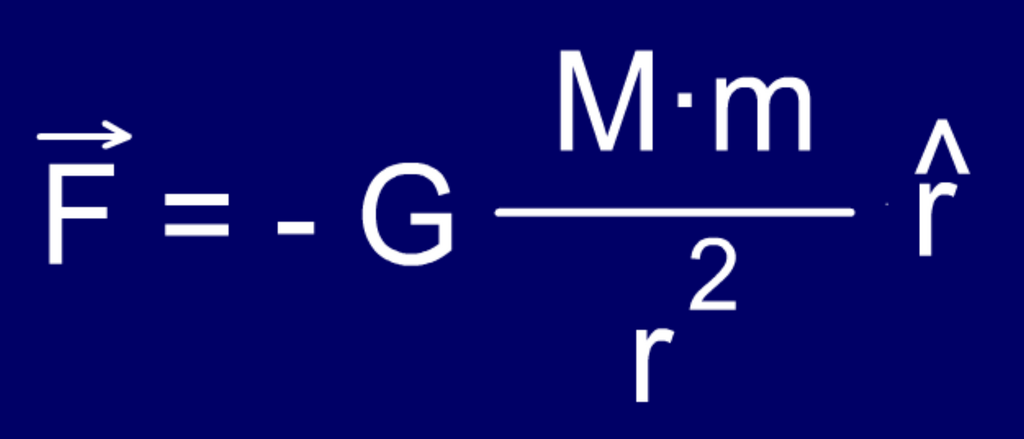
The top part of the fraction, , tells us that the force is directly proportional to the product of the masses. If you double the mass of one object, the gravitational force doubles. If you double the mass of both objects, the force becomes four times stronger.
The bottom part, , is the key to how gravity weakens over distance. The force is inversely proportional to the square of the distance. This is known as an inverse-square law. If you double the distance between two objects, the force doesn't get cut in half. It drops to one-quarter of its original strength. If you triple the distance, the force drops to one-ninth.
A Universal Constant
What about the 'G' in the equation? This is the gravitational constant. It's a fixed value that applies everywhere in the universe. It's the ingredient that makes the units work out correctly and scales the force appropriately.
The value of G is approximately . It's an incredibly small number.
The tiny value of G is why we don't notice the gravitational pull between everyday objects. The product of our masses is just too small to create a significant force when multiplied by G. It’s only when you have planet-sized masses that the force becomes powerful enough to shape orbits and hold us to the ground.
Let's check your understanding of these core ideas.
What was Isaac Newton's primary insight about the force that made an apple fall?
According to the inverse-square law, if you triple the distance between two objects, the gravitational force between them becomes...
This law was a revolutionary step. It unified the heavens and the Earth under a single, predictable principle, explaining everything from falling apples to the majestic dance of the planets.