Grade 5 Math Practice
Whole Numbers
The Building Blocks of Numbers
Everything in math starts with whole numbers. They're the numbers you count with: 0, 1, 2, 3, and so on. But how do we handle really big numbers, like the population of a city or the distance to a star?
The secret is place value. Each digit in a number has a specific value based on its position. The digit on the far right is in the ones place. The next one to the left is in the tens place, then the hundreds, thousands, and it keeps going.
Let's look at the number 357,912. It's not just a random string of digits. Each one has a job:
- 2 is in the ones place (2)
- 1 is in the tens place (10)
- 9 is in the hundreds place (900)
- 7 is in the thousands place (7,000)
- 5 is in the ten thousands place (50,000)
- 3 is in the hundred thousands place (300,000)
When you add them all up—300,000 + 50,000 + 7,000 + 900 + 10 + 2—you get 357,912. This system lets us write any number, no matter how huge, using just ten simple digits (0-9).
Place Value
noun
The numerical value that a digit has by virtue of its position in a number.
Understanding place value is the foundation for all the basic operations: adding, subtracting, multiplying, and dividing. It’s what allows us to organize our calculations and make sense of the results.
Putting Numbers Together and Taking Them Apart
Addition and subtraction are two sides of the same coin. Addition combines quantities, while subtraction finds the difference between them. When you're working with multi-digit numbers, the key is to line up the place values correctly.
Let's add 4,178 and 2,594. We stack them vertically, making sure the ones, tens, hundreds, and thousands places are aligned. Then we add each column, starting from the right.
Subtraction works the same way, but sometimes you need to "borrow" from the column to the left. This is really just regrouping. If you need to subtract 8 from 3 in the ones column, you can't. So you borrow 1 from the tens place, which is the same as adding 10 to the ones place. The 3 becomes 13, and you can now subtract.
For example, to solve 543 - 268, you'd need to borrow from both the tens and hundreds places.
Always line up your numbers by their place value. Ones under ones, tens under tens, and so on. This simple step prevents most common mistakes.
Scaling Up with Multiplication and Division
Multiplication is a fast way to do repeated addition. While you can add 58 seven times, it's much quicker to multiply 58 x 7. When multiplying multi-digit numbers, you multiply the top number by each digit of the bottom number separately, then add the results, called partial products.
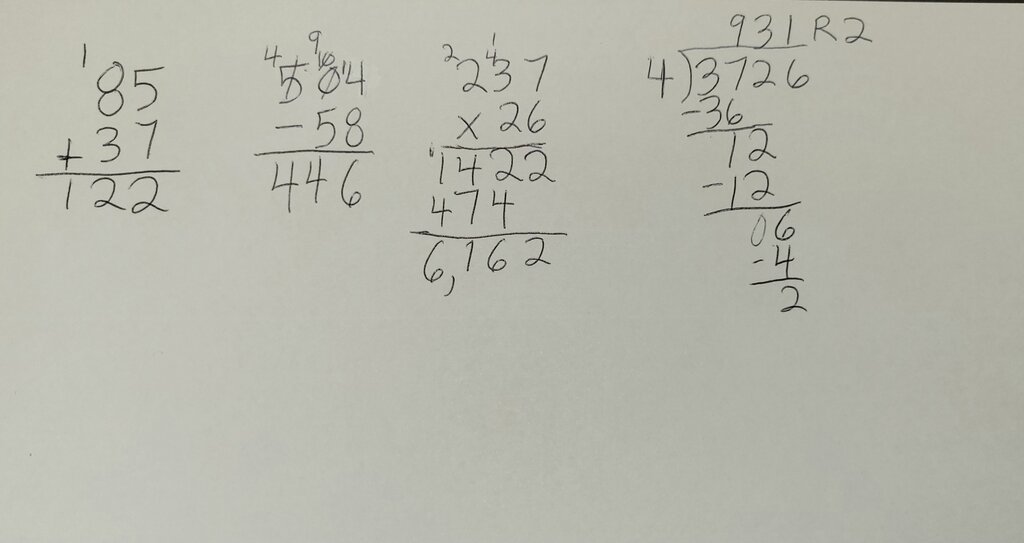
Division is the opposite of multiplication. It helps us split a quantity into equal groups. For big numbers, we use a process called long division. It looks complicated, but it's just a series of smaller, repeated steps: divide, multiply, subtract, and bring down the next digit.
Let's say you want to divide 472 by 3. You'd ask: How many times does 3 go into 4? Then into 17? Then into 22? Each step breaks the big problem into a manageable piece.
Close Enough Is Good Enough
Sometimes you don't need an exact answer. You just need a general idea. That's where estimation and rounding come in handy. Rounding makes numbers simpler to work with.
To round a number, you look at the digit to the right of the place you're rounding to. If that digit is 5 or greater, you round up. If it's 4 or less, you round down.
For instance, if a company sold 18,724 cars, you might round that to the nearest thousand. You look at the hundreds digit, which is 7. Since 7 is 5 or greater, you round up to 19,000. It's an easy way to talk about the number without getting lost in the details.
| Original Number | Round to Nearest Ten | Round to Nearest Hundred | Round to Nearest Thousand |
|---|---|---|---|
| 4,827 | 4,830 | 4,800 | 5,000 |
| 12,391 | 12,390 | 12,400 | 12,000 |
| 9,555 | 9,560 | 9,600 | 10,000 |
Estimation uses rounded numbers to get a quick, approximate answer. Before solving 592 x 48, you could estimate by calculating 600 x 50. The answer is 30,000. This tells you your exact answer should be somewhere around that value, which is a great way to check if your final calculation is reasonable.
Ready to put these skills to the test?
In the number 842,193, what is the value of the digit 4?
What is the sum of 5,289 and 3,417?
Mastering these core operations with whole numbers is the key to unlocking more advanced math. They are the tools you'll use again and again.