Grade 11 & 12 Physics Essentials
Kinematics
Describing Motion
Kinematics is the study of how things move. It's a bit like being a sportscaster doing a play-by-play. We're focused on describing the action—where an object is, how fast it's going, and what direction it's headed—without getting into the why. The forces causing the motion can wait for later. For now, we're just the observers.
To start, we need to be clear about two fundamental ideas: distance and displacement. They might sound like the same thing, but in physics, they're quite different.
Distance is the total length of the path you travel. If you walk 5 meters east and then 5 meters west, you've walked a total distance of 10 meters.
Displacement is the straight-line change in your position from start to finish. In that same walk, because you ended up exactly where you started, your displacement is zero.
Think of it this way: your phone's fitness tracker measures the distance you've covered to count your steps. But if you want to give someone directions, you tell them your displacement—how to get from point A to point B. Distance is a simple number (a scalar), while displacement has both a size and a direction (a vector).
Speed vs. Velocity
Just as we distinguished between distance and displacement, we must do the same for speed and velocity. Speed is how fast you're going. A car's speedometer tells you your speed. Like distance, speed is a scalar—it's just a number.
Velocity
noun
The rate at which an object changes its position.
Velocity, on the other hand, is speed in a specific direction. It’s a vector. Saying a storm is moving at 20 miles per hour tells you its speed. Saying it's moving at 20 miles per hour northeast tells you its velocity. That extra piece of information—the direction—is often critical.
Average velocity is calculated by dividing the displacement by the time it took to travel.
Here, is average velocity, is displacement (change in position), and is the change in time.
Speeding Up and Slowing Down
When velocity changes, we call it acceleration. We often think of acceleration as just speeding up, but in physics, it's more than that. Since velocity includes direction, you are accelerating if you:
- Speed up
- Slow down (this is often called deceleration)
- Change direction
A car turning a corner at a constant speed is accelerating because its direction is changing. Average acceleration is the change in velocity over a period of time.
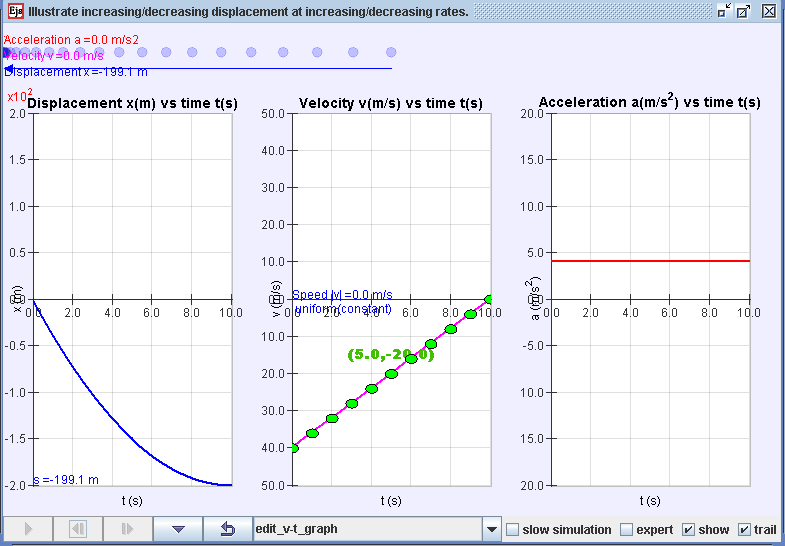
Just like velocity, acceleration is a vector. It has both a size (magnitude) and a direction. The relationship between displacement, velocity, and acceleration can be visualized with graphs. For an object with constant acceleration, the velocity graph is a straight line, and the displacement graph is a curve.
The Equations of Motion
When an object moves with constant acceleration, we don't need to guess about its motion. A set of simple but powerful equations, known as the kinematic equations, can tell us everything we need to know. They relate the five key variables: displacement (), initial velocity (), final velocity (), acceleration (), and time ().
If you know any three of these variables, you can use these equations to find the other two. They are the essential toolkit for solving problems about motion.
Here are the main equations for motion with constant acceleration:
Let's use them. Imagine a train starting from rest () that accelerates at a constant rate of . How fast is it going after 10 seconds?
We know , , and . We want to find . The first equation is perfect for this.
After 10 seconds, the train is moving at 20 meters per second.
Motion in Two Dimensions
Of course, objects don't always move in a straight line. They fly through the air, turn corners, and follow curved paths. The key to analyzing this more complex motion is to break it down. We can treat the horizontal (x-axis) and vertical (y-axis) components of motion completely independently of each other.
The classic example of this is projectile motion.
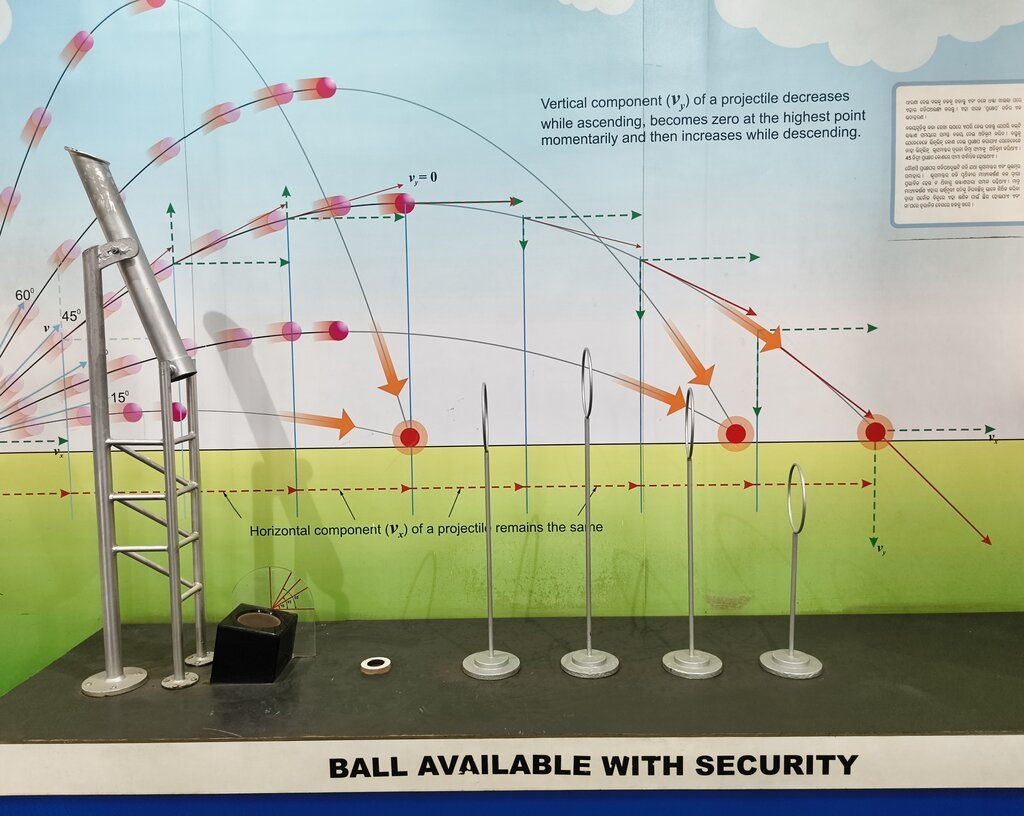
When you throw a ball, its motion has two parts. Horizontally, it travels at a mostly constant velocity (if we ignore air resistance). Vertically, it is constantly accelerated downward by gravity. Gravity pulls it down, but nothing is pushing it sideways.
By analyzing the horizontal and vertical parts of its journey separately using the kinematic equations, we can predict its path, or trajectory, with great accuracy. For the vertical part, the acceleration is the acceleration due to gravity, , which is approximately downwards. For the horizontal part, the acceleration is zero.
| Motion Component | Acceleration | Velocity |
|---|---|---|
| Horizontal (x) | Constant () | |
| Vertical (y) | Changes () |
This powerful idea—of breaking down complex problems into simpler, perpendicular parts—is a theme you'll see again and again in physics. It all starts here, with describing the simple flight of a ball.