GPU Kernel Execution Mechanics
Kernel Dispatch Mechanics
The Host-Device Handshake
When you launch a kernel, you're not directly telling the GPU's cores to start running code. Instead, you're initiating a sophisticated handoff between the host (CPU) and the device (GPU). The CPU's primary role is to package the work order. This is done through the GPU driver, which translates your high-level kernel launch call—like one from CUDA or OpenCL—into a low-level set of instructions.
These instructions are bundled into a , a specific block of memory. This buffer is the official work order. It contains pointers to the compiled kernel code (the device-side executable), the kernel's arguments, the grid and block dimensions that define the scale of parallelism, and any synchronization primitives needed. The host queues this command buffer into a command stream, and this is where the CPU's direct involvement ends for this specific task. The GPU is now on its own.
Hardware Takes the Wheel
Once the command buffer is sent to the GPU, a dedicated piece of hardware takes over. This is the (CP), sometimes called the Frontend. The CP's job is to read the command buffers from the stream, parse the low-level commands, and prepare the GPU for execution. It's the gatekeeper that manages the flow of work for the entire chip.
For a kernel launch, the CP forwards the grid specifications to the (GMU). The GMU is responsible for the high-level scheduling of the entire grid of thread blocks. It understands the full scope of the requested work—for example, a grid of 1,000,000 thread blocks—and begins the process of assigning those blocks to the available compute resources. The GMU doesn't manage individual threads; it manages the blocks they are grouped into.
The GMU's primary task is to dispatch thread blocks to the various Streaming Multiprocessors (SMs) on the chip. It doesn't just assign them in a round-robin fashion. Instead, the GMU performs resource-based scheduling. It checks the resource requirements of a thread block—how many registers it needs, how much shared memory it will use—against the available resources on each SM. An SM with free resources is a candidate to receive a new block. This ensures that blocks are sent to SMs that can actually run them, maximizing hardware occupancy and preventing stalls.
This resource-based logic is why a kernel's performance can be highly sensitive to its register usage or shared memory footprint. Exceeding an SM's limits, even slightly, can dramatically reduce the number of blocks that can run concurrently.
Hardware Context Switching
On modern GPUs, this entire dispatch process happens with hardware-level preemption and context switching. If a high-priority task arrives (like rendering the OS user interface), the GMU and CP can pause the execution of a running kernel. The hardware saves the execution state of the active thread blocks—their program counters, register values, and shared memory contents.
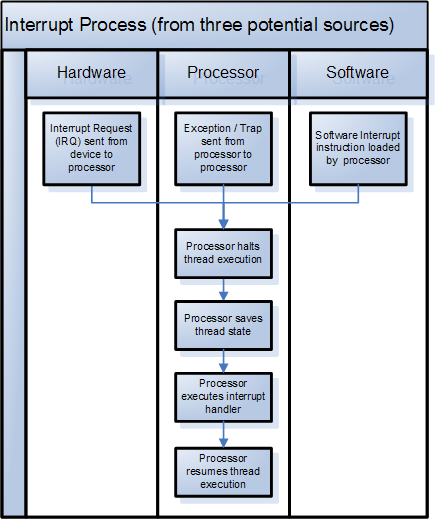
Once the high-priority task is complete, the hardware can restore the saved state and resume the preempted kernel exactly where it left off. This context switching is much faster than traditional CPU-based context switching because it's managed by dedicated silicon. This capability is crucial for systems where a single GPU is shared between compute tasks and graphical rendering, ensuring the user experience remains smooth even when the GPU is under heavy load.
Let's check your understanding of the concepts we've covered.
What is the primary role of the CPU (the host) when launching a GPU kernel?
Which piece of dedicated GPU hardware is the first to handle a work order, reading command buffers from the stream and parsing the commands?
Understanding how work is assigned and managed at the hardware level is key to writing high-performance code that fully utilizes the GPU's parallel architecture.