GPS Clock Synchronization Explained
Introduction to GPS Timekeeping
Time Is Everything
To find your location, a GPS receiver needs to know its distance from several satellites orbiting Earth. The fundamental principle for measuring that distance is simple. It all comes down to a basic formula you might remember from school:
GPS satellites send out radio signals, which travel at the speed of light, a constant and known value. Your GPS receiver picks up these signals. If your receiver knows exactly how long a signal took to travel from the satellite to you, it can calculate the distance.
This means that to get an accurate distance, you need incredibly precise time measurement. A tiny error in timing, even just a millionth of a second, could throw off a location calculation by hundreds of meters. For GPS to work, it needs clocks that are almost unimaginably accurate.
Clocks in the Sky
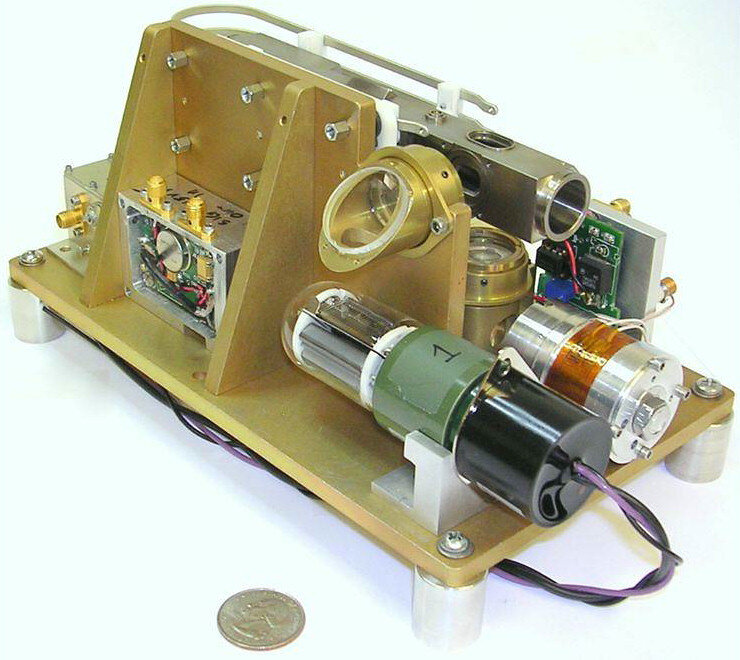
Each GPS satellite is essentially a flying clock. But these aren't your average digital or analog timepieces. They are atomic clocks, the most precise timekeeping devices ever created. Instead of relying on a swinging pendulum or a vibrating quartz crystal, an atomic clock measures time based on the consistent, predictable vibrations of atoms, typically cesium or rubidium.
How accurate are they? An atomic clock might lose or gain only a single second over millions of years. This extraordinary stability is the key to the entire GPS system. To ensure reliability and have backups, each satellite carries multiple atomic clocks on board.
GPS Time
With dozens of ultra-precise clocks orbiting the planet, they all need to be perfectly synchronized. This is achieved through a unified time standard known as GPS Time. It's the master clock for the whole system, maintained by the U.S. Naval Observatory.
GPS Time is a continuous timescale. It began at midnight on January 6, 1980, and has been counting forward ever since. Unlike Coordinated Universal Time (UTC), the time standard we use in daily life, GPS Time does not add leap seconds to stay aligned with the Earth's slowing rotation. As a result, GPS Time is currently ahead of UTC by 18 seconds. This difference is broadcast by the satellites, allowing your phone or car to convert GPS Time into the local time you're used to seeing.
Precise timing is crucial for accurate GPS positioning.
Your receiver determines its location by measuring the travel time of signals from at least four different satellites. The receiver listens for a signal that essentially says, "This message was sent at time T1." The receiver notes when it received the message, at its own time, T2. The difference, T2 - T1, is the signal's travel time.
Multiplying this travel time by the speed of light gives the distance to that one satellite. By repeating this process with signals from other satellites, the receiver can pinpoint its exact location on Earth through a process called trilateration. Without the stability of atomic clocks and the uniformity of GPS Time, none of this would be possible.
Ready to check your understanding of GPS timekeeping?
What type of clock is used in GPS satellites to ensure the high precision needed for accurate location services?
A GPS receiver calculates its distance from a satellite by multiplying the signal's travel time by what constant value?
In the next section, we'll look at how your receiver deals with its own, much less accurate, internal clock.