GP Rating: GSK and MEK Essentials
Ship Types and Anatomy
Designed for a Purpose
Every ship is a solution to a problem. Its design, from the curve of its hull to the layout of its decks, is dictated by its mission. We can broadly classify ships into three main categories based on what they do: cargo carriers, passenger vessels, and service vessels.
A ship's purpose defines its form. A tanker designed to carry crude oil will have a fundamentally different structure from a cruise ship built for a thousand passengers.
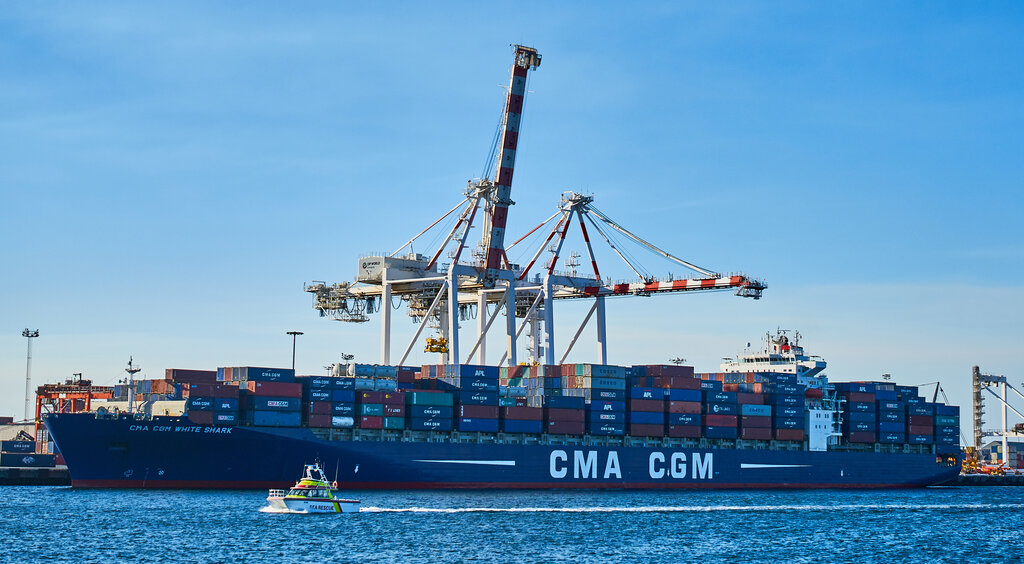
Cargo ships are the workhorses of global trade. They include bulk carriers, which transport loose cargo like grain or ore in vast holds; tankers, designed with specialised tanks for liquids like oil and chemicals; and container ships, which carry standardised boxes, enabling fast loading and unloading. Each design maximises efficiency for its specific cargo type.
Passenger vessels, on the other hand, prioritise people. Ferries are built for short, functional trips, while cruise ships are floating resorts, their superstructures packed with cabins, restaurants, and entertainment venues. Their design must balance comfort and amenities with safety and stability.
Then there are service vessels, the specialists of the maritime world. This category includes everything from powerful tugboats that guide larger ships in port to offshore supply vessels that support oil rigs and wind farms. Their designs are highly specialised for their unique, often demanding, tasks.
The Blueprint of a Ship
Beyond its type, a ship is defined by its principal dimensions. These numbers aren't just for specifications; they dictate where a ship can go, how much it can carry, and how it behaves in the water.
| Dimension | Abbreviation | Significance |
|---|---|---|
| Length Overall | LOA | The maximum length of the vessel. Crucial for determining if a ship can fit into a specific dock or lock. |
| Length Between Perpendiculars | LBP | The length at the waterline. Used in naval architecture calculations for buoyancy and hydrodynamics. |
| Breadth (Beam) | B | The ship's widest point. A key factor in stability and access to narrow channels like the Panama Canal's locks. |
| Depth | D | The vertical distance from the keel to the main deck. It determines the hull's volume and structural strength. |
| Draught (Draft) | T | The vertical distance from the waterline to the keel. It indicates how deep the ship sits in the water and is critical for navigating shallow areas. |
These dimensions are all interconnected. A ship with a large breadth will be more stable but might be too wide for certain ports. A deep draught allows for more cargo but restricts the ship to deeper waters. Naval architects must balance these trade-offs to create a vessel that is both effective and profitable.
The Skeleton and Skin
A ship's strength comes from its internal structure, much like a skeleton. The foundation of this structure is the hull, which provides buoyancy and protects the interior from the sea. Running along the very bottom of the hull is the keel, which can be thought of as the ship's spine.
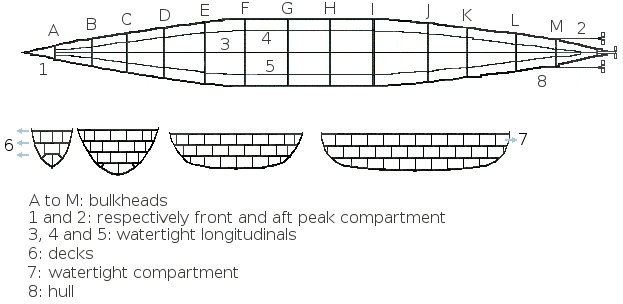
Attached to the keel are frames, the ribs of the ship, which give the hull its shape and transverse strength. Spaced throughout the hull are bulkheads, which are vertical steel walls. These walls divide the ship into watertight compartments, a critical safety feature that can prevent a single hull breach from flooding the entire vessel.
Decks are the horizontal surfaces that form the floors of a ship. They divide the vessel vertically and add longitudinal strength. Above the main deck is the superstructure, which houses the bridge, crew accommodation, and other essential spaces. The hull and superstructure are typically built from high-tensile steel, chosen for its strength and resistance to the harsh marine environment. However, modern shipbuilders are increasingly using aluminium and composite materials, especially in superstructures, to reduce weight and improve fuel efficiency.
Functional Spaces
Within this structure are the ship's functional areas. The purpose of the ship dictates the size and layout of these spaces.
In a cargo ship, the majority of the hull is dedicated to cargo holds or tanks. The engine room is usually located in the aft section and contains the main propulsion machinery and power generators. Above it all sits the bridge, the nerve centre of the ship, from which the Captain and officers navigate and control the vessel. Finally, the accommodation block provides living quarters for the crew. The careful arrangement of these areas is essential for the ship's operational efficiency and the safety and well-being of those on board.
Let's test your understanding of these core concepts.
A naval architect designs a ship with a very wide breadth. What is a primary advantage of this design choice?
Which structural component of a ship is analogous to a human's spine, running along the very bottom of the hull?
Understanding a ship's anatomy is the first step toward mastering its operation. Each component, from the keel to the bridge, plays a vital role in its mission at sea.