Google Vendor Enablement Program Management
Program Management Fundamentals
Beyond a Single Project
Imagine you're building a house. That's a project. It has a clear start, a defined end, and a specific outcome: one house. Now, imagine you're building an entire neighborhood. That's a program. It involves multiple, related projects—building houses, paving roads, installing utilities, landscaping parks—that all need to work together to achieve a larger, strategic goal.
Program management is the art of coordinating these related projects to deliver benefits that wouldn't be possible if the projects were managed separately. It’s about seeing the forest, not just the individual trees. While a project manager focuses on completing a specific project on time and within budget, a program manager focuses on the long-term value and strategic alignment of the entire program.
Program
noun
A group of related projects, subprograms, and program activities that are managed in a coordinated way to obtain benefits not available from managing them individually.
The Program Manager’s Role
A program manager is like the conductor of an orchestra. Each musician (or project team) might be an expert on their instrument, but the conductor ensures they all play in harmony to create a beautiful symphony. They are responsible for the big picture, guiding multiple project teams and ensuring their combined efforts align with the organization's overarching goals.
Key responsibilities fall into three main areas:
-
Strategic Alignment: The program manager constantly checks that the program and its projects are contributing to the company's strategic objectives. If the company's goal is to become an industry leader in sustainability, a program to develop eco-friendly products is strategically aligned. The manager ensures every project within that program serves this larger purpose.
-
Stakeholder Engagement: Programs involve many stakeholders: executive sponsors, project teams, customers, and suppliers. The program manager is the central point of communication, managing expectations, securing resources, and ensuring everyone stays informed and engaged. They need to speak the language of both the boardroom and the project team.
-
Risk Management: What could go wrong? A program manager's job is to ask this question constantly. They identify potential risks across all projects—a delayed supply chain, a new competitor, a change in technology—and develop plans to mitigate them before they derail the entire program. This is about proactive problem-solving on a large scale.
A project is focused on outputs (the 'what'), while a program is focused on outcomes (the 'why').
The Program Lifecycle
Just like a project, a program follows a lifecycle, but it operates at a higher level. The phases are less about specific tasks and more about governing the projects within the program to deliver value over time.
During the Delivery phase, individual projects are initiated, planned, and executed. The program manager doesn't manage the day-to-day tasks of each project. Instead, they provide oversight, coordinate shared resources, and ensure that the benefits—the real value the program is supposed to deliver—are being realized and measured.
Ways of Working
How do program managers and their teams get the work done? Two popular methodologies guide the process: Waterfall and Agile. They represent different philosophies for tackling complex work.
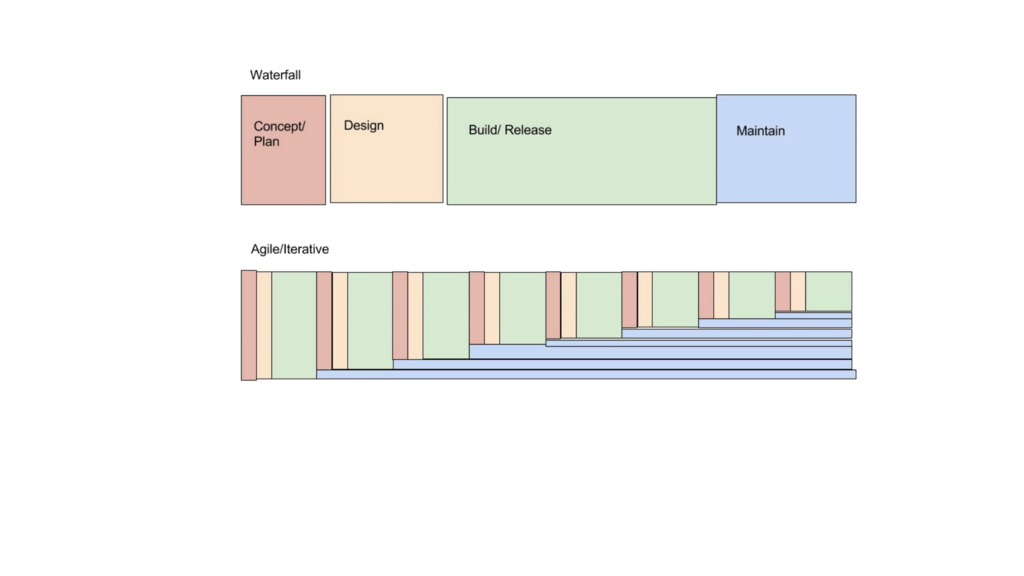
The Waterfall method is traditional and sequential. You complete one phase entirely before moving to the next, like a waterfall flowing over a cliff edge. You gather all requirements, then design the entire solution, then build it, then test it. It’s very structured and works well when the end goal is clearly understood from the start and unlikely to change, like in construction or manufacturing.
Agile, on the other hand, is iterative and flexible. Work is broken down into small, manageable cycles called sprints. At the end of each sprint, the team delivers a working piece of the product. This allows for constant feedback and adaptation. Agile is ideal for projects where requirements are expected to evolve, such as software development or research and development initiatives.
A program can even use a hybrid approach, where some projects follow a Waterfall model while others use Agile, depending on their specific needs. The program manager's job is to ensure these different methodologies can coexist and contribute to the program's overall success.
Now let's review some of the key ideas we've covered.
Ready to test your knowledge?
Which statement best distinguishes a program from a project?
A program manager's primary focus is on:
Understanding these fundamentals—the role, the lifecycle, and the methodologies—is the first step toward successfully navigating the complexities of program management.