Glycolysis The First Step of Energy
Introduction to Glycolysis
Splitting Sugar for Energy
Every living cell needs energy to function, and the most common fuel source is a simple sugar called glucose. But how does a cell actually use a glucose molecule? It can't just burn it like a log. Instead, it has to carefully break it down in a series of chemical reactions to release the energy stored inside. The very first step of this process is called glycolysis.
Glycolysis is the breakdown of a molecule of glucose into two molecules of pyruvate and free energy.
The name itself gives a clue: "glyco" comes from the Greek word for sweet (referring to sugar), and "lysis" means to split. So, glycolysis is literally "sugar splitting." In this pathway, a single six-carbon glucose molecule is split into two smaller, three-carbon molecules called pyruvate.
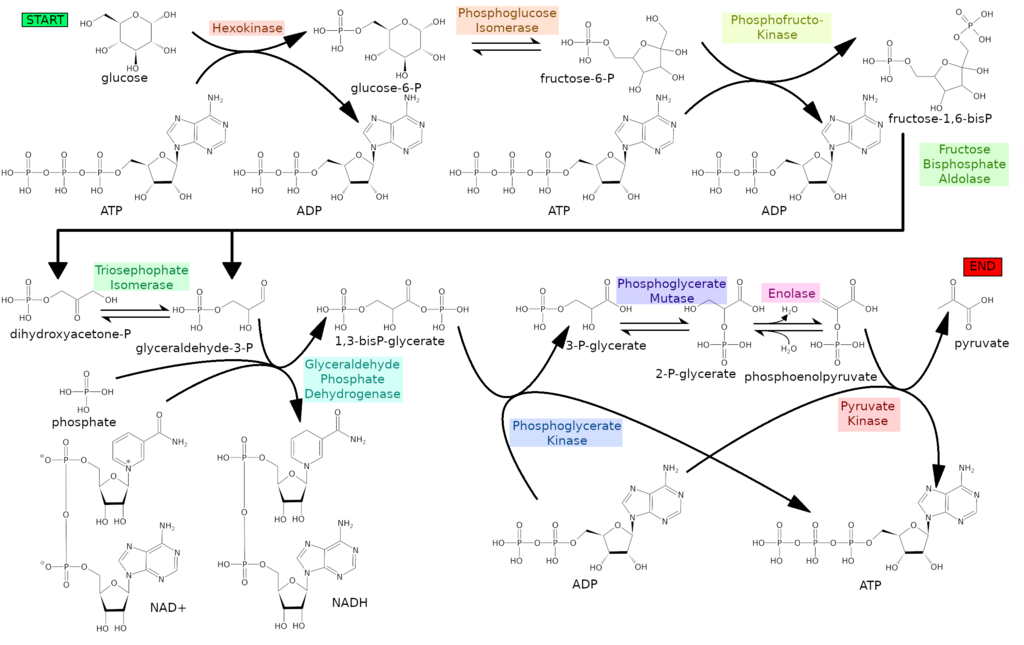
This process doesn't happen just anywhere in the cell. It takes place in the cytoplasm, the jelly-like substance that fills the cell. This is significant because it means glycolysis can occur in virtually all forms of life, including simple organisms that lack complex internal structures like mitochondria. Furthermore, glycolysis is an anaerobic process, which means it doesn't require oxygen to work. This makes it a fundamental energy-producing pathway for organisms living in oxygen-poor environments and for our own muscle cells during intense exercise.
Investment and Payoff
You have to spend money to make money, and the same principle applies to energy in the cell. Glycolysis is divided into two main phases: an initial investment phase and a subsequent payoff phase.
Think of glycolysis like starting a small business. First, you invest some startup capital. Then, if all goes well, you start earning a profit.
1. The Energy Investment Phase: In the first few steps, the cell actually spends energy. Two molecules of ATP, the cell's main energy currency, are used to modify the glucose molecule. This makes it unstable and ready to be split apart. This initial investment prepares the glucose for the energy-releasing steps to come.
2. The Energy Payoff Phase: Once the six-carbon sugar is split into two three-carbon molecules, the process starts to pay dividends. In this second half, a series of reactions extracts energy, generating a total of four ATP molecules and two molecules of NADH, another important energy-carrying molecule.
| Phase | Starting Molecule | ATP Used | ATP Produced | Net ATP Gain |
|---|---|---|---|---|
| Investment | 1 Glucose | 2 ATP | 0 ATP | -2 ATP |
| Payoff | 2 G3P molecules | 0 ATP | 4 ATP | +4 ATP |
| Overall | 1 Glucose | 2 ATP | 4 ATP | +2 ATP |
After subtracting the initial investment of two ATP from the four ATP produced, the cell is left with a net gain of two ATP molecules for every molecule of glucose that undergoes glycolysis. While this might not seem like a huge amount of energy, it's a quick and reliable source that's crucial for cellular function. The two pyruvate molecules and two NADH molecules produced can then move on to other metabolic pathways to generate even more energy, but that's a story for another time.
Ready to check your understanding of these core ideas?
What is the literal meaning of the term "glycolysis"?
Where in the cell does glycolysis take place?