Glycogen Metabolism and Regulation
Glycogen Structure
Glycogen's Smart Design
Think of glycogen as your body's emergency stash of energy, neatly packed away for when you need it most. It's a large, branched polymer made entirely of glucose units. Unlike a simple string of beads, glycogen's structure is complex and highly efficient, designed for rapid storage and release.
At the very heart of every glycogen molecule is a special protein called glycogenin. This protein doesn't just sit there; it kicks off the whole process. Glycogenin acts as a primer, attaching the first few glucose units to itself to start building the molecule. From this protein core, the glycogen particle grows outwards in layers, like a tree growing branches in every direction.
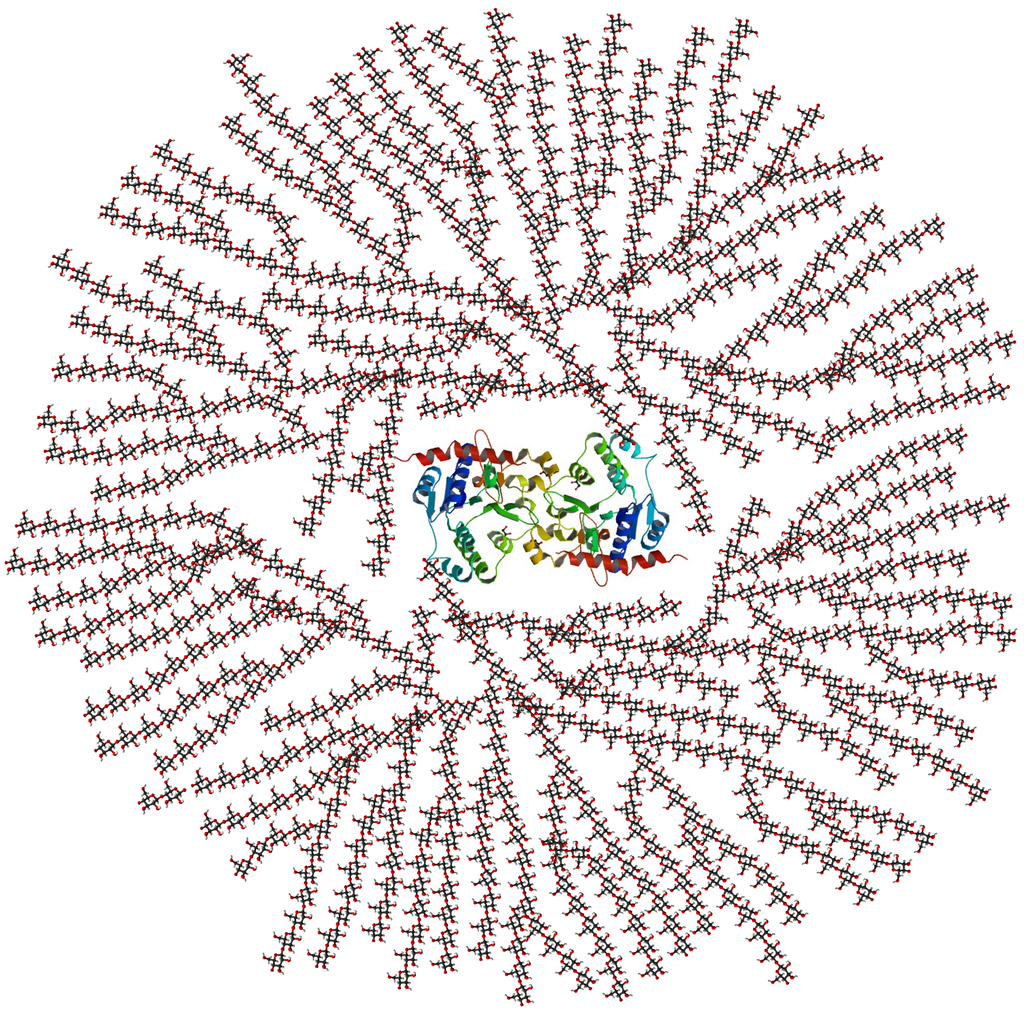
The glucose units are linked together in two different ways. The main, linear chains are formed by alpha-1,4 glycosidic bonds. This means the first carbon atom of one glucose molecule connects to the fourth carbon atom of the next one.
But if glycogen were just a long, straight chain, it would be slow to access. This is where branching comes in. About every 8 to 12 glucose units, a branch point is created by an alpha-1,6 glycosidic bond. This bond links the first carbon of a glucose molecule to the sixth carbon of a glucose unit in the main chain, starting a new branch.
This extensive branching is glycogen's secret weapon. Each branch ends with a chemically reactive site called a non-reducing end. Because there are so many branches, there are thousands of these ends on the surface of a single glycogen molecule. When your body needs a quick burst of energy, enzymes can work on all these ends simultaneously, rapidly breaking off glucose molecules for use. This multi-threaded approach to breakdown is far faster than if enzymes had to nibble away at one end of a single long chain.
Location, Location, Location
While glycogen is found in most tissues, the two main storage depots are the liver and skeletal muscles. However, the glycogen in each location serves a very different purpose.
| Feature | Liver Glycogen | Muscle Glycogen |
|---|---|---|
| Primary Role | Maintain blood glucose | Provide fuel for muscle contraction |
| Total Storage | ~100 grams (up to 10% of liver weight) | ~400 grams (1-2% of muscle weight) |
| Regulation | Responds to glucagon and insulin | Responds primarily to epinephrine and insulin |
| Glucose Release | Can release free glucose into the bloodstream | Glucose-6-phosphate is trapped and used only by the muscle cell |
Liver glycogen acts as a generous community bank, releasing glucose into the bloodstream to keep levels stable for the entire body, especially the brain. When your blood sugar drops, the liver breaks down its glycogen stores to share with everyone.
Muscle glycogen is more like a personal power bank. The glucose released from it is used exclusively by the muscle cell it's stored in. It provides the immediate, high-octane fuel needed for intense exercise. A muscle cell will not share its glycogen with the rest of the body, no matter how low blood sugar gets.
This carefully designed structure and strategic storage system make glycogen an indispensable part of our metabolism. Its architecture is perfectly suited for its job: providing a dense, yet readily accessible, source of glucose to power our bodies.
What is the primary structural feature of glycogen that allows for its rapid breakdown into glucose?
The main role of liver glycogen is to provide energy exclusively for the liver cells.