Global Wind Systems Dynamics
Coriolis Force Dynamics
The Planet's Gentle Nudge
If air simply moved from high to low pressure, winds would blow in straight lines. But they don't. Anyone looking at a weather map sees swirling cyclones and curved wind patterns. This deflection is caused by the Earth's rotation. As our planet spins, it imparts a 'nudge' to any object moving over long distances, including vast air masses. This apparent force is known as the Coriolis effect and it is fundamental to understanding global weather.
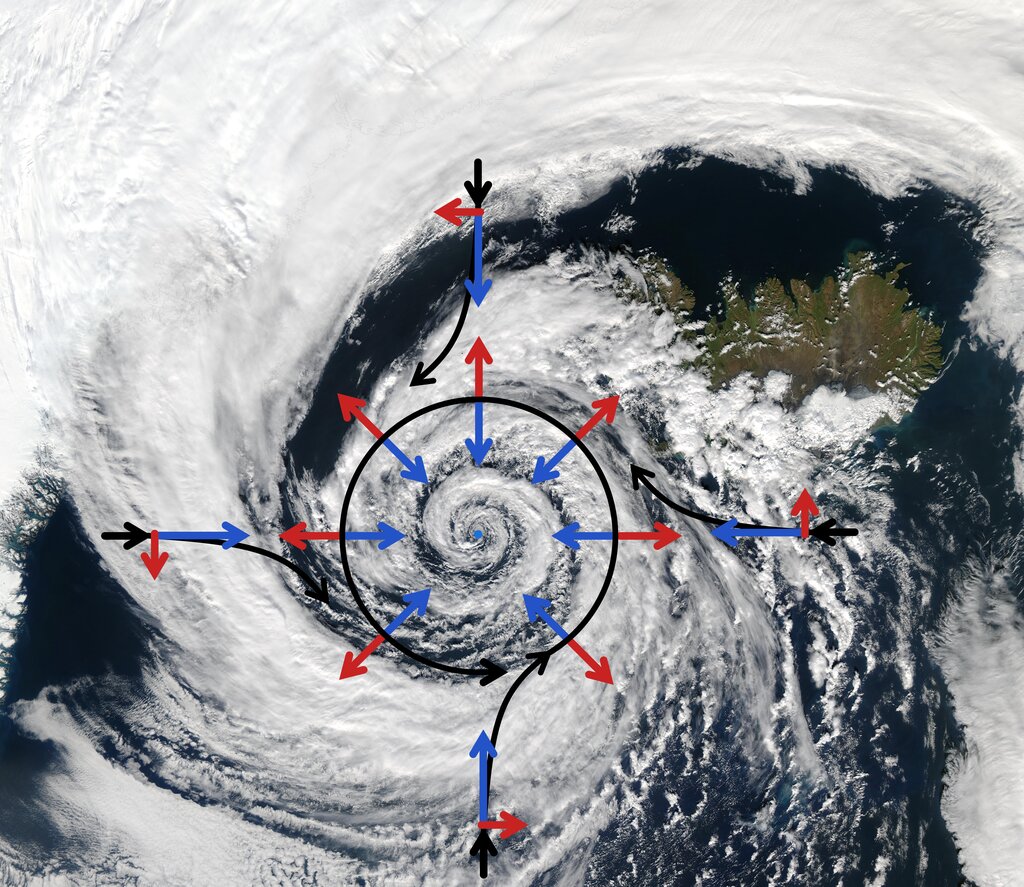
The rule is simple but powerful. In the Northern Hemisphere, moving objects are deflected to the right. In the Southern Hemisphere, they are deflected to the left. Imagine standing on a spinning merry-go-round and trying to roll a ball to someone on the opposite side. From your perspective, the ball would appear to curve away from its intended target. The ball is moving in a straight line, but the surface beneath it is rotating. Earth's atmosphere behaves in the same way. A pocket of air moving from the North Pole toward the equator will drift westward, to its right, because the ground beneath it is moving eastward at an ever-increasing speed.
Where You Stand Matters
The strength of the Coriolis effect is not uniform across the globe. It is strongest at the poles and diminishes to zero at the equator. This is because the rotational speed of the Earth's surface changes with latitude. A person standing on the equator is moving at roughly 1,670 kilometres per hour, while someone at the poles is essentially just spinning in place. An object moving from a slower-moving latitude to a faster-moving one will seem to lag behind, causing the curve. The French scientist was the first to mathematically describe this phenomenon in 1835.
This latitude dependence can be expressed mathematically. The magnitude of the Coriolis force () on an air parcel is given by:
This is why hurricanes and cyclones almost never form within about 5 degrees of the equator. Without a significant Coriolis force to initiate the spinning motion, the storm systems can't organize themselves.
A Balancing Act
So, if the Coriolis force is always pushing winds sideways, why don't they just spiral outwards forever? Because another force is at play: the pressure gradient force, which pushes air from high-pressure to low-pressure areas. Far above the ground, where friction is negligible, these two forces often reach a state of balance. The pressure gradient force tries to push air directly towards a low-pressure center, while the Coriolis force deflects it to the right (in the Northern Hemisphere). The result is a wind that flows parallel to the isobars (lines of equal pressure), a condition known as geostrophic balance or geostrophic flow. This balance is what creates the large, organized wind patterns that define our weather systems.
This balance is rooted in the conservation of angular momentum. As an air parcel moves closer to the poles, its distance from the Earth's axis of rotation decreases. To conserve angular momentum, its speed must increase, just as an ice skater spins faster when they pull their arms in. This change in speed, relative to the ground, is what we perceive as the Coriolis deflection. It's not a mysterious force, but a direct result of moving on a spinning sphere.
Understanding this planetary nudge is the key to moving beyond simple high-and-low pressure systems and seeing how the Earth's rotation orchestrates the grand dance of global winds.