Global Religious Demographics
Introduction to World Religions
A Tour of World Faiths
Roughly 85% of people on Earth identify with a religion. These belief systems shape cultures, guide moral choices, and offer answers to life's biggest questions. While countless faiths exist, a few have grown to influence billions of lives across the globe. Let's explore five of the most prominent: Judaism, Christianity, Islam, Hinduism, and Buddhism.
The Abrahamic Faiths
Three of the world's major religions trace their spiritual lineage to a single figure: Abraham. Judaism, Christianity, and Islam are all monotheistic, meaning they share a belief in one God. They see this God as the creator of the universe and a being who communicates with humanity.
Monotheism
noun
The belief that there is only one God.
Judaism is the oldest of the three, originating in the Middle East over 3,500 years ago. Its core belief is the covenant, a special agreement between God and the Jewish people. The Torah, the first five books of the Hebrew Bible, is its most sacred text, containing foundational laws and narratives. Key practices include observing the Sabbath (a day of rest), following dietary laws (kashrut), and celebrating important holidays like Yom Kippur and Passover.
Christianity emerged from Judaism in the 1st century CE. It is centered on the life, teachings, death, and resurrection of Jesus of Nazareth, whom Christians believe is the son of God and the savior of humanity. The Christian holy book is the Bible, which includes the Hebrew Bible (called the Old Testament) and the New Testament, which details the story of Jesus and his followers. Core beliefs include the Trinity (God as Father, Son, and Holy Spirit) and salvation through faith in Jesus.
Islam arose in the 7th century CE in the Arabian Peninsula. Its followers, known as Muslims, believe that God (Allah, in Arabic) revealed his word to the prophet Muhammad. These revelations are recorded in the Qur'an, Islam's sacred text. The central belief is submission to the will of Allah. This is expressed through the Five Pillars of Islam: the declaration of faith, prayer, charity, fasting during Ramadan, and a pilgrimage to Mecca.
| Religion | Founder/Key Figure | Sacred Text(s) |
|---|---|---|
| Judaism | Abraham, Moses | Torah, Tanakh |
| Christianity | Jesus Christ | Bible (Old & New Testaments) |
| Islam | Muhammad | Qur'an |
The Dharmic Traditions
Originating on the Indian subcontinent, Hinduism and Buddhism share a common cultural and philosophical background. They are often called Dharmic traditions, referring to the concept of dharma, which can mean duty, law, or right conduct. Both also share beliefs in reincarnation and the law of karma.
Reincarnation
noun
The rebirth of a soul in a new body.
Hinduism is one of the world's oldest living religions, with roots stretching back at least 4,000 years. It has no single founder. Hindus believe in a cycle of birth, death, and rebirth called samsara. The goal is to achieve moksha, or liberation from this cycle. While Hindus worship many gods and goddesses, they are often seen as different aspects of a single, supreme reality known as Brahman. The Vedas are among the most ancient and sacred Hindu texts.
Buddhism began in the 5th century BCE with Siddhartha Gautama, a prince who became known as the Buddha, or "enlightened one." Troubled by the existence of suffering, he sought and found a path to liberation. Buddhists do not typically worship a creator god. Instead, they follow the Buddha's teachings, which are centered on the Four Noble Truths and the Eightfold Path. The ultimate goal is to achieve nirvana, an end to suffering and the cycle of rebirth.
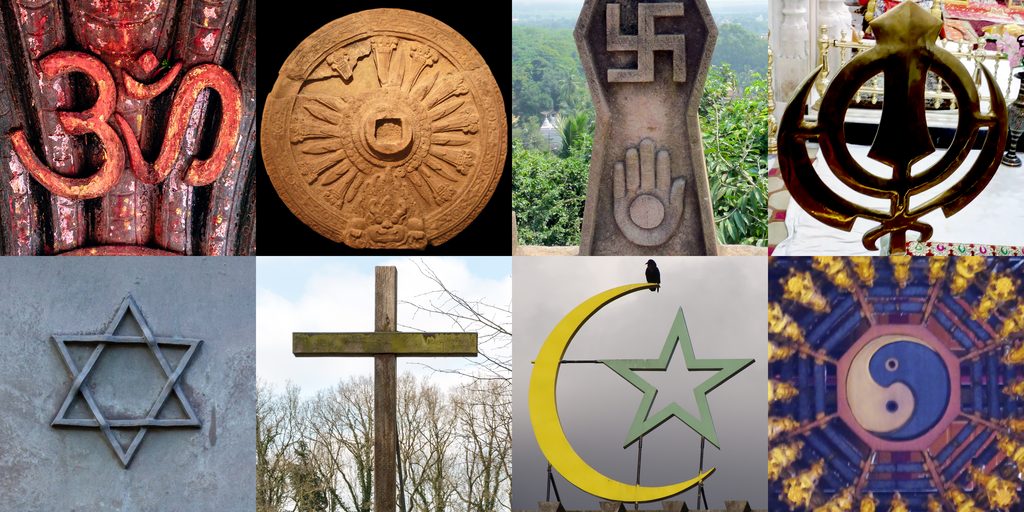
Each of these five faiths offers a unique lens through which to view the world. They have different histories, rituals, and ideas about the divine. Yet they all grapple with the same fundamental human questions of purpose, morality, and what lies beyond our daily lives.