Global Martial Arts Systems and Applications
Striking Systems Mechanics
Power From the Ground Up
A powerful strike doesn't start in the fist or the foot. It starts from the ground. Every punch, kick, elbow, or knee is the final expression of a chain reaction that travels through the body. This is often called kinetic linking, or the kinetic chain—a sequence of movements where energy is transferred from one body segment to the next.
Think of it like cracking a whip. The motion starts with a large, slow movement at the handle (your legs and hips) and accelerates as it moves down the length, culminating in a final, explosive snap at the tip (your fist or shin).
A fighter pushes off the ground, generating force. This force rotates the hips, which in turn rotates the torso. The shoulder is pulled forward, then the arm, and finally, the fist connects. Each link in the chain adds momentum and velocity, multiplying the initial force. The goal is to maximise kinetic energy upon impact.
This principle is universal across striking arts. Whether it's a boxer's cross or a karateka's reverse punch, the mechanics are the same: efficient energy transfer from the largest muscles to the smallest, fastest-moving parts.
Straight Lines and Arcs
Strikes generally follow one of two paths: linear or circular. A linear strike, like a boxer's jab or a front kick, travels in a straight line from origin to target. It's the shortest distance between two points, making it fast and efficient for setting up combinations or interrupting an opponent's attack.
A circular strike, such as a hook or a roundhouse kick, travels along an arc. This longer path takes more time to complete but allows the fighter to build up significantly more angular momentum. The rotation of the hips and torso acts like a slingshot, generating immense power that can be difficult to block because it comes from the side, outside the opponent's direct line of sight.
The trade-off is simple: speed versus power. Linear strikes are for speed and setup; circular strikes are for causing damage.
The Art of Distance
Effective striking isn't just about mechanics; it's about positioning. Every art has its own philosophy on managing distance, or range. In boxing, one of the most crucial and dangerous areas is the pocket—the close range just outside of a clinch, where fighters are close enough to land powerful hooks and uppercuts but too close to throw straight punches effectively.
Operating in the pocket requires exceptional head movement, footwork, and timing. It's a high-risk, high-reward zone. You can inflict serious damage, but you're also well within your opponent's striking range.
Muay Thai offers a different solution for close-range combat: the clinch. Instead of trading punches, a Muay Thai fighter will aim to control the opponent's head and posture by locking their hands behind their neck. From this dominant position, they can deliver powerful knees to the body and head, or create space to land short, cutting elbows.
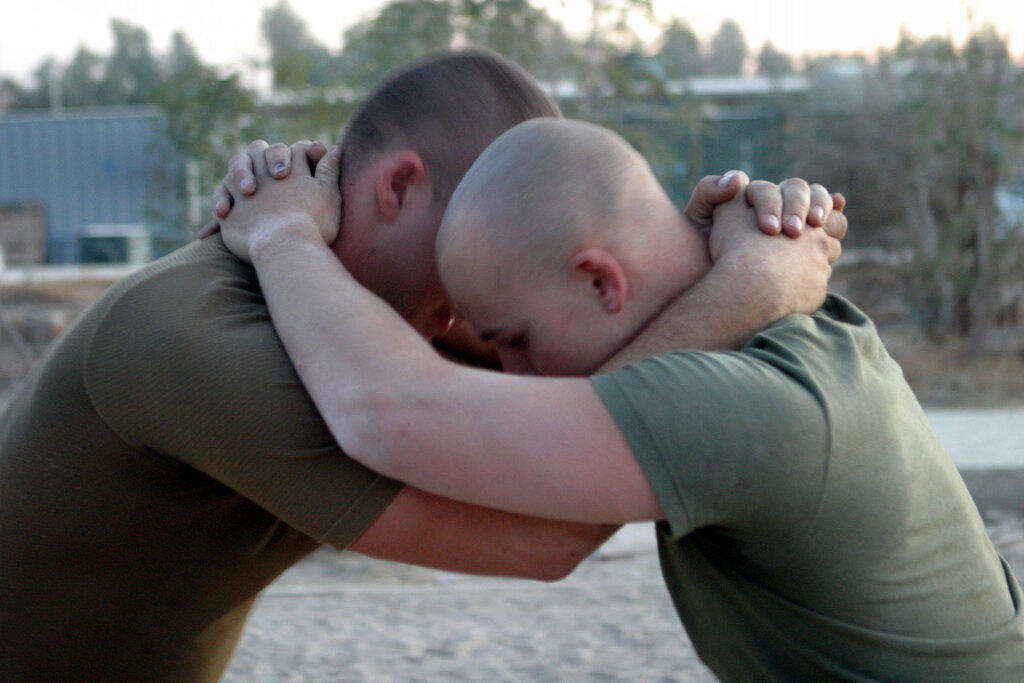
The clinch effectively neutralises a boxer's primary weapons while opening up a new arsenal of attacks. It transforms the fight from a striking exchange at a distance to a grueling battle of strength, leverage, and position up close.
Footwork Is Everything
Footwork is the engine that drives every offensive and defensive action. It governs distance, angles, and balance. In boxing, footwork is fluid and dynamic. Fighters are constantly moving, using pivots and lateral steps to create angles for attack while making themselves an elusive target. The goal is to be where your opponent isn't, allowing you to hit and not get hit.
Muay Thai footwork is typically more grounded and methodical. The stance is often squarer to allow for checking leg kicks. Instead of constant lateral movement, fighters often employ a steady forward pressure, using footwork to close distance for the clinch or to position themselves for powerful roundhouse kicks. The concept of Maai, or combative distance, is central. A fighter must intuitively understand the exact distance needed to land their techniques while staying safe from their opponent's.
The main goal of striking martial arts fighting methods is to maintain enough distance from your opponent so that you can strike them with your hands, legs, or even your head.
These different strategies highlight a core trade-off. Boxing's footwork excels at evasion and creating angles for hand strikes but can leave a fighter vulnerable to leg kicks. Muay Thai's solid base provides a powerful platform for all eight limbs but can be less mobile, making it harder to evade a high-pressure boxer.
Ultimately, the mechanics of striking systems are a study in physics and strategy. Each art offers a unique set of tools and solutions to the fundamental problem of how to hit an opponent effectively while avoiding being hit yourself.
According to the principle of the kinetic chain, where does the power for a strong punch primarily originate?
A roundhouse kick is considered a circular strike because it travels along an arc to build up more angular momentum.