Global Martial Arts Systems
Striking System Biomechanics
The Kinetic Chain in Striking
A powerful strike isn’t just about arm or leg strength. It’s a full-body symphony of movement. The secret lies in the kinetic chain — the sequence of body segments activated to transfer force from the ground, up through your body, and into your opponent. Think of it like cracking a whip. The handle moves first, but the powerful snap happens at the very tip. In striking, your feet are the handle, and your fist or shin is the tip.
Every effective strike begins with the feet pushing against the floor. This initial force travels up through the legs, is amplified by the rotation of the hips and torso, and is finally channelled through the shoulder and into the striking limb. Mastering this sequence is the difference between a weak shove and a knockout blow. The timing and coordination of this chain dictates not only the power but also the type of force generated.
Rotational vs. Linear Power
Different martial arts have refined distinct ways of using the kinetic chain. These methods generally fall into two categories: rotational and linear power generation.
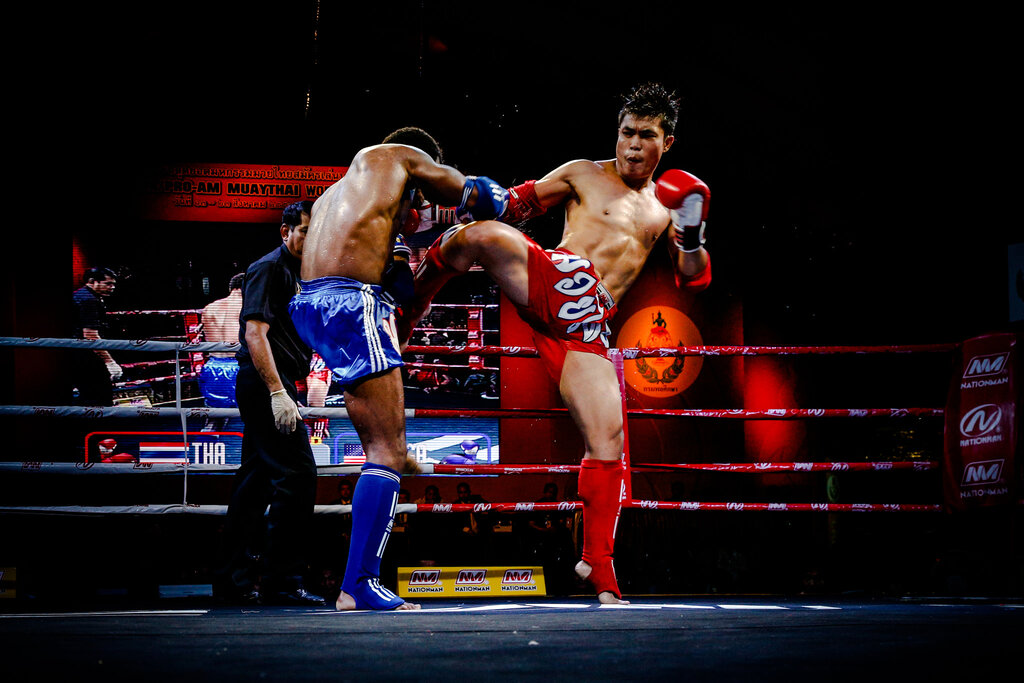
Muay Thai is a masterclass in rotational power. Consider its signature roundhouse kick. The fighter pivots on their standing foot, swinging the entire striking-side of their body as a single, unified lever. The hips and torso rotate violently, creating immense torque that culminates in the shin connecting with devastating force. It’s less of a kick and more of a full-body swing.
Karate, particularly in its traditional forms, often exemplifies linear power. The reverse punch (gyaku-zuki) is a perfect example. From a stable stance, the power drives in a straight line from the ball of the rear foot. The hip twists forward, but the energy travels a direct path through the torso and shoulder, extending the fist straight into the target. The goal is maximum velocity and penetration along a single, efficient line.
Western Boxing finds a middle ground. A jab is largely linear, but a hook or an uppercut relies heavily on rotation. For a hook, the boxer pivots on their lead foot, rotating their hips and torso to swing their arm in an arc. It combines the ground-up force of a linear strike with the torque of a rotational one, creating a powerful blow that comes from an angle.
The Art of Eight Limbs
Muay Thai is famously known as the Art of Eight Limbs because it utilises fists, elbows, knees, and shins as weapons. This isn't just about having more tools; it's about biomechanical efficiency at different ranges.
Fists and shins are long-range weapons. Elbows and knees are devastating in close quarters. Because the elbow and knee joints are closer to the body's centre of mass, they travel a shorter distance to the target. This means they can be deployed rapidly with minimal telegraphing. While the velocity might be lower than a fully extended punch or kick, the force is concentrated over a very small, hard surface area (the point of the elbow or knee), resulting in tremendous impact pressure. The physics equation for pressure is , where force () is applied over an area (). A smaller area creates much higher pressure.
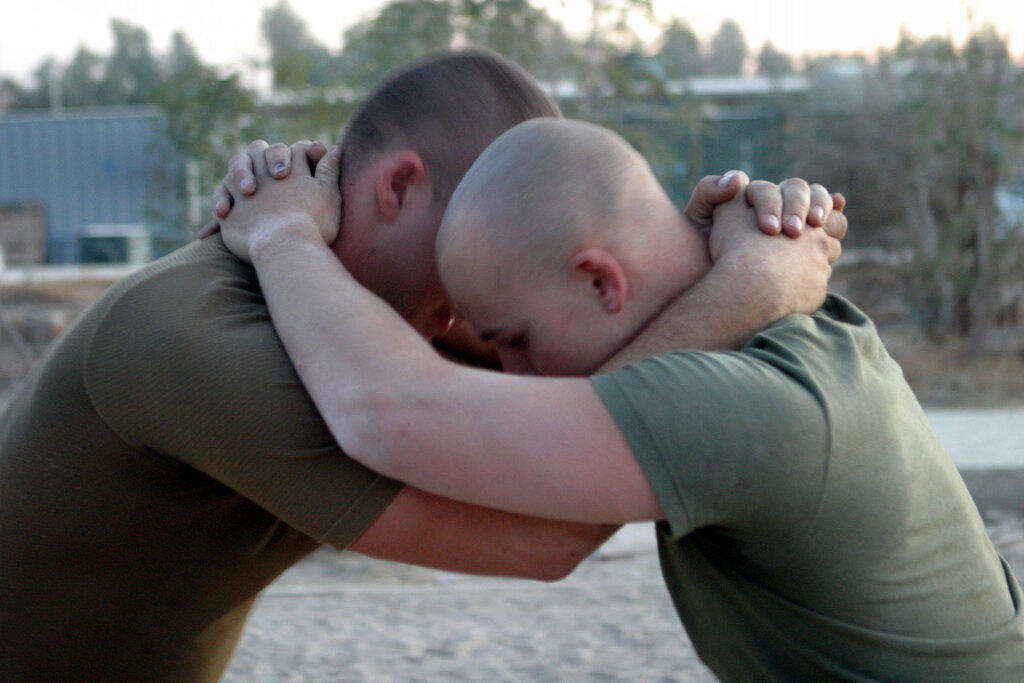
The clinch is where these close-range weapons shine. By controlling an opponent's head and posture, a Muay Thai fighter can disrupt their balance and create openings to land powerful knees to the body or head, and sharp elbows that can cause cuts. This grappling aspect turns a striking art into a close-range powerhouse.
Stances and Strategic Trade-offs
A fighter's stance is the foundation from which all offence and defence is launched. Each style's stance is a compromise, balancing mobility, stability, and defensive responsibility.
The typical Muay Thai stance is relatively square and upright, with weight distributed evenly. This posture makes it easy to lift a leg to either throw a kick or "check" an incoming low kick by raising the shin to block it. However, this square-on posture presents a larger target and offers less lateral mobility compared to a bladed stance.
A Western Boxing stance is more bladed, with the lead shoulder pointing towards the opponent. This presents a smaller target, protects the chin behind the shoulder, and facilitates quick jabs and crosses. The trade-off? It leaves the lead leg vulnerable to low kicks and makes it much harder to check them effectively. The emphasis is on head movement and footwork to evade strikes, rather than blocking with the legs.
Traditional Karate stances, like zenkutsu-dachi (front stance), are often lower and longer. This lowers the and creates a very stable platform for generating powerful linear strikes. The rooted connection to the ground is excellent for power, but it can be slow to move in and out of, making it less mobile in a dynamic, continuous fight. Modern sport Karate has adapted with lighter, more mobile stances, but the principle of a stable base remains central.
Ultimately, there is no single 'best' stance. The optimal stance depends on the rules of the sport, the opponent's style, and the fighter's own strategy. It is a constant negotiation between stability, mobility, and protection.
What is the primary function of the kinetic chain in generating a powerful strike?
Which martial art is most commonly associated with linear power generation, as seen in its traditional reverse punch (gyaku-zuki)?
That's a brief look at the fascinating biomechanics that power the world's striking arts. Each style is a unique solution to the universal problem of hitting an opponent effectively.