Global Climate Dynamics and Landscapes
Causal Drivers of Climate
The Uneven Engine
Climate isn't random. It's a direct consequence of the Earth's relationship with the sun. Because our planet is a sphere tilted on its axis, solar energy doesn't arrive evenly. The equator gets a direct, concentrated dose of sunlight, while the poles receive slanted, weaker rays. This simple fact of uneven heating is the primary engine driving all of our weather and climate patterns.
This energy imbalance creates a massive heat-transfer system. The warm, less dense air at the equator rises, creating a zone of low pressure. As it reaches the upper atmosphere, it spreads out toward the poles, cools, and eventually sinks back down around 30° latitude. This descending air creates areas of high pressure, completing a massive convection loop known as a Hadley cell. This global-scale circulation is the foundation of our planet's climate zones.
Where the rising air from the equator converges, we find the Intertropical Convergence Zone (ITCZ). This is a belt of low pressure that circles the globe, characterized by calm winds, warm temperatures, and high humidity. It's the region where the trade winds of the Northern and Southern Hemispheres meet, forcing air upward and generating towering clouds and heavy rainfall. This is why tropical rainforests are concentrated near the equator.
Conversely, the sinking air around 30° latitude creates the subtropical highs, also known as the horse latitudes . This is a zone of high atmospheric pressure, leading to calm winds and very little precipitation. The world's great deserts, like the Sahara and the Sonoran, are located under these persistent high-pressure belts. The air is sinking, not rising, which prevents cloud formation and rain.
Land vs. Water
The location of continents and oceans adds another major layer of complexity. Land and water absorb and release heat at very different rates due to differences in their specific heat capacity. Water can absorb a lot of heat without its temperature rising much, and it releases that heat slowly. Land heats up quickly and cools down quickly.
This phenomenon, called continentality, explains why coastal areas have more moderate climates than inland regions. In the summer, the ocean acts like an air conditioner, keeping coastal cities cooler. In the winter, it acts like a heater, releasing stored warmth and preventing extreme cold. An inland city at the same latitude will experience much hotter summers and colder winters.
A city on the coast might have a mild temperature range of 40-75°F year-round, while an inland city at the same latitude could swing from 0°F in winter to 100°F in summer.
This land-sea thermal contrast is the driving force behind monsoons. In the summer, massive landmasses like Asia heat up much faster than the surrounding Indian Ocean. The hot air over the land rises, creating a powerful low-pressure system that draws in moist, heavy air from the ocean. This influx of marine air results in months of torrential rain. In the winter, the pattern reverses. The land cools rapidly, creating a high-pressure system that pushes dry air out over the warmer ocean.
Oceans and Pressure Systems in Motion
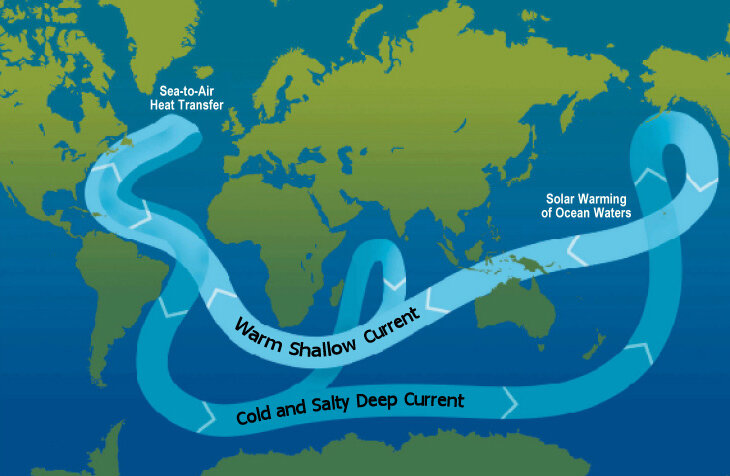
Ocean currents also act as massive thermal regulators, moving vast amounts of heat around the planet. Currents like the Gulf Stream bring warm water from the tropics far into the North Atlantic, giving Western Europe a much milder climate than its latitude would suggest. Without it, London would have a climate more like that of Siberia.
Finally, these global pressure belts aren't static. They migrate north and south with the seasons, following the sun's most direct rays. This seasonal shift is why certain climates are confined to specific geographic locations. Mediterranean climates, for instance, are found on the western edges of continents around 30-45° latitude. In the summer, the subtropical high-pressure belt shifts over these regions, bringing dry, clear weather. In the winter, the belt moves toward the equator, allowing the wetter, stormier westerlies to move in and bring rain.
A similar dynamic creates the Marine West Coast climate. Located poleward of Mediterranean climates, these regions are under the influence of the moist westerlies year-round, resulting in mild, damp conditions and abundant cloud cover.
Ready to test your understanding of what drives global climate patterns?
What is the primary engine driving Earth's global weather and climate patterns?
The world's major deserts, such as the Sahara and the Sonoran, are typically found under the subtropical highs around 30° latitude. What is happening in this zone?
Understanding these large-scale drivers—solar radiation, pressure systems, continentality, and ocean currents—is the key to deciphering the global climate map.