Glacial Dynamics and Geomorphology
Glacier Mechanics and Deformation
The Slow Flow of Ice
Glaciers are not static blocks of ice. They are immense, slow-moving rivers of ice that deform and flow under their own immense weight. This movement is what allows them to gouge out valleys, transport massive boulders, and fundamentally reshape the surface of the Earth. But how can a solid, crystalline material like ice behave like a fluid? The answer lies in the physics of stress and strain within its crystal structure.
Stress, Strain, and Creep
Every part of a glacier experiences stress, which is simply the force exerted on it by the weight of the ice above. The deeper the ice, the greater the stress. This constant stress causes the ice to strain, or deform. For glacial ice, this deformation isn't sudden. Instead, it's a slow, continuous process known as plastic deformation, or creeps.
Ice is made of water molecules arranged in a hexagonal crystal lattice. Under low stress, this structure is strong. But as the pressure from overlying ice builds, it forces planes within these crystals to slip past one another. Think of it like a brand new deck of cards. If you push gently on the top, nothing happens. But if you push firmly from the side, the cards will slide over each other, and the whole deck will change shape. This same slipping mechanism, happening in countless ice crystals, allows the entire glacier to deform and flow internally.
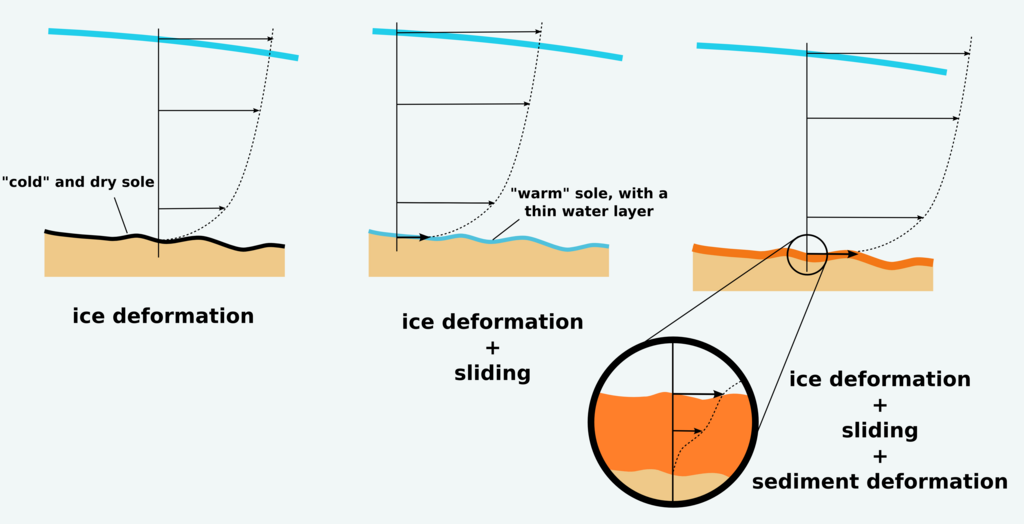
This internal movement isn't uniform. The velocity of the ice changes with depth, creating a distinct flow profile. This happens because the stress isn't the same throughout the glacier. The friction from the valley floor and walls creates resistance, slowing the ice down at the base and sides. As you move up and toward the center, this resistance lessens, allowing the ice to flow faster. The result is a velocity profile where the fastest-moving ice is at the surface and in the middle of the glacier.
While internal deformation governs much of a glacier's movement, the ice can also behave as a brittle solid, especially near the surface where pressure is lower. Here, the stresses of movement can cause the ice to fracture, forming deep cracks known as crevassess. These typically form where the glacier's velocity changes, such as when it flows over a bump in the bedrock or around a sharp bend in a valley.
The Glen-Nye Flow Law
To quantify the relationship between stress and strain in ice, glaciologists use the Glen-Nye Flow Law. This is a cornerstone equation in glaciology that describes how quickly ice deforms. It shows that the rate of deformation is highly sensitive to both stress and temperature.
The most important takeaway from the flow law is the exponent, . This means that if you double the stress on the ice, its rate of deformation increases by a factor of eight (). This non-linear relationship is why thick, steep glaciers flow so much faster than thin, flat ones.
Understanding these mechanics is critical. The way a glacier deforms and flows dictates its ability to erode rock, transport sediment, and respond to changes in climate. A slight increase in temperature not only causes surface melting but also warms the ice internally, increasing the rate factor and accelerating its flow towards the sea.
Ready to test your knowledge on how these rivers of ice move?
What is the primary process that allows the solid ice within a glacier to move and flow like a river?
Where would you expect to find the fastest-moving ice in a typical valley glacier?
The principles of creep, stress, and flow govern how these massive ice bodies sculpt our planet's landscapes.