GitHub Copilot Deep Dive
Introduction to AI Pair Programming
Your New Coding Partner
For decades, pair programming has been a common practice in software development. Two developers share one computer. One, the 'driver,' writes the code, while the other, the 'navigator,' reviews it, spots errors, and thinks about the bigger picture. This collaboration often leads to better, more robust code.
Now, imagine your navigator is an AI. That's the core idea behind AI pair programming. Instead of a human partner, you have an intelligent assistant integrated directly into your code editor, offering suggestions, completing lines of code, and even generating entire functions based on simple comments.
This isn't just a smarter version of the autocomplete you're used to. Early code completion tools were based on simple text matching or analyzing the syntax of your current file. Today's AI assistants have been trained on billions of lines of code from across the internet, allowing them to understand context, patterns, and programming conventions on a much deeper level.
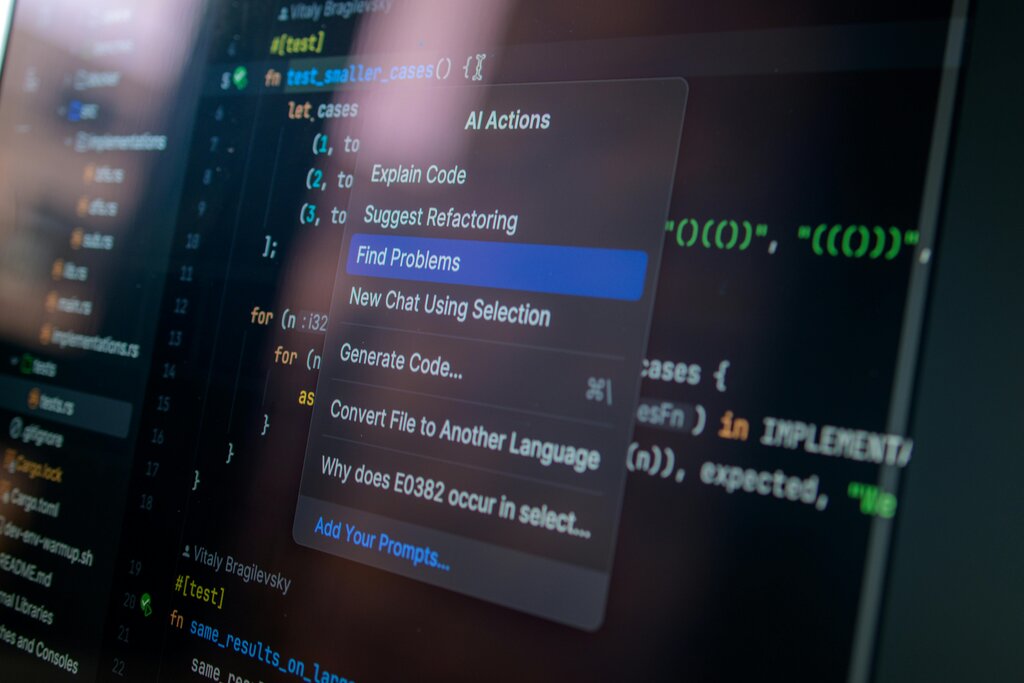
The most well-known of these tools is GitHub Copilot. Released in 2021, it fundamentally changed how many developers approach their work. It acts as a real-time collaborator, constantly analyzing your code and comments to predict what you might want to do next.
Fitting Into the Workflow
Integrating an AI pair programmer into your workflow feels surprisingly natural. These tools work as plugins for popular code editors like Visual Studio Code. As you type a line of code or a comment describing what you want to do, the AI instantly offers a suggestion, which you can accept, reject, or modify.
This creates a dynamic feedback loop. You're still in charge—the driver—but you have a navigator that can instantly pull up boilerplate code, remember complex syntax, or suggest a standard way to solve a common problem. It's less about the AI writing the code for you and more about a collaborative process that speeds up development.
Benefits and Challenges
AI-assisted coding brings clear advantages. The most obvious is speed. Repetitive, boilerplate code that once took minutes to write can now be generated in seconds. This frees up developers to focus on more complex, creative, and critical aspects of their work, like system architecture and user experience.
These tools can also act as a learning aid. By observing the patterns and solutions suggested by the AI, developers can discover new libraries, learn idiomatic ways to write code in an unfamiliar language, or see alternative approaches to problems they've solved before.
However, the technology isn't without its challenges. The primary concern is the potential for incorrect or insecure code. An AI assistant might generate code that looks plausible but contains subtle bugs or security vulnerabilities. The developer is still ultimately responsible for the code they commit, so a critical eye is essential. Over-reliance is another risk; developers, especially those who are learning, must still focus on understanding the fundamentals rather than simply accepting suggestions without thinking.
| Benefits | Challenges |
|---|---|
| Increases development speed | Potential for incorrect or insecure code |
| Reduces repetitive coding tasks | Risk of over-reliance |
| Helps with learning new languages/patterns | Suggestions may lack full context |
| Assists in brainstorming solutions | Intellectual property and licensing concerns |
Finally, because these models are trained on vast amounts of public code, questions around licensing and intellectual property can arise. It's crucial for developers and organizations to understand the terms of use for their AI assistant and the potential implications of the code it generates.
Thinking of an AI assistant as a junior developer or an eager intern is a helpful mental model. You guide it, review its work carefully, and take full responsibility for the final product. When used thoughtfully, it's a powerful tool that changes the 'how' of writing code, allowing you to focus more on the 'what' and 'why'.