Gita for Gen Z
Introduction to the Bhagavad Gita
A Conversation on a Battlefield
The Bhagavad Gita, or “The Song of God,” is one of the most important scriptures in Hinduism. It isn't a standalone book, but a 700-verse section within a much larger epic poem called the Mahabharata. The Mahabharata tells the story of a great war between two sets of cousins, the Pandavas and the Kauravas, for control of a kingdom.
The Gita captures a single, dramatic moment just before the war is about to begin. The setting is the battlefield of Kurukshetra. Two massive armies are assembled, ready for a catastrophic conflict.
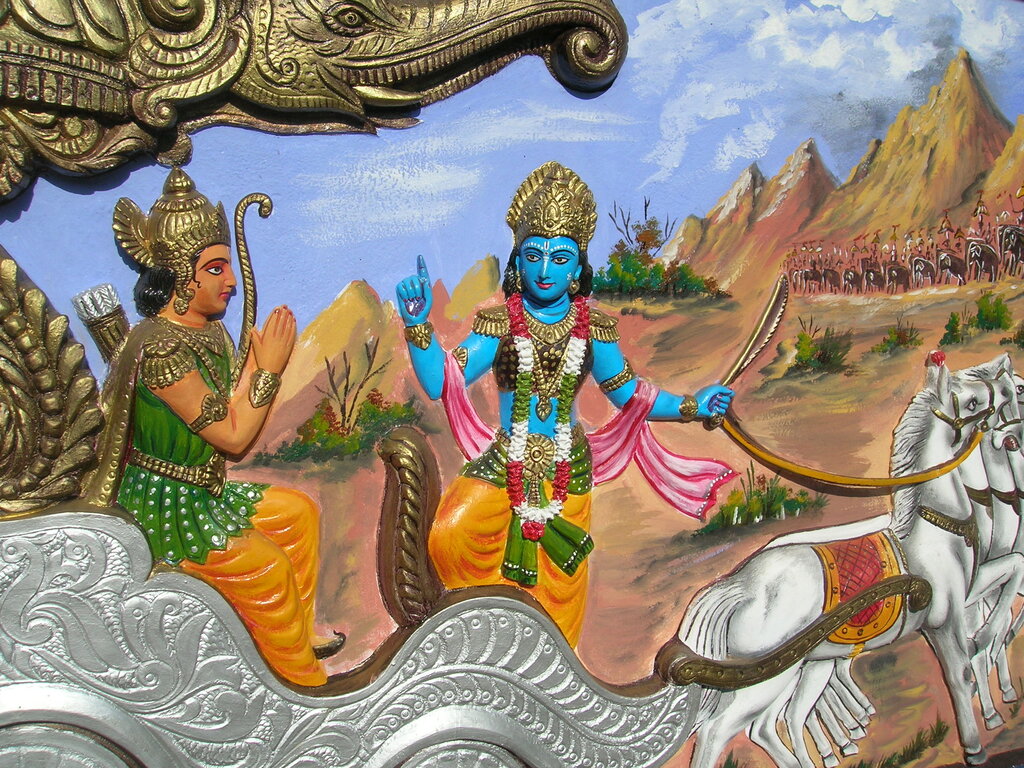
At the center of this scene are two key figures. The first is Arjuna, a heroic warrior and one of the five Pandava princes. He is faced with an impossible choice: to fight for his rightful claim to the throne, he must wage war against his own relatives, teachers, and friends who are fighting on the opposing side.
Overcome with grief and doubt, Arjuna throws down his bow and declares he cannot fight. His charioteer and guide is the second key figure: Lord Krishna, who is an avatar of the god Vishnu. The entire Bhagavad Gita is the conversation that follows between a despairing Arjuna and an enlightening Krishna.
The Structure of the Song
The Gita is organized into 18 chapters. These chapters can be broadly grouped into three sections of six chapters each. The first section focuses on action and duty, the second on devotion, and the third on knowledge. This structure guides the reader through a progressive journey of spiritual understanding.
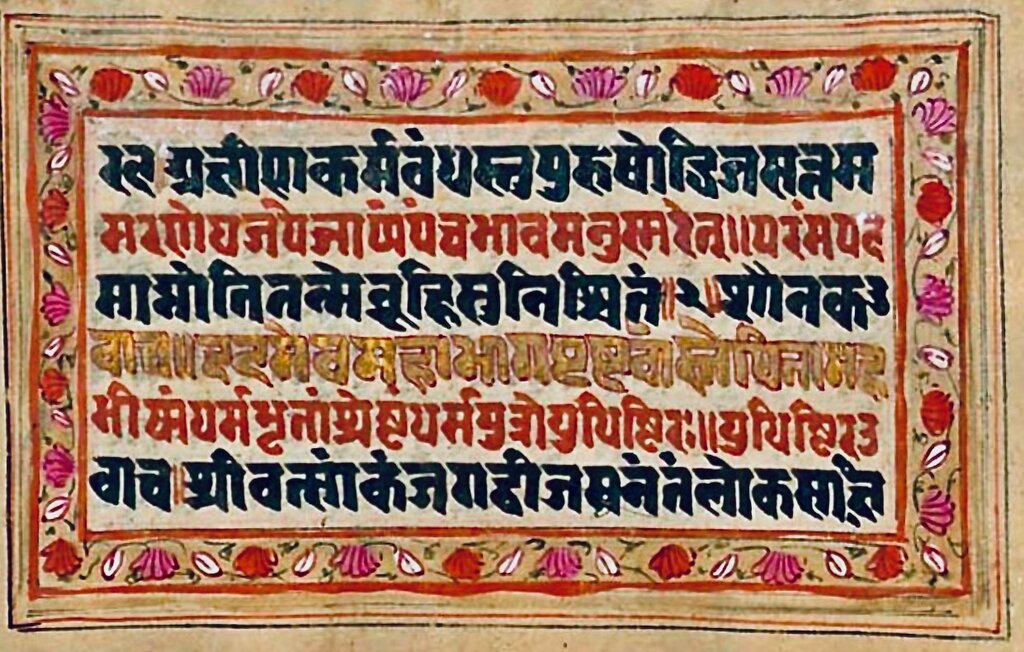
Through this structured dialogue, Krishna addresses Arjuna's crisis, but his teachings expand to cover the fundamental questions of life, duty, and the nature of reality. It's a compact, philosophical guide embedded within an epic war story.
Core Themes
The conversation between Krishna and Arjuna explores several profound themes, but a few stand out as central to the text.
The most fundamental theme is dharma. This concept is crucial to understanding the Gita's message.
dharma
noun
A complex concept that can mean duty, righteousness, cosmic law, or one's inherent nature. It is the path of right living and moral order.
Arjuna's crisis is a crisis of dharma. He is torn between his duty as a warrior to fight for justice and his duty to his family. Krishna's guidance helps him understand his true dharma and the importance of fulfilling his responsibilities without attachment to the results.
This leads to another key theme: spirituality. The Gita explores the nature of the self, God, and the universe. Krishna explains that the soul is eternal and that one's true identity is not the physical body. He teaches that by performing one's duty selflessly, one can achieve spiritual liberation, or moksha.
Ready to check your understanding?
The Bhagavad Gita is a 700-verse scripture that is part of which larger Hindu epic poem?
Who are the two central figures engaged in the dialogue of the Bhagavad Gita?
The Gita's setting on a battlefield is a powerful metaphor for the internal struggles we all face. It frames profound spiritual wisdom within the context of a real-world crisis.