Git and GitHub Essentials for Developers
Introduction to Version Control
The Problem with Final_v2.doc
You’ve probably done it before. You're working on a big project, and you save your file as report_final.doc. Then you make a few more changes and save it as report_final_v2.doc. Before you know it, your folder is a mess of files named report_final_REALLY_final.doc and report_final_USE_THIS_ONE.doc.
This is a messy, manual way of tracking changes. What if you want to see what you changed between version 2 and the one you sent to your boss? What if you accidentally delete a paragraph and need it back a week later? This is where a Version Control System, or VCS, comes in.
A VCS is a tool that tracks and manages changes to files over time. It's like a time machine for your project, allowing you to recall specific versions later.
Instead of saving dozens of nearly identical files, a VCS stores one project and a log of all the changes made to it. Every change is saved as a snapshot, or a "commit." You can jump back to any snapshot in your project’s history, compare changes between snapshots, and see who made each change and why. It’s an essential tool for any project, especially in software development where teams of people are constantly changing code.
A Tale of Two Systems
Version control systems generally come in two flavors: centralized and distributed.
Centralized Version Control Systems (CVCS) were the standard for many years. Think of a CVCS like a library with a single, central server holding the master copy of all the books (your project files). To work on a book, you have to check it out from the central server. When you're done, you check it back in.
This works, but it has a major weakness. If the central server goes down, nobody can check anything in or out. If the server's hard drive gets corrupted and there are no backups, you lose the entire history of the project. Everything is tied to that one central point of failure.
Distributed Version Control Systems (DVCS) changed the game. Instead of just checking out the latest version of a file, every developer gets a full copy of the entire project history on their local machine. This is a fundamental shift.
Now, if the central server goes offline, you can keep working. You have the full history on your own computer. You can even share changes with a colleague directly without needing the server at all. If the main server is lost, any developer's copy can be used to restore it. This makes the system far more resilient and flexible.
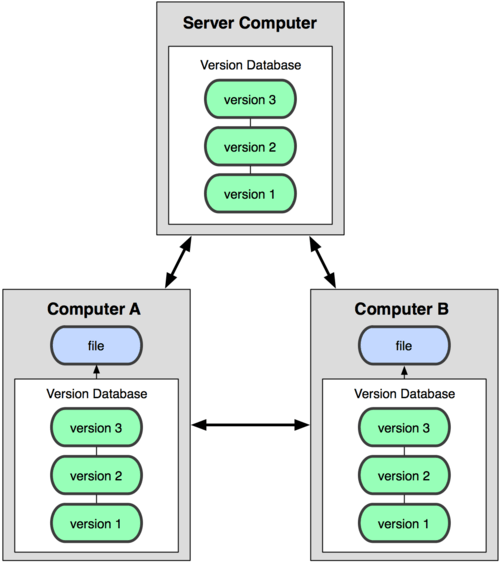
In distributed version control systems (DVCS), every team member has a copy of the project files with their history on their computer, so you don't need to rely on a central server to keep track of all the versions of a project's files.
The Benefits of Version Control
Using a VCS, especially a distributed one like Git, offers massive advantages for any project, big or small.
Collaboration without Chaos: When multiple people work on the same project, it's easy to overwrite each other's work. A VCS provides a structured way for developers to work on different parts of a project simultaneously and then intelligently merge their changes together.
A Complete History: Every change is recorded. You have a detailed log showing who changed what, when they changed it, and a message explaining why. This is invaluable for tracking down bugs or understanding why a certain piece of code was written a particular way.
Branching and Experimentation: Want to try out a new feature without messing up the main project? A VCS lets you create a "branch" an independent line of development. You can experiment freely in your branch. If the new feature works, you can merge it back into the main project. If it doesn't, you can simply delete the branch, and the main project remains untouched.
While there are several version control systems, like Subversion (a CVCS) and Mercurial (a DVCS), Git has become the undisputed standard for modern software development due to its speed, flexibility, and robust branching capabilities.
Ready to get a handle on your projects? Let's test what you've learned about the fundamentals.
What is the primary problem that a Version Control System (VCS) is designed to solve?
What is the key weakness of a Centralized Version Control System (CVCS)?