German Language Fundamentals
German Alphabet
The German Alphabet
Getting started with German is easier than you might think. The German alphabet uses the same 26 letters as English, so you already have a head start. The main difference lies in how some of these letters are pronounced and the addition of four special characters.
Most German letters are pronounced similarly to their English counterparts, making the language quite phonetic. What you see is often what you get.
| Letter | German Name | Pronunciation Guide |
|---|---|---|
| A a | Ah | Like the 'a' in 'father' |
| B b | Beh | Like the 'b' in 'bed' |
| C c | Tseh | Like the 'ts' in 'cats' |
| D d | Deh | Like the 'd' in 'dog' |
| E e | Eh | Like the 'e' in 'get' |
| F f | Eff | Like the 'f' in 'fish' |
| G g | Geh | Like the 'g' in 'go' |
| H h | Hah | Like the 'h' in 'hat' |
| I i | Ih | Like the 'ee' in 'see' |
| J j | Yot | Like the 'y' in 'yes' |
| K k | Kah | Like the 'k' in 'kite' |
| L l | Ell | Like the 'l' in 'love' |
| M m | Emm | Like the 'm' in 'man' |
| N n | Enn | Like the 'n' in 'no' |
| O o | Oh | Like the 'o' in 'open' |
| P p | Peh | Like the 'p' in 'pen' |
| Q q | Kuh | Like 'kv', as in 'kvell' |
| R r | Err | A rolled or gargled 'r' sound |
| S s | Ess | Like the 's' in 'sun' |
| T t | Teh | Like the 't' in 'top' |
| U u | Uh | Like the 'oo' in 'moon' |
| V v | Fau | Like the 'f' in 'fan' |
| W w | Veh | Like the 'v' in 'van' |
| X x | Iks | Like the 'x' in 'box' |
| Y y | Üpsilon | Like the German 'ü' |
| Z z | Tzett | Like the 'ts' in 'cats' |
The Special Characters
Beyond the standard alphabet, German has three vowels with umlauts and one unique consonant. These characters are essential for correct pronunciation and spelling.
Umlaut
noun
A mark (two dots) placed over a vowel in German to indicate a change in sound.
The umlaut changes the sound of the vowels a, o, and u. The fourth special character, the Eszett, represents a sharp 's' sound.
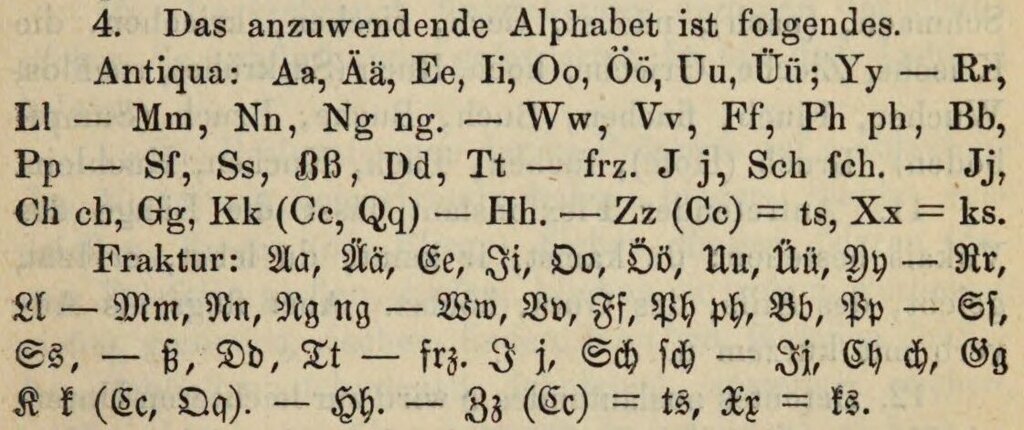
Let's break down these unique sounds.
Ä / ä (a-umlaut) This sounds like the 'a' in 'cat' or the 'e' in 'bed'. For example, the word Männer (men) uses this sound.
Ö / ö (o-umlaut) This sound doesn't exist in English. To make it, try saying "uh" as in 'burn' but round your lips as if you were about to say "oh". A good example is the word schön (beautiful).
Ü / ü (u-umlaut) This is another sound without a direct English equivalent. Say "ee" as in 'see', but keep your lips tightly rounded. You'll hear it in the word für (for).
ß (Eszett or scharfes S) This letter looks like a capital 'B' with a tail, but it's pronounced like a sharp, hissing 's', just like the 'ss' in 'kiss'. It's called scharfes S, which means "sharp S." You will never find it at the beginning of a word. A common word with this letter is Straße (street).
Now that you've seen all the letters, it's time to test your knowledge.
How many special characters does the German alphabet have in addition to the 26 letters it shares with English?
The German letter 'Ä' is pronounced like the 'a' in which English word?
Getting comfortable with these letters and their sounds is the first big step in learning to speak and read German. Practice them regularly, and you'll build a solid foundation.