German for Beginners A1 Level
German Alphabet and Pronunciation
The German Alphabet
Learning German starts with the alphabet. The good news is that it uses the same 26 letters as English. While many letters sound similar, some have their own unique German pronunciation. Knowing the name of each letter is key to spelling words out loud correctly.
Understanding the German alphabet is crucial for accurate pronunciation and comprehension.
| Letter | German Name | Sounds Like... |
|---|---|---|
| A a | Ah | 'a' in 'father' |
| B b | Beh | 'b' in 'bed' |
| C c | Tseh | 'ts' in 'cats' |
| D d | Deh | 'd' in 'dog' |
| E e | Eh | 'e' in 'bed' |
| F f | Eff | 'f' in 'fish' |
| G g | Geh | 'g' in 'go' |
| H h | Hah | 'h' in 'hat' |
| I i | Ih | 'ee' in 'see' |
| J j | Yot | 'y' in 'yes' |
| K k | Kah | 'k' in 'kite' |
| L l | Ell | 'l' in 'love' |
| M m | Emm | 'm' in 'man' |
| N n | Enn | 'n' in 'no' |
| O o | Oh | 'o' in 'open' |
| P p | Peh | 'p' in 'pen' |
| Q q | Kuh | 'kv' sound, like 'qu' in 'queen' |
| R r | Err | Rolled or gargled in the throat |
| S s | Ess | 's' in 'sun' or 'z' in 'zoo' |
| T t | Teh | 't' in 'top' |
| U u | Uh | 'oo' in 'moon' |
| V v | Fow | 'f' in 'fan' |
| W w | Veh | 'v' in 'van' |
| X x | Iks | 'x' in 'box' |
| Y y | Ypsilon | 'ü' sound (see below) |
| Z z | Tsett | 'ts' in 'cats' |
Special Characters
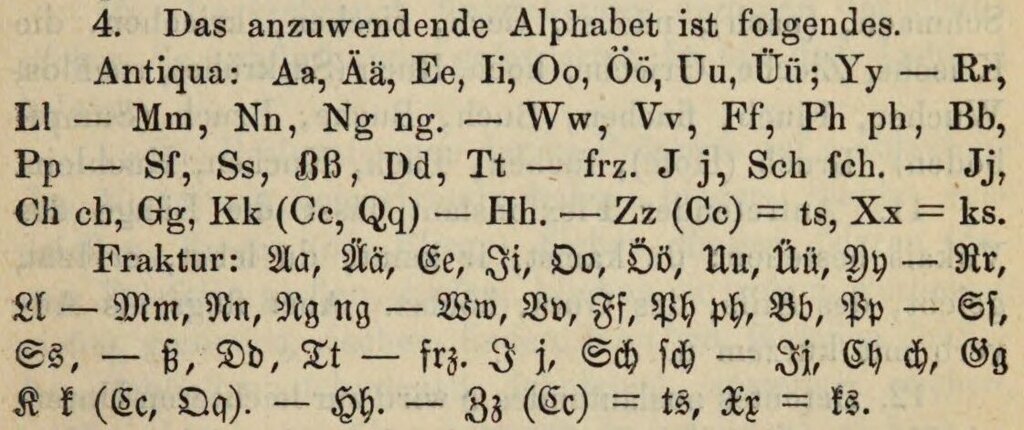
Beyond the standard 26 letters, German has four special characters you'll need to know. Three of these are called Umlaute (umlauts), which are vowels with two dots above them. The dots change how the vowel is pronounced.
Ä / ä: Sounds like the 'e' in "bet" or "get". Ö / ö: This sound doesn't exist in English. To make it, say "ay" as in "day," but round your lips into an 'o' shape. Ü / ü: This is another sound new to English speakers. Try saying "ee" as in "see," but purse your lips as if you're about to whistle.
The fourth special character is the Eszett, or "sharp S."
Eszett
noun
A special character (ß) in German that represents a sharp, voiceless 's' sound, like the 'ss' in 'kiss'. It typically follows a long vowel or a diphthong.
The Eszett (ß) is only used in lowercase. If you're typing and can't find it, you can substitute "ss". In Switzerland and Liechtenstein, the Eszett is not used at all; they always write "ss" instead.
Key Pronunciation Rules
German pronunciation is generally more consistent than English. Once you learn the rules, you can reliably figure out how to say most words.
Vowels
Vowels can be long or short.
- Long vowels often appear before a single consonant, before an 'h', or when doubled (like in See). They sound like their letter names: A (ah), E (eh), I (ee), O (oh), U (oo).
- Short vowels usually come before two or more consonants. They are clipped and quick: A (as in 'cat'), E (as in 'get'), I (as in 'it'), O (as in 'hot'), U (as in 'put').
Diphthongs
Diphthongs are pairs of vowels that create a single, gliding sound. There are a few main ones to know.
- ei / ai: Always sounds like the English word "eye". For example, mein (my) and Mai (May).
- au: Sounds like "ow" in the word "cow". For example, Haus (house).
- eu / äu: Sounds like "oy" in the word "boy". For example, neu (new) and Häuser (houses).
Tricky Consonants
Some consonant sounds are quite different from English.
- ch: This has two sounds. After 'a', 'o', 'u', or 'au', it's a hard, throaty sound from the back of your throat, like in the Scottish word "loch". After other vowels or consonants, it's a soft, hissing sound, like a forceful 'h' in "huge".
- s: At the beginning of a word or syllable before a vowel, 's' sounds like the 'z' in "zoo". For example, Sonne (sun).
- st / sp: When these combinations appear at the beginning of a word or syllable, they are pronounced 'sht' and 'shp'. For example, Straße (street) and sprechen (to speak).
- z: Always sounds like 'ts' in "cats". For example, Zeit (time).
- v: Usually pronounced like an 'f'. For example, Vater (father).
- w: Always pronounced like a 'v'. For example, Wasser (water).
Word Stress
Just like in English, knowing which syllable to emphasize, or stress, is important for being understood.
In most German words, the stress falls on the first syllable. This is true for simple words like Wasser (water) or Arbeit (work).
However, there are exceptions. For words with inseparable prefixes (like be-, ge-, er-, ver-, zer-), the stress is on the root of the word, not the prefix. For example, in bestellen (to order), the stress is on the second syllable.
Listening to native speakers is the best way to get a feel for the natural rhythm and stress patterns of the language.
Ready to test your knowledge on the German alphabet and pronunciation?
How is the German diphthong 'au' typically pronounced?
In German pronunciation, the letter 'w' is almost always pronounced like the English letter...
Getting these fundamental sounds right will build a strong foundation for everything you learn next.