German Adjective Declension
Introduction to German Adjectives
Describing the World
Adjectives are words that describe nouns. In English, we say “a tall man” or “a fast car.” The words “tall” and “fast” are adjectives. They give us more information about the man and the car.
German works the same way. The adjective for “good” is gut. The word for “book” is Buch. So you can say:
Das Buch ist gut. (The book is good.)
Here, gut describes das Buch. Simple enough. But in German, there’s a twist. When an adjective comes before the noun it describes, it usually needs to change its ending. This is called adjective agreement or declension.
Don't worry about memorizing every ending right now. The goal is to understand why the endings change.
Making Adjectives Agree
In German, adjectives change to match the noun’s gender, number, and case. You already know that every German noun has a gender (masculine, feminine, or neuter) and a number (singular or plural). Case refers to the noun's role in the sentence, like whether it's the subject or an object.
Think of it like dressing for an occasion. You wear different clothes for a wedding, a job interview, or a trip to the beach. Similarly, an adjective “dresses up” with different endings to match the noun’s specific situation in the sentence.
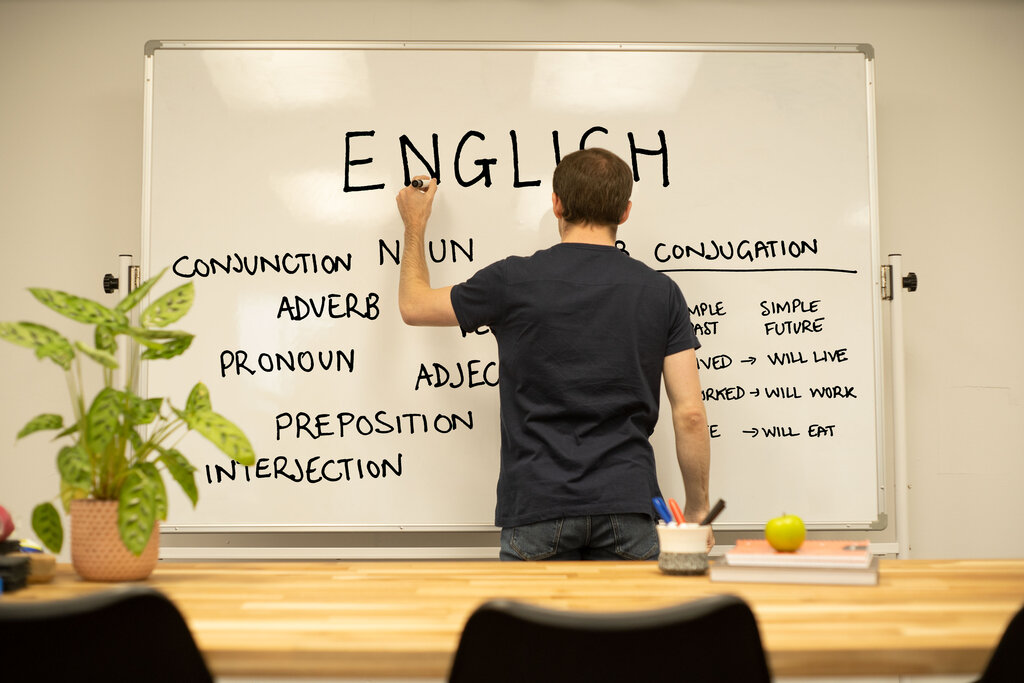
Let’s look at the adjective rot (red) with three different nouns:
- der rote Stuhl (the red chair, masculine)
- die rote Blume (the red flower, feminine)
- das rote Auto (the red car, neuter)
Notice the adjective rot gains an -e ending in each example. The ending is the same here, but in other situations, it will change depending on the noun's gender, number, and case. This system of changing endings helps clarify relationships between words in a sentence.
Where Adjectives Go
German adjectives can appear in two main spots. Where you place them determines whether they need an ending.
1. After the verb (Predicative)
When an adjective comes after a verb like sein (to be), it doesn't get a special ending. It stays in its basic form. This is the simplest way to use an adjective.
- Der Kaffee ist heiß. (The coffee is hot.)
- Die Suppe ist heiß. (The soup is hot.)
- Das Wasser ist heiß. (The water is hot.)
In all three sentences, the adjective heiß stays the same, regardless of the noun’s gender.
2. Before the noun (Attributive)
When an adjective comes directly before a noun, it must have an ending that agrees with the noun. This is where declension happens.
- der heiße Kaffee (the hot coffee)
- die heiße Suppe (the hot soup)
- das heiße Wasser (the hot water)
See how heiß now has an -e on the end? That ending is there because the adjective is in front of the noun. The specific ending an adjective takes depends on the article (der, die, das, ein, eine), the noun's case, and its gender. We'll explore these patterns in more detail later.
Adjectives must match nouns in gender, number, and case — a detail many beginners forget.
For now, just focus on the key difference: if the adjective follows the verb, no ending. If it comes before the noun, it needs an ending.