Geopolitical Risk for Quantum Startups
Understanding Export Controls
What Are Export Controls?
When a company in the United States sends goods or provides services to someone in another country, it's called an export. But not everything can be shipped freely. The U.S. government regulates the export of certain items, information, and software to protect national security and advance its foreign policy goals. These rules are known as export controls.
Think of it as a system designed to keep sensitive technology out of the wrong hands. The goal is to prevent the spread of weapons of mass destruction, stop terrorism, and maintain regional stability. Two main sets of regulations form the backbone of this system: the International Traffic in Arms Regulations (ITAR) and the Export Administration Regulations (EAR).
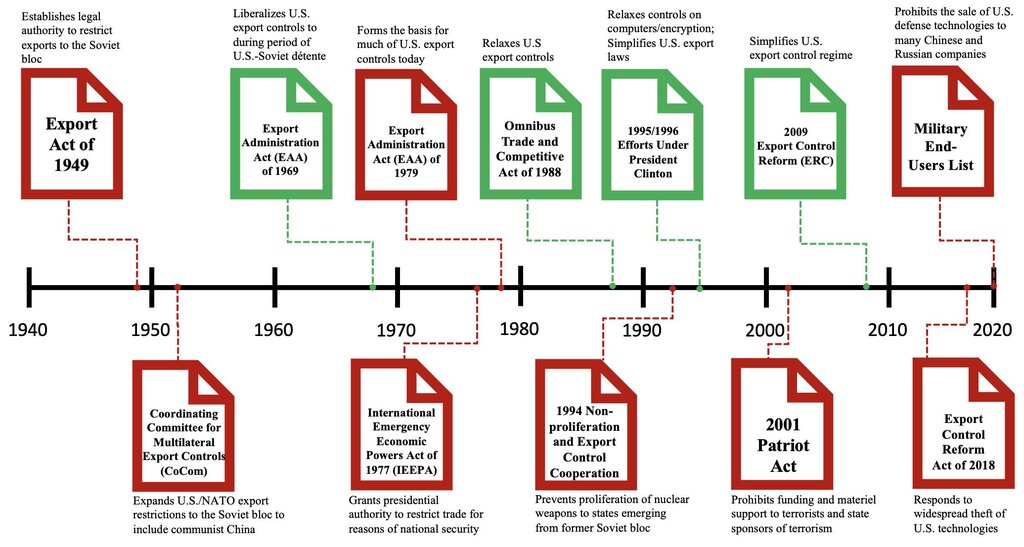
These aren't just for physical products like missiles or satellites. Export controls also apply to technical data, software, and even conversations. If you share controlled technical blueprints with a non-U.S. person, even if they're located inside the U.S., it can be considered a "deemed export" and is subject to the same rules.
ITAR vs EAR
While both ITAR and EAR manage exports, they focus on different categories of items. Understanding the distinction is crucial for any company dealing with advanced technology.
ITAR is for items with a direct military or defense application. Managed by the Department of State, it's the stricter of the two. The list of controlled items is called the United States Munitions List (USML). This includes things you’d expect, like tanks and firearms, but also less obvious technology.
A single sentence, contained in the International Traffic in Arms Regulations act, classifies all spacecraft and satellite-related data as "significant military equipment" subject to strict national security controls.
EAR, on the other hand, is managed by the Department of Commerce and covers "dual-use" items. These are technologies that have legitimate commercial uses but could also be adapted for military purposes. Think high-performance computers, advanced sensors, or encryption software. The list for EAR is called the Commerce Control List (CCL).
Here’s a simple breakdown:
| Feature | ITAR | EAR |
|---|---|---|
| Regulating Body | Department of State | Department of Commerce |
| What it Covers | Defense articles & services | Dual-use items & technology |
| Governing List | U.S. Munitions List (USML) | Commerce Control List (CCL) |
| Primary Goal | Control military tech | Control versatile, sensitive tech |
So where do cutting-edge fields like quantum technology fit in? The answer is: it depends. A quantum computing system designed specifically for military code-breaking would almost certainly fall under ITAR. But a general-purpose quantum sensor developed for commercial use in medical imaging would likely be governed by EAR. The specific application and technical capabilities determine which rules apply.
Getting a License
If you need to export an item controlled by ITAR or EAR, you’ll likely need a license from the government. The process differs for each.
For ITAR, you must first register with the State Department's Directorate of Defense Trade Controls (DDTC). Once registered, you can apply for a license, which involves a detailed description of the item, the recipient, and the end-use. The review process is thorough and focused on national security implications.
For EAR, you start by determining if your item has an Export Control Classification Number (ECCN) on the Commerce Control List. If it does, the ECCN tells you why it's controlled (e.g., for national security or nuclear nonproliferation reasons) and which destinations require a license. Some low-sensitivity items might not require a license to be sent to allied countries. The application is submitted to the Commerce Department's Bureau of Industry and Security (BIS).
The Stakes of Non-Compliance
Ignoring export controls can lead to severe consequences. The penalties for violating ITAR or EAR are not trivial. They can include substantial fines, reaching millions of dollars per violation. Individuals can even face prison time.
Beyond the financial and legal penalties, a company can lose its export privileges, effectively cutting it off from the global market. This can cripple a business, especially one that relies on international sales or collaboration. The government maintains public lists of individuals and companies barred from exporting, causing significant reputational damage.
Simply put, compliance isn't optional. For any organization working with advanced technology, understanding and following these regulations is a fundamental part of doing business.
Ready to test your knowledge on these key regulations?
What is the primary purpose of U.S. export control regulations like ITAR and EAR?
The International Traffic in Arms Regulations (ITAR) primarily governs items with direct military applications, which are listed on the ______.
Navigating export controls requires careful attention to detail, but understanding these core principles is the first and most important step.