Geometrical Gravity
Introduction to General Relativity
A New Idea of Gravity
For centuries, Isaac Newton's law of universal gravitation was the final word. Gravity was a force, an invisible rope pulling objects toward each other. But Albert Einstein had a different idea. He wondered if gravity wasn't a force at all, but a feature of the universe itself.
This questioning led to his general theory of relativity, which redefines gravity. It's not a pull, but a curve. Mass and energy warp the fabric of the universe, a four-dimensional tapestry called spacetime. What we feel as gravity is just us moving through this curved landscape.
The Equivalence Principle
Einstein's journey began with a thought experiment. Imagine you're in a windowless room, like an elevator. If the elevator is stationary on Earth, you feel the familiar pull of gravity holding you to the floor. Now, imagine the elevator is in deep space, far from any planet, but is accelerating upwards at a constant rate of . Your feet would be pressed to the floor with the exact same feeling.
Could you tell the difference? Einstein realized you couldn't. There's no experiment you could perform inside the room to distinguish between being in a gravitational field and being in a state of constant acceleration. This insight is the equivalence principle: the effects of gravity are locally indistinguishable from the effects of acceleration.
Spacetime Curvature
If gravity and acceleration are two sides of the same coin, what does that mean for how we see the universe? Einstein proposed that massive objects don't create a force. Instead, they warp or curve the fabric of spacetime around them. Think of spacetime as a stretched-out rubber sheet. If you place a bowling ball in the center, the sheet will sag.
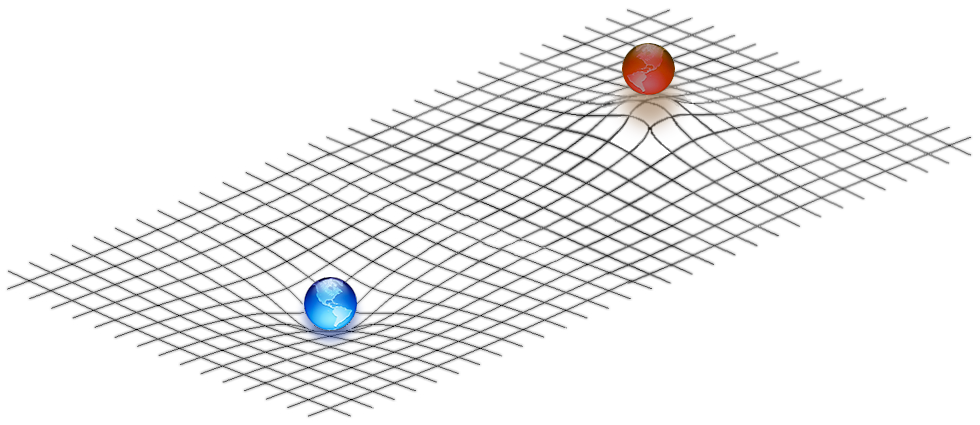
Now, if you roll a small marble nearby, it won't be 'pulled' by the bowling ball. It will simply follow the curve in the sheet created by the larger object. Its path is altered by the geometry of the space it's moving through. This is general relativity's vision of gravity. Planets orbit the Sun not because they are tethered by a force, but because they are following the straightest possible path through the curved spacetime created by the Sun's immense mass.
The Rules of the Universe
To describe this relationship mathematically, Einstein developed his famous field equations. They are the heart of general relativity. In a compact form, they look like this:
This equation looks dense, but the idea behind it is elegant. The left side () describes the geometry of spacetime, essentially how it's curved. The right side () describes the distribution of mass and energy within that spacetime. In short, the equation says:
Matter and energy tell spacetime how to curve, and curved spacetime tells matter how to move.
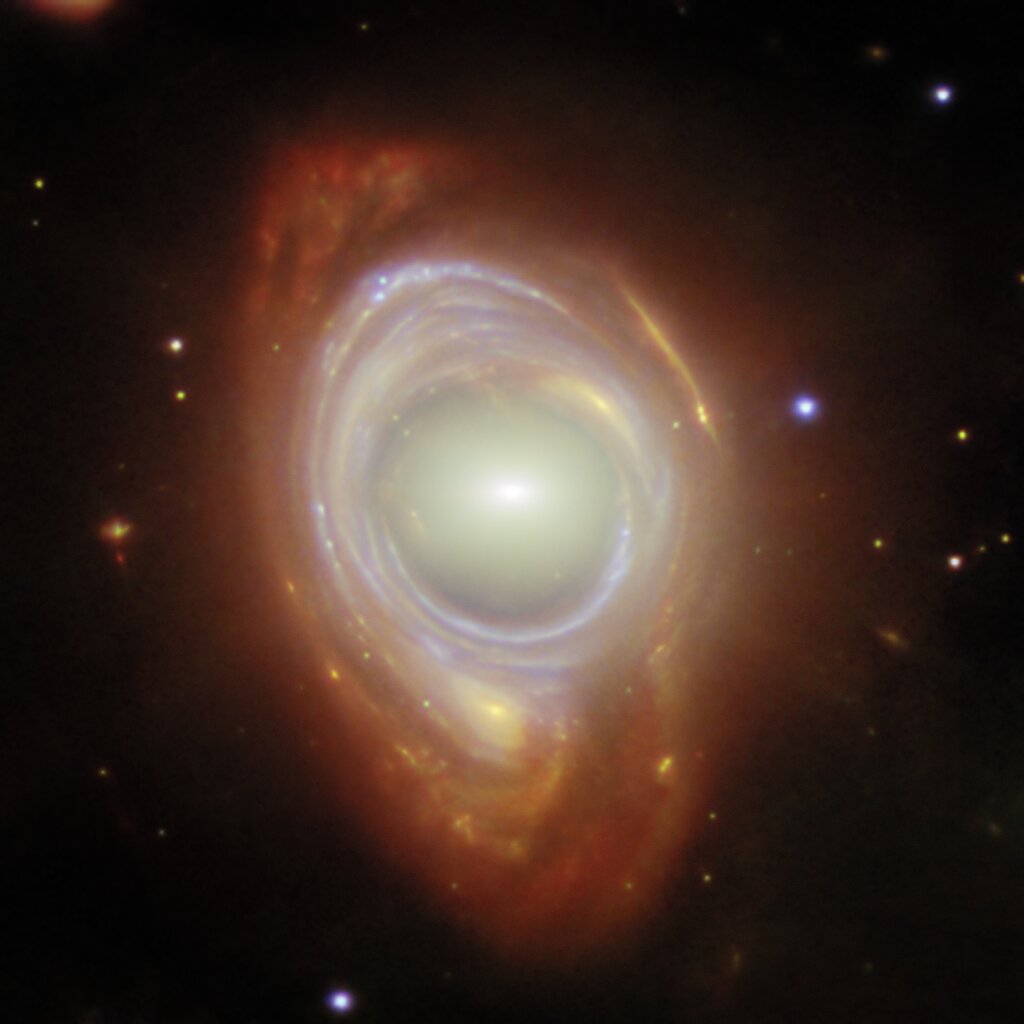
These equations are the engine of the theory. They predict everything from the slight wobble in Mercury's orbit to the existence of black holes and the bending of starlight around massive objects, a phenomenon called gravitational lensing.
Straight Lines in a Curved World
In this curved spacetime, how do objects move? They follow what are called geodesics. A geodesic is the shortest, most direct path between two points. On a flat plane, a geodesic is a straight line. But on a curved surface, like the Earth, the shortest path between two cities isn't a straight line on a map; it's a great circle route, the path a plane flies.
Objects in free-fall, whether it's an apple falling from a tree or a planet orbiting the sun, are simply following their geodesic through spacetime. They are moving along the straightest possible path in a curved geometry. They aren't being pulled by a force; they are just coasting.
This geometric view of gravity was a radical departure from Newtonian physics, providing a more accurate description of the cosmos, especially in strong gravitational fields.