Geometric Varieties and the Path to Schemes
Morphisms and Birational Maps
Maps Between Varieties
We've spent time looking at affine and projective varieties as static objects. But the real power in mathematics comes from understanding the relationships between objects. How do we map one variety to another in a way that respects their geometric and algebraic structure?
The first step is to define the right kind of functions. On a variety , a function (where is our field) is called a regular function if, for every point , there's an open neighbourhood of where can be written as a quotient of two polynomials, , with being non-zero everywhere in . Think of these as the 'polynomial-like' functions allowed on a variety. They are the natural functions in this setting, just as smooth functions are natural for manifolds.
A function is regular if it can be locally expressed as a fraction of polynomials, where the denominator is never zero on that local patch.
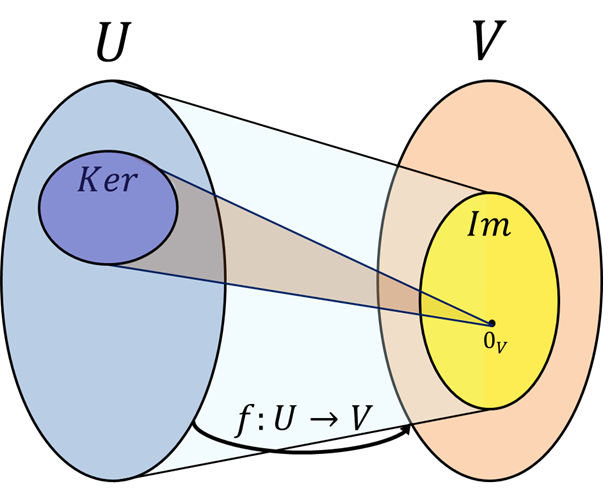
With this, we can define the most important type of map. A morphism between two varieties is a continuous map such that for any open set and any regular function , the composition is a regular function on the preimage . This is a bit of a mouthful, but the core idea is that morphisms play nicely with regular functions. This act of pulling a function from the target space back to the source space is called a pull-back and it's a central idea in geometry.
Beyond Isomorphism
An isomorphism is a morphism that has an inverse that is also a morphism. Two isomorphic varieties are, for all intents and purposes, the same. But this is a very strict condition. Algebraic geometry often deals with a looser, more flexible notion of sameness: birational equivalence.
To get there, we first need the idea of a rational map. A rational map is a morphism from a non-empty open subset to . The double-headed arrow indicates it might not be defined everywhere on . The largest open set on which it is defined is called its domain of definition. For example, the map from the affine line to itself given by is a rational map defined everywhere except at .
A rational map is like a morphism with a few holes in its domain.
Now for the key definition. Two varieties and are birationally equivalent if there are rational maps and that are inverses of each other wherever they are defined. This means that and are isomorphic on large open subsets. They might differ on some smaller, closed pieces, but their general structure is the same.
Fixing Problems with Blow-Ups
Birational maps are not just theoretical curiosities. They are powerful tools for transforming varieties into more manageable forms. One of the most important applications is the resolution of singularities—points where a variety is not 'smooth'. A common example is the cone defined by , which has a sharp point at the origin.
The process of blowing up a point replaces the singular point with a copy of a projective space. Imagine the origin in the -plane. A blow-up replaces this single point with the set of all lines passing through it. Each line corresponds to a point in the projective line . So, a single problematic point is 'blown up' into a whole new space that separates all the directions of approach.
This technique is vital in robotics. The configuration space of a robot arm can have singularities corresponding to positions where the arm's movement is restricted or its end-effector loses degrees of freedom. By blowing up these singular points, mathematicians can create a new, smooth configuration space where path-planning algorithms can work without hitting dead ends. The original and the blown-up spaces are birationally equivalent.
Finally, we can connect this geometric picture back to algebra. For any irreducible variety , we can form its function field, denoted . This is the field of all rational functions on . It's the collection of all formal quotients where and are regular functions. It turns out that this algebraic object captures the geometry perfectly.
A category consists of objects and morphisms (arrows) that describe relationships between these objects.
A fundamental theorem in algebraic geometry states that two varieties, and , are birationally equivalent if and only if their function fields, and , are isomorphic as fields. This beautiful result bridges the gap between flexible geometric equivalence and rigid algebraic isomorphism. It tells us that studying varieties 'up to birational equivalence' is the same as studying their function fields 'up to isomorphism'.
We now have a complete toolkit: regular functions build morphisms, which describe strict equivalence (isomorphism). Rational functions build birational maps, which describe a more flexible, but incredibly useful, form of equivalence. This framework allows us to transform complicated, singular varieties into simpler, smoother ones without losing their essential geometric information.
What is the defining characteristic of a regular function on a variety V?
What is the primary distinction between a morphism and a rational map from a variety V to a variety W?