Geometric Transformations and Similarity
Dilations
Scaling Up and Down
Have you ever used the zoom feature on a camera or pinched your fingers on a phone screen to make a photo larger or smaller? You were performing a geometric transformation called a dilation. A dilation changes the size of a figure without changing its shape.
Dilation
noun
A transformation that produces an image that is the same shape as the original, but is a different size.
Think of it as creating a scaled model. A toy car is a dilation of a real car. A map is a dilation of a geographical area. To perform any dilation, you need two key pieces of information: a center of dilation and a scale factor.
The Anchor Point
Every dilation happens from a fixed point called the center of dilation. This point is the anchor for the transformation. All other points of the figure move away from this center if the figure is getting larger, or move toward it if the figure is getting smaller. The center of dilation itself does not move.
In the diagram, point is the center of dilation. Notice how every point on the new triangle, , lies on a line that passes through and the corresponding point on the original triangle, .
The Scale Factor
The second ingredient is the scale factor, often represented by the variable . This number tells you exactly how much the figure will be scaled. It's a ratio of the distance of a point on the new figure from the center of dilation to the distance of the corresponding point on the original figure.
The value of tells you what kind of dilation you're dealing with.
| Scale Factor () | Type of Dilation | Result |
|---|---|---|
| Enlargement | The figure gets bigger. | |
| Reduction | The figure gets smaller. | |
| No change | The figure stays the same size. | |
| Dilation & Rotation | The figure is dilated and rotated 180°. |
For now, we'll focus on positive scale factors. To find the coordinates of a dilated point, you multiply the coordinates of the original point by the scale factor, assuming the center of dilation is the origin .
For example, if we dilate the point by a scale factor of from the origin, the new point is , which is .
Key Properties
Dilations have a couple of important properties that are always true. First, the shape of the figure doesn't change. A dilated triangle is still a triangle. A dilated circle is still a circle. Because of this, the angle measures of a dilated figure are identical to the angles of the original figure. Angles are preserved.
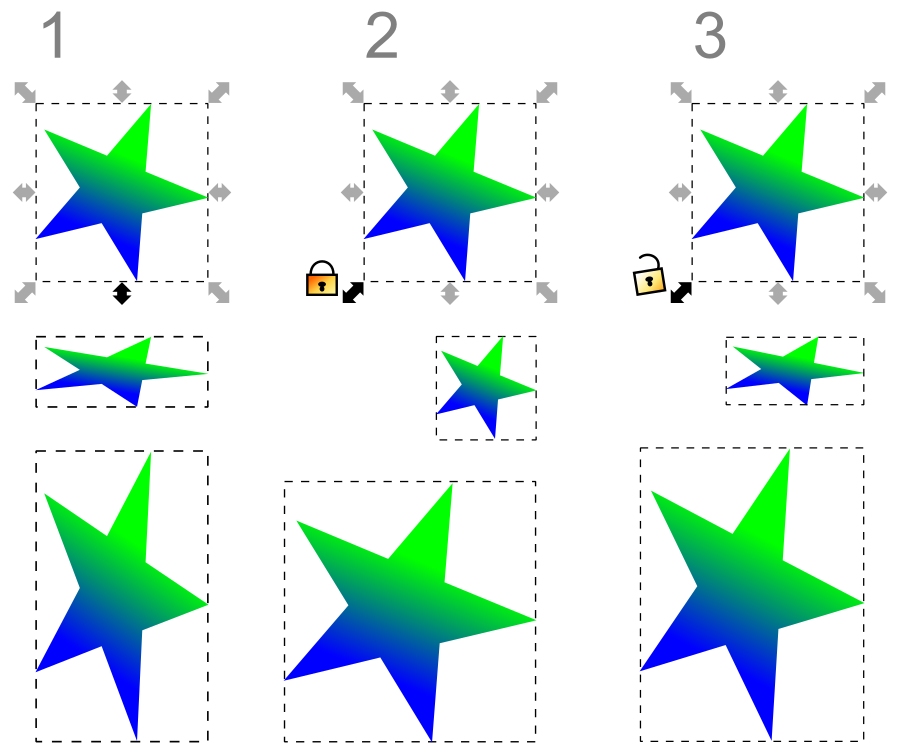
Second, while the side lengths change, they all change by the exact same proportion. If you dilate a square with a scale factor of 3, each side of the new square will be exactly three times as long as the sides of the original square. The corresponding sides are proportional.
If triangle has side lengths 3, 4, and 5, and it's dilated by a scale factor of to create triangle , the new side lengths will be 6, 8, and 10. The ratio of corresponding sides is always equal to the scale factor: .
These two properties, preserved angles and proportional sides, are the defining characteristics of figures that are similar. Dilations are the foundation for the concept of similarity in geometry.
Ready to test your knowledge?
What two pieces of information are essential to perform a dilation?
If a triangle is dilated by a scale factor of 3, what happens to its angle measures?
Understanding dilations is a key step toward mastering geometric transformations and the concept of similarity.