Geometric Meaning of Vector Dot Product
Vectors
What is a Vector?
Some quantities in our world can be described with a single number. Your height, the temperature outside, or the price of a coffee are all examples. These are called scalars. They tell you “how much” of something there is.
But what if you need to give someone directions? Saying “walk for three blocks” isn’t very helpful. Three blocks in which direction? North? South? A better instruction would be “walk three blocks east.” This information has both a size (three blocks) and a direction (east). This is a vector.
A vector is a mathematical object that has both magnitude (length or size) and direction. We often visualize them as arrows. The length of the arrow represents its magnitude, and the way it points shows its direction.
vector
noun
A quantity having direction as well as magnitude, especially as determining the position of one point in space relative to another.
Vectors are everywhere in physics and engineering. They describe forces, velocities, and accelerations. A car traveling at 60 mph is a scalar speed, but a car traveling 60 mph north is a vector velocity.
Describing Vectors with Numbers
Drawing arrows is great for building intuition, but to do math with vectors, we need to represent them with numbers. We do this using a coordinate system, like the familiar Cartesian plane with x and y axes.
A vector can be described by its components along each axis. Think of it as a set of instructions. A vector that tells you to go 3 units to the right (positive x-direction) and 4 units up (positive y-direction) can be written as components.
The top number is the x-component, and the bottom is the y-component. This vector starts at the origin (0,0) and ends at the point (3,4).
This idea extends easily to three dimensions, where we just add a z-component. A 3D vector might look like , representing a movement of 2 units along the x-axis, -1 unit along the y-axis (meaning 1 unit in the negative direction), and 5 units along the z-axis.
Vector Math
We can perform mathematical operations on vectors, just like with regular numbers. The rules are a bit different but very intuitive.
Vector Addition
Adding vectors means combining them. Imagine walking 2 blocks east, then 3 blocks north. Your total displacement from your starting point is the sum of those two vector movements.
Visually, we add vectors using the "head-to-tail" method. Place the tail (start) of the second vector at the head (tip) of the first one. The resulting vector, called the resultant, is an arrow drawn from the tail of the first vector to the head of the second.
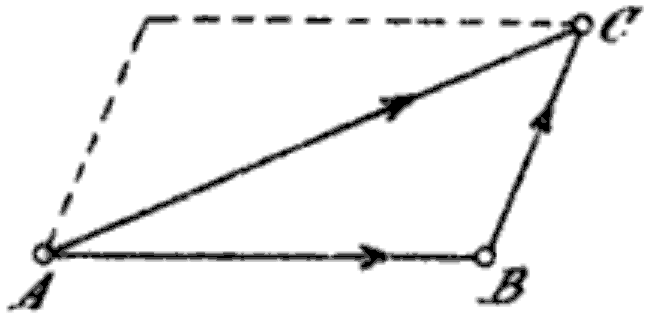
Numerically, addition is even simpler: you just add the corresponding components.
For example, if and , their sum is:
Scalar Multiplication
What happens if you multiply a vector by a scalar (a regular number)? This operation scales the vector's magnitude. Multiplying a vector by 2 makes it twice as long but keeps its direction the same. Multiplying by -1 reverses its direction but keeps its length. Multiplying by 0.5 would make it half as long.
To do this numerically, you simply multiply each component of the vector by the scalar.
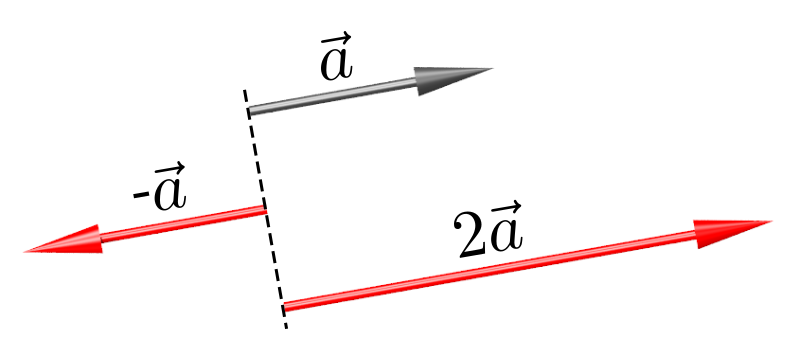
Vector Subtraction
Subtracting a vector is the same as adding its negative. So, is equivalent to . Remember that is just vector with its direction flipped.
Numerically, you just subtract the corresponding components, as you might expect.
Using our previous vectors, and :
These basic operations are the building blocks for working with vectors in more complex scenarios, from charting a course for a plane to creating realistic physics in a video game.
Which of the following is the key difference between a scalar and a vector?
A car's velocity is described as '60 mph north'. If we multiply this vector by the scalar -0.5, what is the new velocity?
With these foundations, you're ready to explore how vectors interact with each other in more advanced ways.